The Library She Built
Fable
Ages 9–11 · 12 min
With hands stained by oil from the cotton mill, a boy named Andrew presses his nose against the window of a private library full of books his mother says are not for people like them.
Andrew Carnegie pressed his nose against the cold glass window of Colonel Anderson's house and felt his breath fog up everything interesting inside.
Books. Hundreds of them. Maybe thousands. Lined up on shelves like soldiers standing at attention, their leather spines gleaming in the lamplight. Red ones, brown ones, green ones with gold letters that caught the light and winked at him like they knew a secret.
Andrew Carnegie pressed his nose against the cold glass window of Colonel Anderson's house and felt his breath fog up everything interesting inside.
Books. Hundreds of them. Maybe thousands. Lined up on shelves like soldiers standing at attention, their leather spines gleaming in the lamplight. Red ones, brown ones, green ones with gold letters that caught the light and winked at him like they knew a secret.
"You're smudging the glass again," said his friend Tommy, pulling him by the sleeve. "Come on. We'll be late to the mill."
Andrew didn't move. He was thirteen years old, barely five feet tall, and he worked six days a week as a bobbin boy in the cotton mill, earning one dollar and twenty cents for every week of aching fingers and cotton dust that made his lungs feel stuffed with clouds. He had exactly four pennies in his pocket and a half-eaten roll from breakfast.
He did not have a single book.
"Andrew!" Tommy called from down the street.
Andrew peeled himself away from the window and ran to catch up, his worn shoes slapping against the cobblestones of Allegheny City. But all day in the mill, as he replaced bobbins on the spinning frames and his fingers moved in their automatic rhythm, his mind stayed in that room full of books. He imagined pulling one from the shelf—a fat one, heavy in his hands—and cracking it open to find maps of Africa or stories about knights or explanations of how steam engines actually worked.
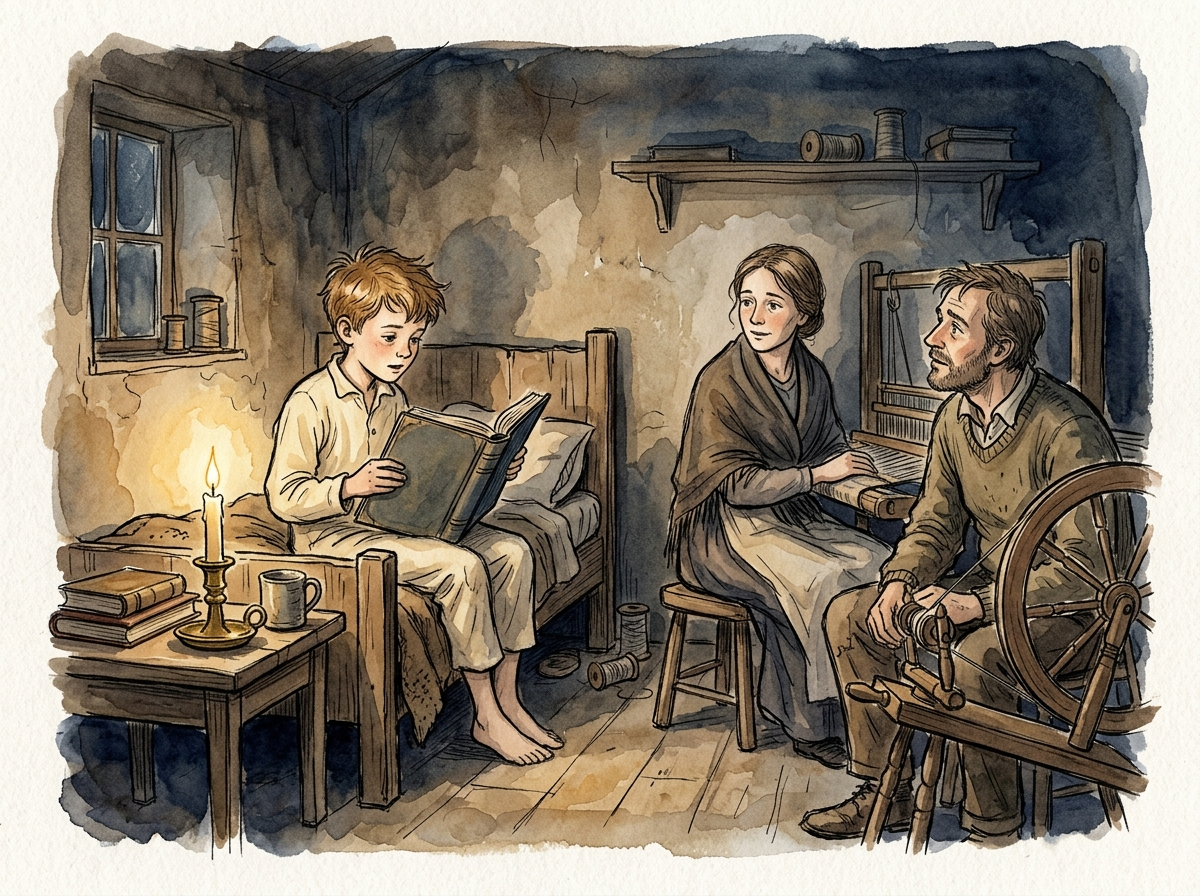
That night, in the small house he shared with his parents and brother, Andrew couldn't sleep. His mother was still up, mending clothes by candlelight, her needle darting in and out of fabric like a silver fish.
"Mam," he said from his cot. "Have you ever been inside a library?"
His mother didn't look up from her sewing. "Libraries aren't for people like us, Andrew."
"But why not?"
She paused then, her needle hovering. Margaret Carnegie had a way of going quiet that meant she was choosing her words carefully, like picking her way across stepping stones in a river.
"We came to this country with almost nothing," she said. "Back in Dunfermline, your father was a fine weaver. The best. But the power looms took his trade, and so we came here." She bit off a thread with her teeth. "Libraries are for gentlemen. Men with clean hands and proper coats."
Andrew looked at his own hands in the candlelight. They were rough and nicked, stained with machine oil that never fully washed away. He tucked them under his blanket.
The next Saturday, Andrew saw the notice.
It was pinned to a post outside the general store, written in neat black ink:
Colonel James Anderson opens his personal library to working boys of Allegheny City. Every Saturday, two o'clock to five o'clock. All are welcome.
Andrew read it three times. Then he read it once more, just to make sure the words "all are welcome" hadn't rearranged themselves into something else.
"Tommy," he said, grabbing his friend's arm so hard that Tommy yelped. "Tommy, look."
Tommy read the notice slowly, moving his lips. "So? It's just books."
"Just books?" Andrew stared at him. "Tommy, it's all the books. And he's letting us in. For free."
The following Saturday felt like it would never arrive. Andrew spent the whole week distracted at the mill, nearly getting his fingers caught in the machinery twice because he was thinking about what book he would choose first. A history book? A science book? Maybe a book of poems like the ones his father used to read aloud back in Scotland, the Robert Burns verses that made his mother laugh and cry in the same breath.
When Saturday finally came, Andrew washed his hands seven times. He scrubbed them with lye soap until they stung, trying to get the oil stains out from under his fingernails. They wouldn't budge completely, and for a terrible moment he considered not going at all.
But he went.
He stood on Colonel Anderson's front porch with four other boys from the mills. They were all scrubbed and nervous, holding their caps in their hands. One boy had combed his hair so aggressively that you could see the comb marks running through it like furrows in a field.
The door opened, and there stood Colonel Anderson himself—a tall man with white whiskers and kind, crinkled eyes that looked like they'd spent a lifetime smiling.
"Well," he said, looking at them all. "Come in, come in. The books have been waiting for you."
Andrew stepped inside, and the smell hit him first. It was like nothing he'd encountered—old paper and leather and something else, something warm and quiet and deep. It smelled the way he imagined wisdom might smell, if wisdom had a scent.
The room was even more magnificent than it had looked through the window. Floor to ceiling, books everywhere. Andrew's mouth fell open, and he didn't bother closing it.
"You may each borrow one book per week," Colonel Anderson said. "Treat them gently, return them on time, and you may borrow as many as you like over the course of your life."
The other boys moved toward the shelves with a kind of cautious politeness, as if the books might bite. But Andrew walked straight to the nearest shelf and ran his finger along the spines, reading every title. His finger stopped on a thick volume: A History of the United States.
He pulled it from the shelf. It was heavier than he expected, and he nearly dropped it. When he opened the cover, the binding made a soft cracking sound, like the book was stretching after a long sleep.
"Good choice," said Colonel Anderson, appearing beside him. "Have you read much history?"
"I haven't read much of anything, sir," Andrew admitted. "We don't have books at home."
Colonel Anderson didn't look pitying or surprised. He simply nodded, as if this were exactly the answer he'd expected. "Then you have the most wonderful adventure ahead of you," he said. "Because every book you read from now on will be your first."
Andrew carried that history book home like it was made of glass. He read it by candlelight that night, and the next night, and the next. He read about the Revolution, about the founding fathers, about a country that had been built from nothing by people who decided they could build something. His mother watched him from across the room, her sewing needle pausing more and more often.
"What are you reading?" she finally asked on the third night.
"American history," Andrew said. Then, without being asked, he read a passage aloud—about the Declaration of Independence, about the idea that all men were created equal. His mother set down her mending and listened. His father, who had been quiet and tired ever since the looms stole his livelihood, looked up from his chair.
By the time Andrew finished reading, the candle had burned down to a stub.
"Read the next part," his mother said softly.
Andrew did.
He went back every Saturday. He read the history book, then a book about science, then one about travel, then one about business. Each book opened a door into a room he hadn't known existed, and each room had more doors, and those doors had doors too. It was endless. The entire world was endless, and it was all right there on Colonel Anderson's shelves.
Some Saturdays, Andrew was the only boy who came. The others had lost interest, or their families needed them for extra work, or they simply didn't see the point. But Andrew came every single Saturday—rain or snow or stifling summer heat. He came with clean hands and an empty sack and left with his arms full.
Colonel Anderson noticed. He started setting books aside for Andrew—ones he thought the boy might like. They would talk about what Andrew had read, sometimes for an hour or more, standing between the shelves while dust motes drifted in the afternoon light like tiny golden planets.
"Colonel Anderson," Andrew said one afternoon, "why did you open your library to boys like us?"
The old man considered this for a long moment. "Because someone once opened a door for me," he said. "And I have spent my whole life grateful for it."
Andrew turned the book in his hands over and over.
"If I ever have the chance," he said quietly, "I'd like to open doors too."
Colonel Anderson smiled. "I believe you will."
Andrew carried those borrowed books through the rest of his boyhood—through his years as a bobbin boy, then a telegraph messenger, then a telegraph operator, through every rung of the ladder he climbed with his cracked and oil-stained hands. He never forgot the smell of that library. He never forgot the weight of that first book. He never forgot the way Colonel Anderson had looked at a mill boy with dirty fingernails and said, come in.
Years later—many, many years later—Andrew Carnegie became one of the wealthiest men in the world. And with his fortune, he built two thousand five hundred and nine libraries across the globe. Free. Open to everyone. Working boys, mill girls, immigrants who arrived in a new country with almost nothing, children who had never held a book in their lives.
Many of those libraries had the same words carved above their doors, in one form or another:
Let there be light.
But Andrew always thought the real words—the ones that started everything—were simpler than that.
Come in. The books have been waiting for you.