Before She Was Famous
Fable
Ages 6–8 · 10 min
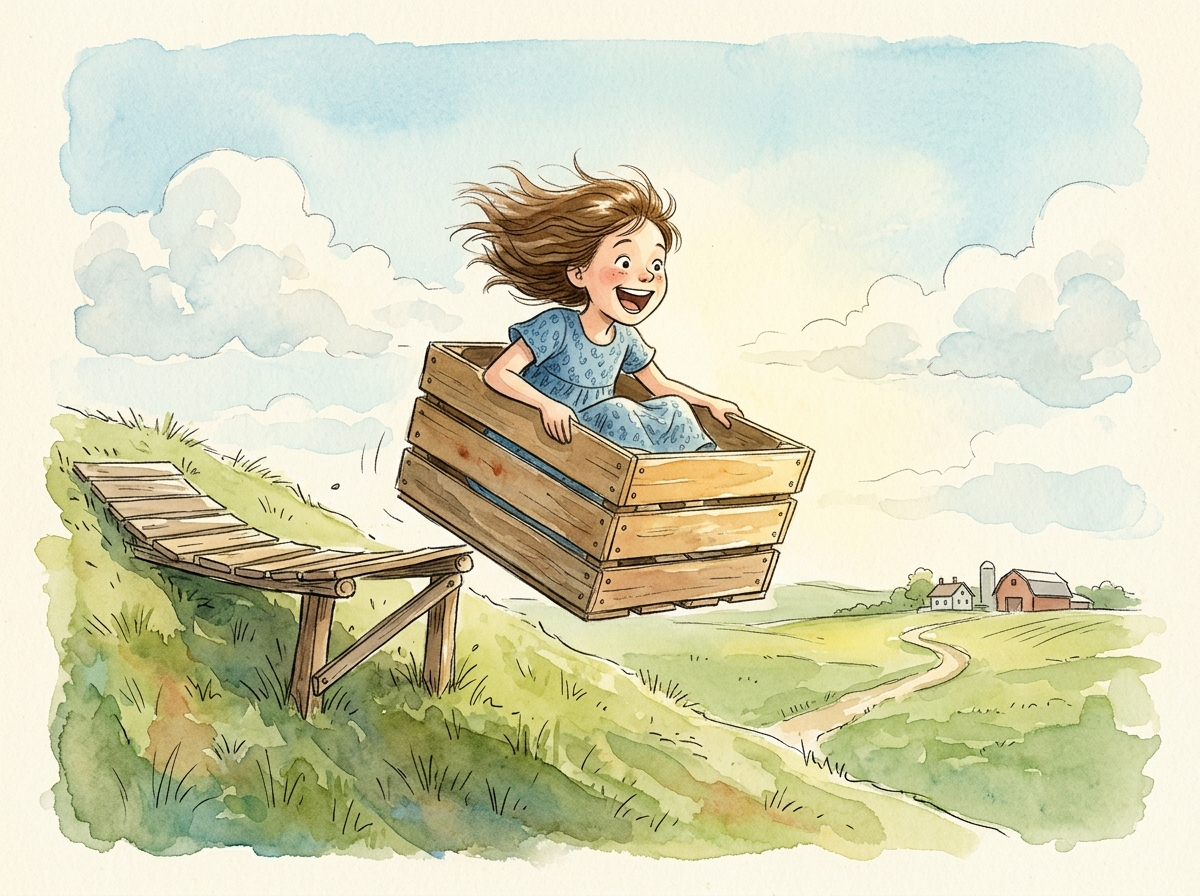
On a big hill in Kansas, a young Amelia Earhart builds a ramp for her grandmother's apple crate because she is ready to fly.
Amelia Earhart was eight years old, and she had mud on her knees, a scrape on her elbow, and the biggest idea she'd ever had.
"Millie," she said to her younger sister, who was sitting in the grass pulling apart a dandelion. "I need your help with something important."
Amelia Earhart was eight years old, and she had mud on her knees, a scrape on her elbow, and the biggest idea she'd ever had.
"Millie," she said to her younger sister, who was sitting in the grass pulling apart a dandelion. "I need your help with something important."
Millie looked up. She knew that look on her sister's face — eyes wide, mouth curled into a grin, already bouncing on her toes. That look always meant something exciting. That look also sometimes meant trouble.
"What kind of important?" Millie asked carefully.
"The flying kind of important."
Millie set down her dandelion.
Amelia pointed to the top of the big hill behind their grandparents' house in Atchison, Kansas. It was the tallest hill in the whole neighborhood — maybe, Amelia thought, the tallest hill in the whole world, though it probably wasn't. From the top, you could see the rooftops of town and the wide, brown Missouri River curling through the valley like a lazy snake.
"We're going to fly off that hill," Amelia announced.
"Fly," Millie repeated.
"Fly."
"Amelia, people can't fly."
"Not yet," Amelia said. "Nobody's built the right thing yet. But I have a plan."
And she did have a plan. She'd been thinking about it all morning — ever since she saw a man at the county fair sitting in a contraption made of wood and wire, telling everybody he was going to take it into the sky someday. The grown-ups had laughed and shaken their heads. But Amelia hadn't laughed. She'd stared and stared, memorizing every piece of it.
Now she grabbed Millie's hand and pulled her toward the shed behind the barn. Inside, it smelled like sawdust and old rain. There were wooden planks leaning against the wall, a rusty hammer, a tin of bent nails, and — most importantly — a big wooden crate that their grandmother used for storing winter apples.
"That's Grandma's crate," Millie said.
"Grandma would want us to use it for science," Amelia replied, already dragging it toward the door.
They spent the whole afternoon building. Amelia hammered planks together to make a ramp — long and steep, propped against the top of the hill with rocks and a wobbly fence post. Millie carried boards, found more nails, and asked important questions like "Are you sure?" and "What if we crash?" and "Can I have a turn?"
The ramp wasn't pretty. It leaned a little to the left. One board was shorter than the others, so there was a bump in the middle. But when Amelia stood back and looked at it with her hands on her hips, she felt a warmth spread through her chest like she'd swallowed sunshine.
"It's beautiful," she whispered.
"It's crooked," said Millie.
"Beautiful things are sometimes crooked," said Amelia.
She positioned the apple crate at the very top of the ramp. It was just big enough for one person to sit inside with their knees pulled up. Amelia climbed in, gripped the sides, and looked down the hill.
It was steep. Very steep. The grass below rippled in the wind, and the whole world seemed to tilt forward.
Her stomach did a little flip.
"Maybe," Millie said softly, standing beside the crate, "maybe you should test it with a rock first. Or a potato."
Amelia thought about the man at the fair. She thought about how the grown-ups laughed. She thought about how sure he looked, sitting in his contraption, even when nobody believed him.
"Potatoes don't need to fly, Millie," she said. "I do."
"Then I'm pushing you," Millie said, and before Amelia could argue, her little sister planted both hands on the back of the crate and shoved with all her might.
The crate tipped forward.
For one second, nothing happened. The wood groaned. The ramp creaked.
Then — WHOOOOSH.
The crate shot down the ramp so fast that Amelia's hair flew straight back and her eyes went wide as dinner plates. The bump in the middle launched her into the air — not a lot, just a few inches — but for that one heartbeat, that one tiny sliver of a moment, the crate left the ramp completely.
All four sides of the box were in the air.
Nothing was touching the ground.
Amelia was flying.
Wind rushed past her ears. The sky opened up above her, blue and enormous and close enough to touch. Her stomach floated up like a balloon inside her body, and she felt something she had never felt before — a feeling so big and bright and wild that she didn't even have a word for it yet.
She laughed right out loud.
Then the crate hit the grass.
It bounced once — BANG — and skidded sideways. It tipped, rolled, and tumbled end over end with Amelia inside it, elbows and knees banging against wood, grass and sky swapping places over and over until — CRASH — the crate smashed into the fence at the bottom of the hill and broke apart into pieces.
Amelia lay in the wreckage, flat on her back, staring up at the clouds.
Millie came running down the hill, her boots slapping against the grass. "AMELIA! Are you alive? Are you dead? Are your bones broken?"
Amelia sat up slowly. Her dress was torn. She had a new scrape on her chin to match the one on her elbow. Her hair was full of grass, and a piece of apple crate was somehow stuck to her shoe.
She was grinning so hard her cheeks ached.
"Millie," she breathed. "I flew."
"You crashed."
"I flew AND crashed. Flying came first."
Millie stared at her sister, at the broken crate, at the crooked ramp still standing on top of the hill. Then she crossed her arms.
"I want a turn," she said.
They couldn't fix the crate — it was truly and completely destroyed, and they both knew Grandma was going to notice. But they sat together at the bottom of the hill, passing a canteen of water back and forth, and Amelia told Millie exactly what it felt like. The wind. The way the ground disappeared. The half-second of weightlessness that felt like it lasted an hour.
"Next time," Amelia said, "we'll build it bigger. Longer ramp. Smoother boards. Maybe we can attach a sheet, like a sail, to catch the wind."
"Next time," Millie said, "I go first."
"Deal."
They shook on it, mud and all.
That evening, Grandma found the remains of her apple crate. She stood on the back porch with her arms folded, looking at the two girls, who were trying very hard to look innocent and failing completely.
"Amelia Mary Earhart," Grandma said. "Did you destroy my apple crate?"
"Yes, ma'am," Amelia said. "But it was for a very good reason."
"And what reason is that?"
Amelia looked at Millie. Millie looked at Amelia.
"Science," they said together.
Grandma was quiet for a long moment. Her mouth twitched. She unfolded her arms, then folded them again.
"Next time you do science," she said, "you ask me first. And you wear your old clothes."
She turned and walked back inside, and through the screen door, the girls heard something that sounded very much like a laugh.
That night, Amelia lay in bed beside her sister, watching the curtains drift in the warm Kansas breeze. Through the window, she could see stars — hundreds of them, thousands of them — scattered across the sky like spilled sugar.
"Millie?" she whispered. "Are you awake?"
"Mm-hm."
"Someday I'm going to go up there. Past the hill. Past the birds. All the way up where the stars are."
Millie was quiet for so long that Amelia thought she'd fallen asleep.
Then, in a small, sleepy voice, Millie said: "I believe you."
Amelia smiled in the dark.
Outside, the wind blew across the top of the hill, over the crooked ramp and the scattered pieces of an old apple crate, and carried the sound of it all the way up — up, up, up — toward the stars, where it would wait for her.