The First Flight Was Short
Fable
Ages 9–11 · 11 min
Before Orville Wright can make the first flight at Kitty Hawk, he must convince his older brother Wilbur that their dream is worth the risk of crashing.
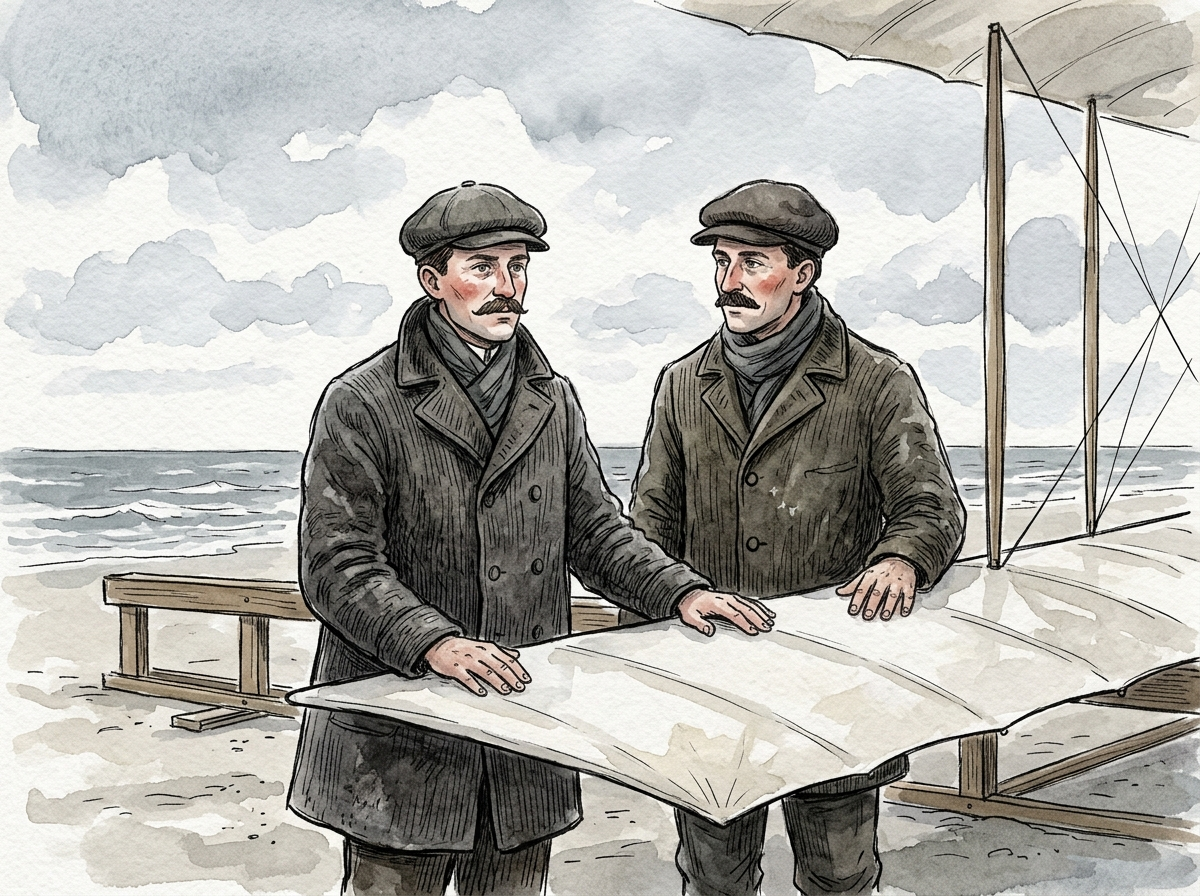
The wind at Kitty Hawk bit through every layer of clothing Orville Wright owned, and he owned quite a few layers. He stood on the flat, sandy stretch of beach with his hands jammed deep in his pockets, watching his older brother Wilbur pace back and forth beside their flying machine like a nervous father outside a hospital room.
It was December 17th, 1903, and the machine was ready.
The wind at Kitty Hawk bit through every layer of clothing Orville Wright owned, and he owned quite a few layers. He stood on the flat, sandy stretch of beach with his hands jammed deep in his pockets, watching his older brother Wilbur pace back and forth beside their flying machine like a nervous father outside a hospital room.
It was December 17th, 1903, and the machine was ready.
The question was whether the Wright brothers were.
"Orville," Wilbur said, stopping mid-pace. "I need to tell you something."
"If it's that my nose is red, I'm aware. I can feel it. It's basically a cherry tomato at this point."
"It's not about your nose."
"Then what?"
Wilbur opened his mouth. Closed it. Looked at the Flyer — their beautiful, ridiculous, wing-and-engine contraption sitting on its launching rail like a dragonfly waiting for permission to exist. Then he looked back at Orville.
"I'm afraid," Wilbur said.
Now, this might not sound remarkable to you. People are afraid all the time. They're afraid of spiders and dentist appointments and that wobbly noise the washing machine makes sometimes at eleven at night. But you have to understand something about Wilbur Wright. Wilbur Wright was not a man who said things like I'm afraid. Wilbur Wright was a man who studied wind tables for fun. Who had read every paper ever published on the physics of bird flight. Who had, over the past four years, built wind tunnels, tested over two hundred wing shapes, and personally written to the Smithsonian Institution requesting "all available literature on human flight" as casually as someone ordering a sandwich.
Wilbur Wright did not get afraid. Wilbur Wright got busy.
So when he said those words, Orville felt his stomach drop the way it does on the first hill of a roller coaster — except there was no roller coaster. Just sand and wind and a machine that had never been in the sky.
"Afraid of what?" Orville asked carefully.
Wilbur looked out toward the ocean. The waves were gray and endless, tumbling over each other like they were in a hurry to get somewhere that didn't exist.
"Three days ago," Wilbur said, "when I tried the flight and the Flyer stalled — when it nosed straight into the sand — do you know what I thought about while I was falling?"
"That you should've listened to me about the elevator angle?"
"I thought about the bicycle shop."
Orville blinked. "The bicycle shop."
"Our beautiful, warm, perfectly safe bicycle shop back in Dayton. Where nobody crashes into sand. Where the floors are level and the wind doesn't try to kill you and there's a very reliable stove in the corner."
Orville almost laughed. Almost. But there was something in Wilbur's voice — a small crack, like a pane of glass with a tiny line running through it — that stopped him.
"Will," he said. "What are you actually saying?"
Wilbur finally looked at him. His older brother's eyes were red-rimmed from the wind, and his mustache had tiny ice crystals forming at the edges, which under different circumstances would have been extremely funny.
"I'm saying that today is your turn to fly. And I'm saying..." He paused. Swallowed. "If something goes wrong — if you crash the way I crashed, or worse — I'll have to live the rest of my life knowing that I helped build the thing that hurt you. And that's..." He shook his head. "That's a thought I can't make small enough to fit anywhere inside my head."
The five men from the nearby lifesaving station who had come to help stood a respectful distance away, stamping their feet against the cold. John Daniels, the biggest of them, was supposed to operate the camera. He kept glancing over nervously, like he was watching two people decide whether or not to jump off a cliff.
Which, in a way, he was.
Orville took his hands out of his pockets. The cold attacked his fingers immediately, mean and sharp, but he didn't put them back. Instead, he walked over to the Flyer and placed one hand on the lower wing. The muslin fabric was tight as a drum. Underneath, the wooden ribs they'd shaped by hand — by hand, with a spokeshave and patience and about four hundred arguments — hummed faintly in the wind.
"Do you remember," Orville said, "the toy?"
Wilbur's eyebrows went up. "Which toy?"
"The one Dad brought home. When we were — what, seven and eleven?"
"The Pénaud helicopter."
"Right. The little rubber-band thing. And we flew it in the living room and it hit the ceiling and Mom said—"
"'If you boys want to fly things, you'll have to build a bigger house.'" The ghost of a smile crossed Wilbur's face. "I remember."
"And what did we do?"
"We tried to build a bigger version. And it didn't fly."
"And what did we do after that?"
Wilbur was quiet for a moment. "We tried again."
"We tried again," Orville repeated. "And it still didn't fly. And we tried again. And then we got distracted by printing presses for a few years, and then bicycles, and then one day you got sick — really sick, remember? Typhoid. And you were stuck in bed for weeks, and you started reading about Otto Lilienthal, the glider pilot, and you couldn't stop talking about it. You were running a hundred-and-three-degree fever and you were lecturing me about wing camber."
"I don't remember it being a lecture—"
"It was absolutely a lecture, Wilbur. You had charts. You made charts while delirious."
A real smile now, breaking across Wilbur's face like sunrise over that gray ocean.
"Here's what I want to say to you," Orville continued, and his voice got quieter, which made Wilbur lean in, which blocked a tiny bit of the wind, which Orville was grateful for. "Every single thing we've done — every wing we've tested, every letter we've written, every night we've stayed up arguing about lift and drag until one of us fell asleep at the table — all of it has been headed here. To this morning. To this sand. To this insane, beautiful, terrifying machine."
He patted the wing. Something inside the engine ticked, a tiny metallic sound, like the Flyer was agreeing with him.
"And yes," Orville said, "something might go wrong. I might nose into the sand like you did. I might break something — the machine or myself. But Will..." He looked his brother straight in the eyes. "If we walk away now, we'll go back to the bicycle shop. And every single day, we'll fix somebody's chain or tighten somebody's spokes and we'll think: I wonder what would have happened if we hadn't walked away."
Wilbur said nothing.
"And that thought," Orville said, "is heavier than crashing."
The wind howled across the flats. Sand skittered along the ground in little rivers. Out by the lifesaving station, the American flag snapped so hard it sounded like a whip.
Wilbur took a long, slow breath. Then he reached out and put his hand on the wing, right next to Orville's. Two hands on the muslin. Two brothers in the cold.
"Twelve miles an hour headwind," Wilbur said quietly, all business now, the crack in his voice sealed back up. "Maybe thirteen. You'll need to keep the elevator steady. Don't overcorrect the way I did."
"I won't overcorrect."
"You always overcorrect. You overcorrect when you're pouring coffee."
"That was one time, and the mug was unusually small."
Wilbur squeezed his brother's shoulder. His grip was firm and steady and said everything that the next few minutes wouldn't leave time to say.
"Go fly, Orville."
Orville climbed onto the Flyer. He lay flat on his stomach on the lower wing, the way they'd designed it, his hips resting in the cradle that controlled the wing-warping. The engine sputtered, coughed, then caught — a rough, clattering roar that vibrated through every bone in his body.
The propellers began to spin.
Wilbur took his position at the right wingtip, steadying the machine as it began to move along the rail. He was jogging, then running, his long legs keeping pace, his hand on the wing like he was guiding a child on a bicycle — which, if you think about it, was kind of perfect.
And then Wilbur's hand was holding nothing but air.
The Flyer lifted. Not soared — lifted, bobbing and dipping like a boat on choppy water, struggling against the wind, alive and unsteady and absolutely, undeniably off the ground.
Orville gripped the controls. The wind roared in his ears. The ground fell away — not far, only about ten feet — and the sand below blurred into a stream of gold and gray, and for one breathless, impossible, world-changing moment, Orville Wright was flying.
He could feel it in his chest. Not just the vibration of the engine, but something else. Something enormous and light at the same time, like a door swinging open onto a room that had always existed but no one had ever walked into.
Twelve seconds later, the Flyer touched back down.
Twelve seconds.
That's less time than it takes to tie your shoes. Less time than it takes to sing the chorus of almost any song you know.
But in those twelve seconds, the ground let go of humanity — just a little.
Wilbur sprinted over. Orville was grinning so hard his frozen cheeks ached. John Daniels, who'd pressed the camera button at exactly the right instant — capturing a photograph that would become one of the most famous images in history — stood with his mouth hanging open.
The brothers looked at each other.
"Twelve seconds," Orville said.
"Twelve seconds," Wilbur agreed. Then, quieter: "Not bad for a couple of bicycle mechanics."
They flew three more times that morning. The last flight — Wilbur's — lasted fifty-nine seconds and covered 852 feet. And then a gust of wind flipped the Flyer and destroyed it, because the universe apparently felt they were getting too confident.
But it didn't matter. The machine could be rebuilt.
The twelve seconds could never be taken back.
That night, they sent a telegram to their father back in Dayton. It said: Success. Four flights Thursday morning. Started from level. Inform press. Home Christmas.
And then Orville and Wilbur Wright walked back to their little wooden shed on the frozen beach — two brothers who had built a bigger house than their mother ever could have imagined — and started packing for home.