The Curious Child
Fable
Ages 9–11 · 11 min
While boys march into the grand university in Warsaw, nine-year-old Maria Skłodowska must knock on a secret door to learn science in a hidden classroom that could be discovered at any moment.
The snow fell thick over Warsaw that morning, blanketing the cobblestones in white, and nine-year-old Maria Skłodowska pressed her nose against the cold window glass until it left a little circle of fog.
"Maria, you'll freeze your face off," her older sister Bronya said from across the room, not even looking up from the potatoes she was peeling.
The snow fell thick over Warsaw that morning, blanketing the cobblestones in white, and nine-year-old Maria Skłodowska pressed her nose against the cold window glass until it left a little circle of fog.
"Maria, you'll freeze your face off," her older sister Bronya said from across the room, not even looking up from the potatoes she was peeling.
"I'm watching the students," Maria whispered.
Across the street, a line of boys in dark coats marched into the great stone schoolhouse. They carried leather satchels full of books—real books, with hard covers and gold lettering. Maria could see one boy swinging his bag carelessly, as if it weighed nothing at all. As if it weren't the most precious thing in the world.
Maria's fingers tightened on the windowsill.
"Come away from there," her father said gently. He stood in the doorway of their small apartment, his spectacles pushed up on his forehead the way they always were when he was thinking. "There's nothing to be done about it today."
And he was right. There was nothing to be done. The Russian government controlled Poland now, and Russians made the rules. Girls were not permitted in the university. Girls were barely permitted in the schools at all. And the schools that did exist taught everything in Russian—Russian history, Russian literature, Russian glory—as if Poland had never existed, as if the Polish language were something to be ashamed of and hidden away like a broken dish.
Maria was not ashamed. Maria was furious.
But fury, she had learned, was something you had to keep quiet in Warsaw. Quiet like the snow.
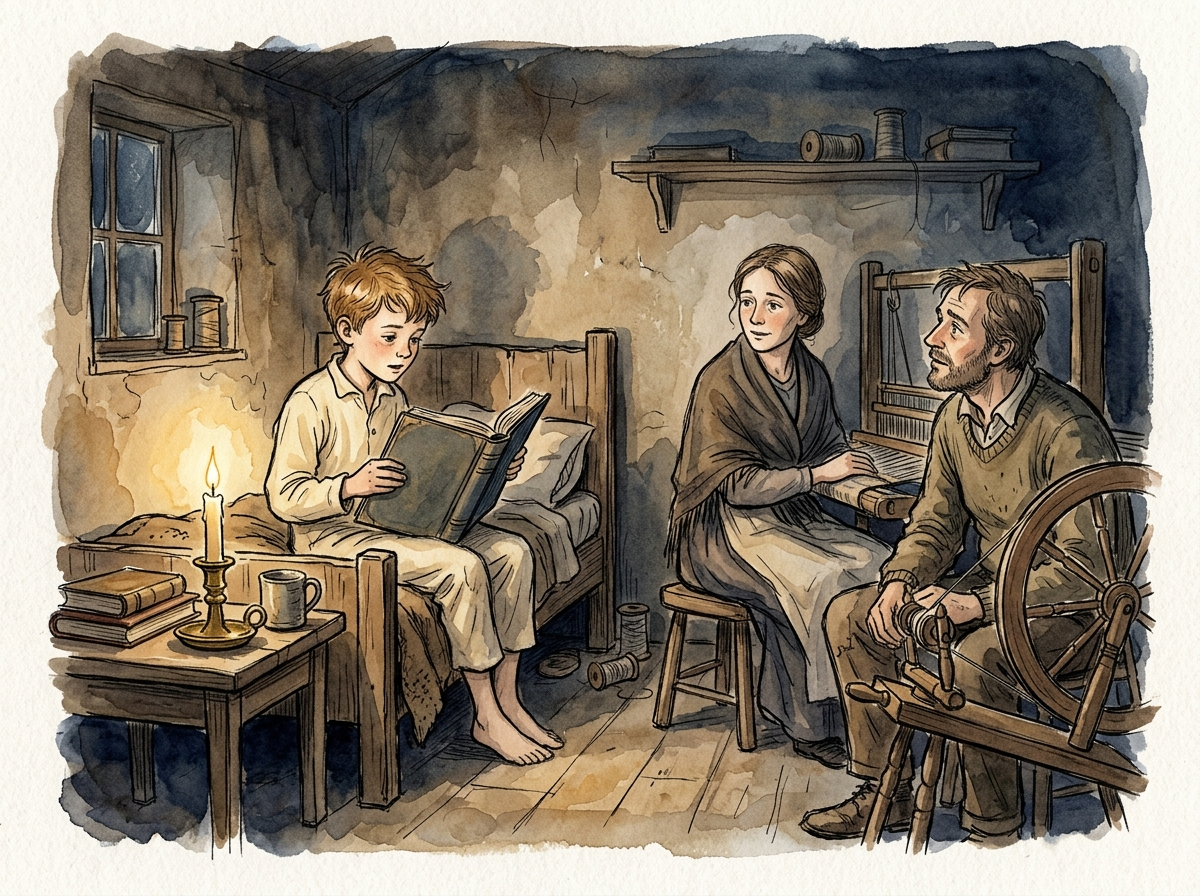
That evening, Maria sat cross-legged on the floor of their apartment while her father set up what he called his "evening laboratory." This was really just their kitchen table, cleared of dishes and covered with a cloth, upon which he placed the treasures he had smuggled home from the school where he worked as a science teacher.
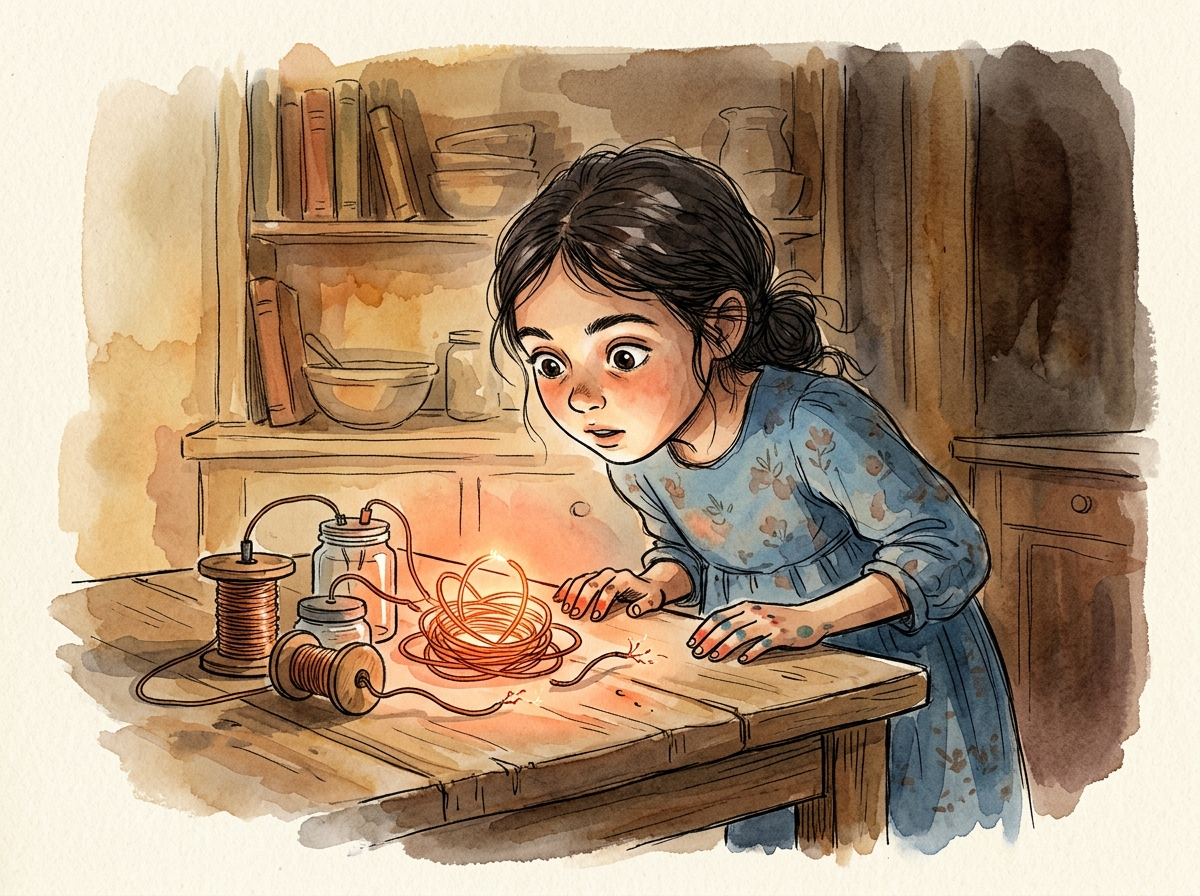
Tonight it was a glass tube, a copper wire, and a small battery.
"Now then," Papa said, adjusting his spectacles. "Who can tell me what happens when I connect this wire to the battery?"
"The wire gets hot," said Bronya, still peeling potatoes. She always answered first because she was fifteen and felt this was her responsibility.
"Yes, but why?" Maria asked, leaning forward so far she was practically on the table.
Her father smiled—that particular smile he saved for Maria, the one that was half proud and half worried. "Why indeed. Let's find out."
He connected the wire. It glowed. Maria's eyes went wide, reflecting the tiny orange light, and she felt something in her chest that was bigger than words—a feeling like a door swinging open into a room she hadn't known existed.
"It's the electricity," she breathed. "It's moving through the wire and the wire is resisting it, and the resistance makes heat, and the heat makes light. Like—like when you rub your hands together on a cold day, but a thousand times faster and smaller!"
Her father stared at her. Bronya stopped peeling.
"Where did you learn that?" Papa asked quietly.
Maria bit her lip. "Your physics book. The one on the top shelf. I've been reading it after everyone goes to sleep."
"Maria, that book is in French."
"Yes. I taught myself French from your dictionary. It took three weeks."
The kitchen was very quiet. The wire had stopped glowing. Bronya set down her potato peeler.
"Three weeks," her father repeated softly.
The next day, Maria bundled herself in her coat and scarf and went out into the snow. She had a mission. She walked six blocks through the freezing streets, past the Russian soldiers who stood on corners looking bored and dangerous, past the shuttered shops, past the church with its cracked bell, until she reached a plain wooden door on Krowia Street.
She knocked three times, paused, then knocked twice more.
The door opened a crack. A woman's eye peered out.
"I'm Maria Skłodowska," Maria said, standing as tall as she could. "I want to learn."
The door opened wider. The woman was young, maybe twenty-five, with ink-stained fingers and a tired face that broke into a careful smile.
"You're Władysław's daughter? The science teacher?"
"Yes."
"How old are you?"
"Old enough."
The woman laughed—a short, surprised sound—and stepped aside. "Come in, then. Quickly."
Inside, Maria found a room full of people. Women and girls of all ages sat on chairs, on cushions, on the floor, bent over books and papers. A man with a white beard was drawing a map of Poland on a chalkboard—a real map, with Polish cities labeled in Polish, which was strictly forbidden. A young woman in the corner was reading a chemistry textbook aloud in a whisper. The air smelled like chalk dust and determination.
This was the Flying University.
It was called "flying" because it never stayed in one place. Every few weeks, the classes moved to a different apartment, a different basement, a different attic, always one step ahead of the Russian police. If the authorities discovered them, everyone in the room could be arrested. Sent to Siberia. Or worse.
Maria sat down on the floor, opened her notebook, and began to write.
She came back every week. Then every other day. Then every day she could.
She learned mathematics from a professor who had been fired from the university for being Polish. She learned chemistry from a woman who ground her own mineral samples with a mortar and pestle she kept hidden in a bread box. She learned history—real history, Polish history—from an old man who cried sometimes when he talked about what their country used to be.
And she learned something else, too. Something that wasn't written in any book.
One February afternoon, the class was interrupted by three sharp knocks at the door. Wrong pattern. Everyone froze.
"Police," someone hissed.
What happened next took eleven seconds. Maria knew because she counted. Books vanished under floorboards. The chalkboard was wiped clean and replaced with a painting of flowers. The chemistry equipment disappeared into a hollowed-out piano bench. Everyone grabbed embroidery hoops that had been placed around the room for exactly this purpose, and by the time the door opened, twelve women and girls sat in a cozy circle, peacefully stitching roses and lilies, looking up with innocent surprise at the two Russian officers.
"What is this?" the taller officer demanded.
"A sewing circle," said the woman with ink-stained fingers, holding up her embroidery with a sweet smile. Her hands weren't even shaking. "Would you like to see my needlework?"
The officers looked around the room. They checked behind the painting. They opened a cupboard and found only cups. One of them stared directly at Maria, and she felt her heart hammering so hard she was sure he could hear it.
She looked back at him and smiled. Then she held up her embroidery hoop. On it, she had stitched—quite badly—a lopsided flower.
The officer snorted and muttered something to his partner, and they left.
The room was silent for a full minute after the door closed. Then the professor with the white beard started laughing. Then the chemistry woman. Then everyone was laughing, that breathless, shaky, wonderful laughter of people who have gotten away with something that matters.
Maria laughed too. But her hands were trembling now, and she pressed them flat against her notebook to make them stop.
That night, she couldn't sleep. She lay in the dark next to Bronya, staring at the ceiling, thinking about the officer's face. Thinking about the books hidden under the floorboards. Thinking about the wire that glowed.
"Bronya," she whispered. "Are you awake?"
"No."
"Do you think I'll ever get to go to a real university?"
Bronya was quiet for so long that Maria thought she'd actually fallen asleep. Then her sister rolled over.
"Not here," Bronya said. "Not in Warsaw. Not as long as things are the way they are."
"Then somewhere else."
"Maria, we don't have money for somewhere else."
"Then I'll earn it. I'll work and save. I'll tutor children. I'll do whatever it takes. And if it takes ten years, then it takes ten years."
"You're nine years old."
"Yes. So I have time."
Bronya propped herself up on one elbow and looked at her little sister in the dark. Maria's jaw was set. Her eyes were bright even without any light to reflect.
"You're serious," Bronya said.
"I have never once in my life not been serious."
Bronya lay back down. Another long silence. Then: "If you help me get to Paris first, I'll help you come after. We'll take turns. We'll find a way."
Maria reached across the blanket and squeezed her sister's hand.
"Deal," she said.
In the weeks that followed, Maria kept going to the Flying University. She kept reading her father's books by candlelight. She kept watching the boys march into the schoolhouse across the street, but something had changed. She didn't press her nose to the glass anymore. She didn't ache the same way.
Because Maria Skłodowska had realized something important. Those boys walked through a door that someone had opened for them. They sat in chairs that someone had pulled out. They read from books that someone had placed on their desks.
She had done none of those things. She had taught herself French in three weeks. She had learned physics from a smuggled textbook. She had studied chemistry in secret, in danger, in the dark. Every single thing she knew, she had reached for with both hands.
And no one—no officer, no government, no rule, no locked door—had been able to stop her.
One morning in early spring, the snow began to melt. Water dripped from the rooftops and ran in little rivers between the cobblestones. Maria walked to the Flying University with her notebook under her coat and her shoes soaking wet and a feeling in her chest like a wire beginning to glow.
She knocked three times, paused, and knocked twice more.
The door opened.
She stepped inside.