Why Is the Sky Blue?
Fable
Ages 6–8 · 10 min
For every scientific answer his sister Mae has about the blue sky, Theo's fizzy brain comes up with another, bigger question.
Theo was young, and his brain was fizzy.
Not fizzy like soda. Fizzy like a jar full of bumblebees, all buzzing at once, all wanting to fly in different directions. Questions lived inside Theo the way goldfish lived inside a pond — swimming around and around, bumping into each other, never sitting still.
Theo was young, and his brain was fizzy.
Not fizzy like soda. Fizzy like a jar full of bumblebees, all buzzing at once, all wanting to fly in different directions. Questions lived inside Theo the way goldfish lived inside a pond — swimming around and around, bumping into each other, never sitting still.
And the person Theo brought every single one of those questions to was Mae.
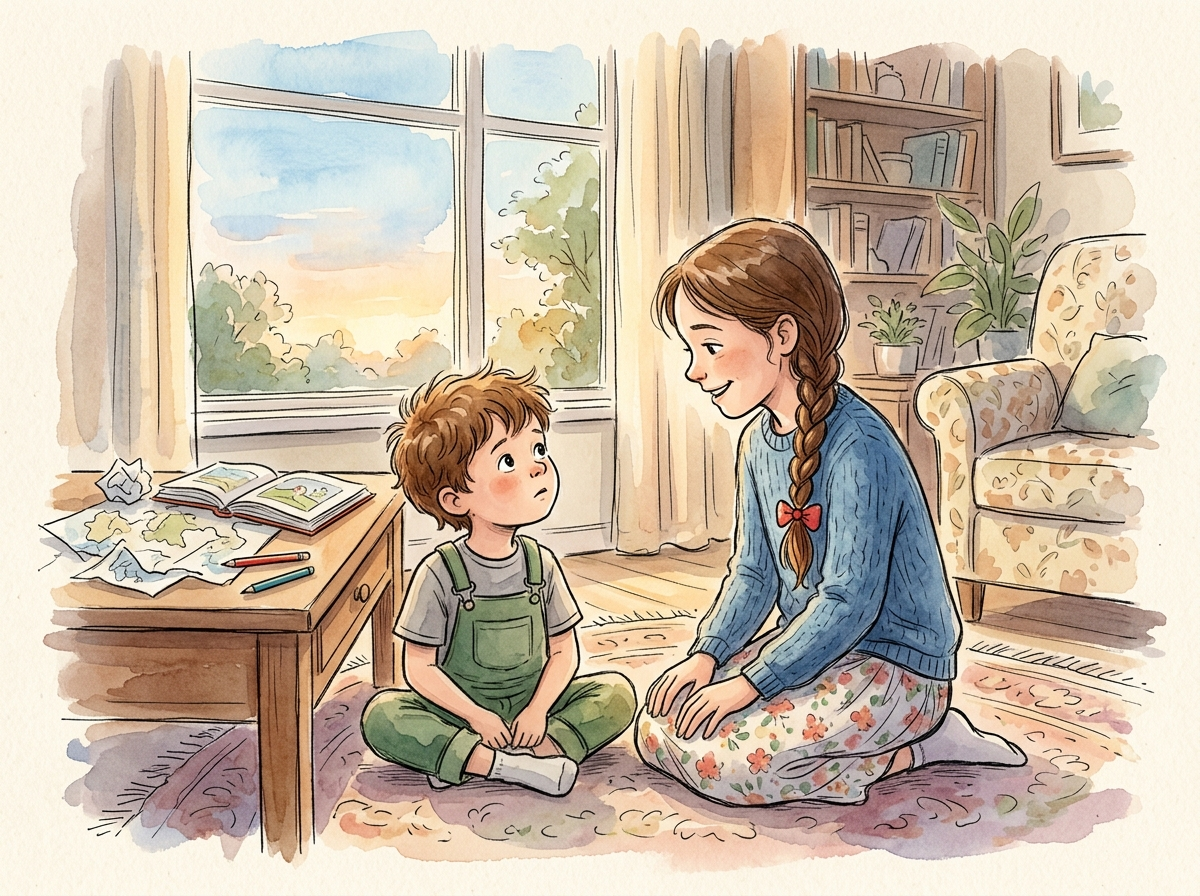
Mae was his older sister. She was ten and three-quarters, which she always said exactly like that — ten and three-quarters — because the three-quarters part mattered. Mae had brown eyes and a long braid and a way of looking at Theo like she was really, truly thinking about what he'd said, even when what he'd said was completely bananas.
One Tuesday after school, Theo was lying upside down on the couch with his legs over the back and his head hanging off the cushion, staring out the window at the sky.
"Mae," he said.
Mae was at the kitchen table, drawing a map of an imaginary country she'd invented called Pellozia. She didn't look up. "Yeah?"
"Why is the sky blue?"
Now Mae looked up. She chewed the end of her pencil. This was a real question with a real answer, and Mae liked real answers.
"Okay," she said, "so. Sunlight looks white, right? But it's actually made of all the colors mixed together. Red, orange, yellow, green, blue, violet — all of them, traveling together. And when the sunlight hits the air — like, all the tiny little pieces of air called molecules — the blue light gets bounced around the most. It scatters everywhere. So when you look up, you're seeing all that blue light bouncing around the sky."
Theo was quiet for three whole seconds, which was a Theo record.
"But why does the blue light bounce more than the red light?"
Mae tapped her pencil. "Because blue light has shorter waves. Tiny, tight little waves. And short waves bump into the air molecules more easily. Red light has long, stretchy waves, so it kind of sails right past."
Theo flipped himself right-side up. His face was pink from being upside down. "What do you mean, waves? Light doesn't look like waves."
"It does, though. You just can't see them. Light moves in waves, like the ocean, except the waves are so incredibly tiny and so incredibly fast that your eyes can't watch them wiggle. But they're wiggling."
"Right now?"
"Right now."
Theo held up his hand and stared at it. Light was landing on his fingers, wiggling invisibly. His eyes got wide.
"Okay but — if all the colors are bouncing around in the sky, why don't we see green? Or purple?"
Mae opened her mouth. Then she closed it. Then she opened it again.
"Well... violet actually does scatter even more than blue. But our eyes aren't great at seeing violet. And the blue mixes with just a tiny bit of the other scattered colors, and our brains go, yep, that's blue. Our brains pick blue. Our brains are sort of... choosing."
Theo grabbed his own head with both hands like it might fly off. "Our BRAINS are CHOOSING? So the sky might not even really BE blue?"
Mae pointed her pencil at him. "Now you're getting into philosophy."
"What's philosophy?"
"Questions that don't have a bottom."
Theo loved that. Questions that don't have a bottom. He was quiet for almost five seconds — an all-time record — and then he said:
"What color would the sky be if I were a dog?"
Mae put her pencil down. She leaned back in her chair. She looked at the ceiling, then out the window, then at Theo.
"Hmm," she said. "Dogs don't see blue the same way we do. So maybe a dog looks up and sees a paler, grayish-blue sky. Like a sky that's been washed too many times."
Theo laughed. "Like Dad's old T-shirts!"
"Exactly like Dad's old T-shirts."
"What about a BEE? What color would the sky be if I were a bee?"
Mae was now fully turned around in her chair, her map of Pellozia forgotten.
"Oh, bees are wild," she said. "Bees can see ultraviolet light — that's a kind of light we can't even see at all. So a bee might look at the sky and see colors that don't even have names in our language. Colors we literally cannot imagine."
Theo's mouth was hanging open. "Colors with no NAMES?"
"No names. No words. No crayons."
Theo jumped off the couch and started walking in a circle, which was what he did when his brain bees were buzzing the absolute loudest. He made three full loops around the coffee table.
"Mae. Mae. What about a FISH? What does the sky look like if you're a fish?"
Mae smiled — her real smile, the slow one that started on just one side. "Well, a fish is looking up through the water. So the sky wouldn't just be blue. It would be a big, shimmery, wobbly circle of light way up above them. Like a glowing window. And all around the edges, it would fade into deep, dark water-color. A fish probably thinks the sky is a hole in the roof of the world."
Theo stopped walking. "A hole in the roof of the world," he whispered.
"And sometimes," Mae went on, "when the water is wavy, the light breaks apart into little dancing sparkles. So to a fish, the sky might look like it's alive."
Theo sat down right in the middle of the living room floor, criss-cross, and looked up at the ceiling like he was trying to see through it.
"Mae?"
"Yeah?"
"What color is the sky at night?"
"What do you think?"
"Well, it LOOKS black. But you said sunlight has all the colors, and the sun is just on the other side of the Earth at night. So is the dark just... the absence of bouncing?"
Mae stared at him.
"Theo. Yes. That's actually exactly right."
Theo grinned so big that his missing tooth showed. He was proud, but he was already moving on, because the bumblebees never stopped.
"LAST question," he said, holding up one finger.
"You said 'last question' four questions ago."
"This is the real last one."
"Go."
Theo looked at her with his most serious face — eyebrows low, chin down, both hands on his knees.
"If I could see EVERY color — like a bee AND a person AND a dog AND a fish, all at the same time — what color would the sky be?"
Mae was quiet for a long time. Longer than Theo had been quiet all day. She looked out the window where the afternoon sky was doing its regular, ordinary, extraordinary thing — just sitting there being blue, or whatever blue actually was.
"I think," Mae said slowly, "it would be a color so big and so full that your brain would have to invent a completely new feeling just to understand it."
Theo sat with that. He rolled it around in his fizzy, buzzy, beautiful brain.
"I think it would look like music sounds," he said.
Mae looked at her little brother — upside-down-couch-sitting, circle-walking, question-asking Theo — and she felt something warm spread inside her chest, like a deep breath she didn't know she needed.
"Yeah," she said softly. "I think you might be right."
Theo jumped up. "Can we get a snack?"
"Yes."
"Mae?"
"Yeah?"
"Why are bananas yellow?"
Mae laughed — her big laugh, the one that sounded like a bell that had never learned to be quiet. She grabbed her brother in a headlock and steered him toward the kitchen.
"Bananas," she said, "are a whole different conversation."
And it was. But that's another story.