A Very Long Time Ago
Fable
Ages 6–8 · 9 min
At the kitchen table, Maya asks her grandpa how long ago dinosaurs lived, and he proposes a game to imagine Earth's entire history as just one year.
Once upon a time — a very long time ago — there was a little girl named Maya who loved dinosaurs more than anything in the whole wide world.
She had dinosaur pajamas. She had dinosaur slippers. She had a dinosaur lunchbox, a dinosaur toothbrush, and exactly forty-seven plastic dinosaurs lined up on her windowsill. She could say "Pachycephalosaurus" without even stopping to breathe.
Once upon a time — a very long time ago — there was a little girl named Maya who loved dinosaurs more than anything in the whole wide world.
She had dinosaur pajamas. She had dinosaur slippers. She had a dinosaur lunchbox, a dinosaur toothbrush, and exactly forty-seven plastic dinosaurs lined up on her windowsill. She could say "Pachycephalosaurus" without even stopping to breathe.
One Tuesday afternoon, Maya was sitting at the kitchen table with her grandpa, drawing a Triceratops with her best green crayon.
"Grandpa," she said, "how long ago did the dinosaurs live?"
Grandpa leaned back in his chair and rubbed his chin. "Oh, a very, very long time ago."
"But how long?"
"Well," said Grandpa, "the last dinosaurs disappeared about sixty-six million years ago."
Maya scrunched up her nose. She knew what a million was. Sort of. It was a lot. Like, more than all the grains of rice in the big bag at the grocery store. Probably.
"I don't think I can imagine that," she said.
Grandpa smiled. "Neither can I, to be honest. But — what if we played a little game? What if we pretended that the entire history of the Earth — all four and a half billion years of it — was squeezed into just one single year? One calendar year, January to December."
Maya sat up straighter. "Like a birthday-to-birthday year?"
"Exactly like that. The Earth is born on January first. And right now — today — is midnight on December thirty-first. New Year's Eve. The very last second of the year."
"Okay," said Maya. "I'm ready."
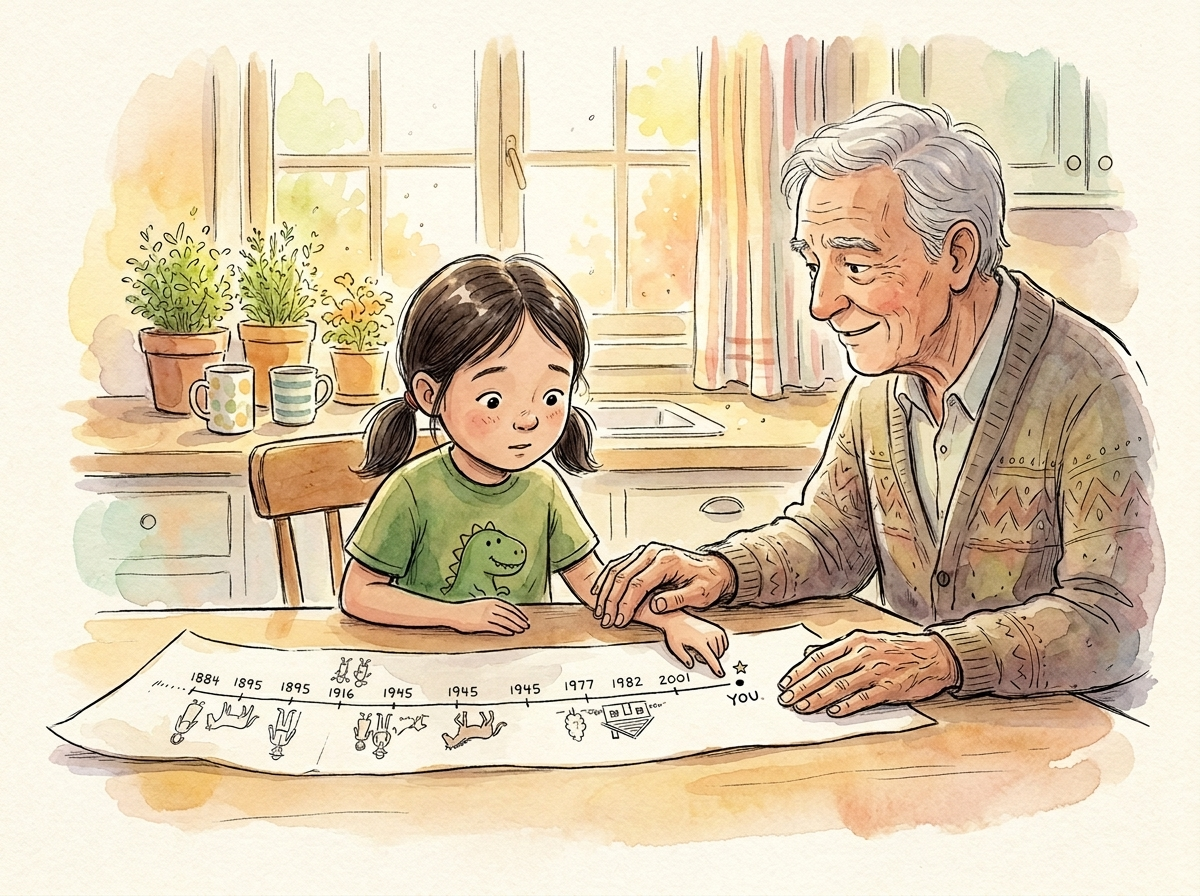
Grandpa pulled a big piece of paper across the table and drew a long line from one side to the other. At the left end, he wrote January 1st. At the right end, he wrote December 31st.
"So," he began, "the Earth forms on New Year's Day. It's a big ball of hot, melted rock. No oceans. No air you could breathe. Just heat and bubbling lava everywhere."
"No dinosaurs?" Maya asked.
"Oh, not even close. For a long time, there's nothing alive at all. The first tiny, tiny living things — so small you'd need a microscope to see them — don't show up until around... March."
"March!" said Maya. "That's already a long time to wait."
"And here's the thing," said Grandpa. "Those teeny tiny creatures? They're the only living things on Earth for a long, long, long while. All of spring. All of summer. They just float around in the ocean, being very small and very simple."
Maya giggled. "That sounds boring."
"Maybe. But they were busy! They were slowly, slowly changing. And finally, around November —"
"November?"
"November. The first animals with actual bodies you could see start to appear in the ocean. Little squishy things. Wormy things. Things with too many legs."
Maya looked at the paper. Grandpa had drawn little squiggles near November. That meant almost the WHOLE year had gone by with just tiny invisible blobs.
"What about fish?" she asked.
"Fish show up around November twenty-fifth or so. And then things start happening faster. The first plants grow on land in early December. Insects come along. Then amphibians — you know, like frogs and salamanders — they crawl onto land around December third."
"And THEN the dinosaurs?" Maya was bouncing in her seat.
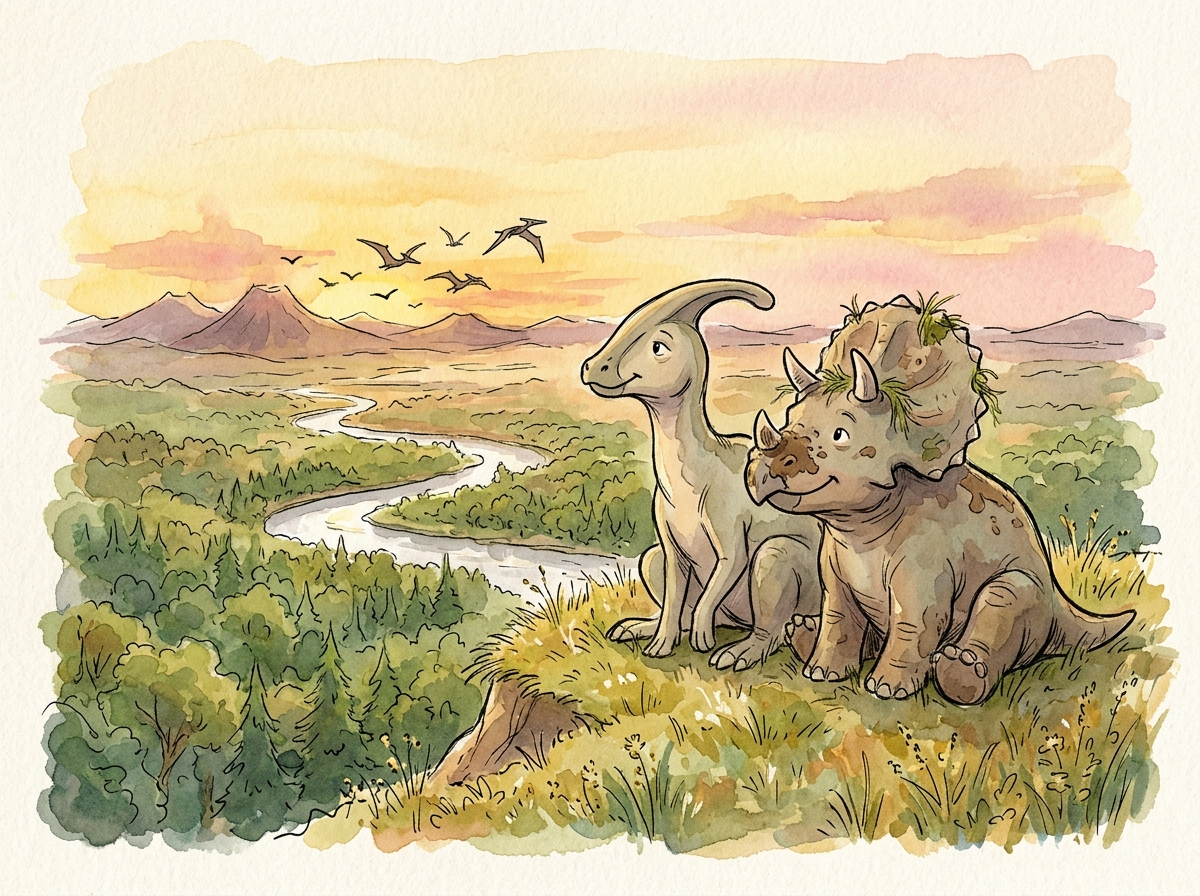
Grandpa grinned. He drew a little spot on the line, way over near the right end. "The dinosaurs arrive on about... December fourteenth."
"December fourteenth! That's only —" Maya counted on her fingers — "seventeen days before the end of the year!"
"That's right. After waiting all year long — all of January, February, March, April, May, June, July, August, September, October, November, and most of December — the dinosaurs finally show up on the fourteenth."
Maya stared at the line. "But they were so BIG. And so IMPORTANT."
"They were! And they stuck around for a good while, too. They roamed the Earth from December fourteenth all the way to... December twenty-sixth."
"The day after Christmas!"
"Yep. On December twenty-sixth, a giant asteroid crashes into the Earth, and the dinosaurs are gone."
Maya was quiet for a moment. She looked at her Triceratops drawing. Even the mighty dinosaurs had only gotten twelve days out of the whole year.
"Grandpa," she said slowly, "when do people show up?"
Grandpa's eyes twinkled. He picked up his pen and made the tiniest little dot — right at the very, very end of the line. Right up against December 31st.
"People like us — humans who walk and talk and draw dinosaurs with green crayons — we show up on December thirty-first at about... eleven fifty-eight at night."
Maya's mouth dropped open.
"Eleven fifty-eight PM? On the LAST DAY? That's only two minutes before midnight!"
"Two minutes," said Grandpa. "That's us. The whole story of humans — every person who ever lived, every castle ever built, every song ever sung, every spaceship ever launched — it all fits into the last two minutes of the very last day of the year."
Maya looked at the long, long line stretching across the paper. She looked at the months and months of tiny invisible creatures. She looked at the little section for dinosaurs near the end. And then she looked at that tiny, tiny dot for people, right at the edge.
"We're so new," she whispered.
"Brand new," said Grandpa. "The Earth has been here all year long, and we just walked in the door."
Maya sat very still, thinking. She thought about the Earth spinning through all those empty months, with nothing but ocean and rocks and little blobs. She thought about the first fish, wiggling through dark water. She thought about the dinosaurs, stomping and roaring for their twelve big days. And then she thought about people — showing up right at the end, like a guest who arrives at a party just before the music stops.
"Grandpa?" she said.
"Yes, Maya?"
"If we only got here two minutes ago... then there's SO much that happened before us. So much we missed."
"There really is."
"That makes me feel... small."
Grandpa reached over and put his warm hand over hers. "Me too. But you know what? It also makes me feel lucky. Out of that whole long year — all those billions of years of rocks and rain and strange creatures — here we are. Right here at this kitchen table, drawing Triceratops."
Maya looked down at her drawing. Then she looked at the long timeline. Then she picked up her green crayon.
"I'm going to draw the WHOLE year," she announced. "January blobs and November worms and December dinosaurs and everything."
"That," said Grandpa, "is going to be one amazing drawing."
And so Maya drew. She drew bubbling lava and tiny floating things and weird squishy ocean creatures and fish with funny faces and the first brave little plant growing on empty land. She drew enormous dinosaurs with enormous teeth and a giant asteroid streaking through the sky. And at the very, very end — in the tiniest little corner — she drew two small people sitting at a kitchen table.
One was a grandpa. One was a girl with a green crayon.
And underneath, in her best wobbly handwriting, she wrote:
We just got here. Isn't that cool?