Where I'm From
Fable
Ages 6–8 · 11 min
After a classmate asks where she is really from, Yara must fill her blank heritage project poster with the story of a country she does not remember.
Yara knew the question was coming before the words even left the boy's mouth.
It was the way he tilted his head, the way his eyes narrowed slightly, like he was trying to solve a math problem. She'd seen that look a hundred times before—at the grocery store, at the dentist's office, at summer camp. It was the look people got right before they said the thing.
Yara knew the question was coming before the words even left the boy's mouth.
It was the way he tilted his head, the way his eyes narrowed slightly, like he was trying to solve a math problem. She'd seen that look a hundred times before—at the grocery store, at the dentist's office, at summer camp. It was the look people got right before they said the thing.
"But where are you really from?"
His name was Derek, and he sat two seats behind her in Ms. Ramirez's fifth-grade class. They were supposed to be working on their heritage projects—big poster boards about family history that would line the hallway during parent night. Derek had already filled half his board with a map of Ireland, photos of his grandparents, and a recipe for something called colcannon.
Yara's board was blank.
"I'm from Maple Creek," she said, not looking up. "Same as you."
"No, I mean, like, originally. Like, where were you born?"
Yara pressed her marker into the poster board so hard it squeaked. "Ethiopia," she said quietly.
"Cool. So do you remember it? Do you speak the language? Do you have, like, your real family there?"
Each question landed like a small stone dropped into still water. Yara felt the ripples spreading through her chest.
"I was a baby," she said. "I don't remember anything."
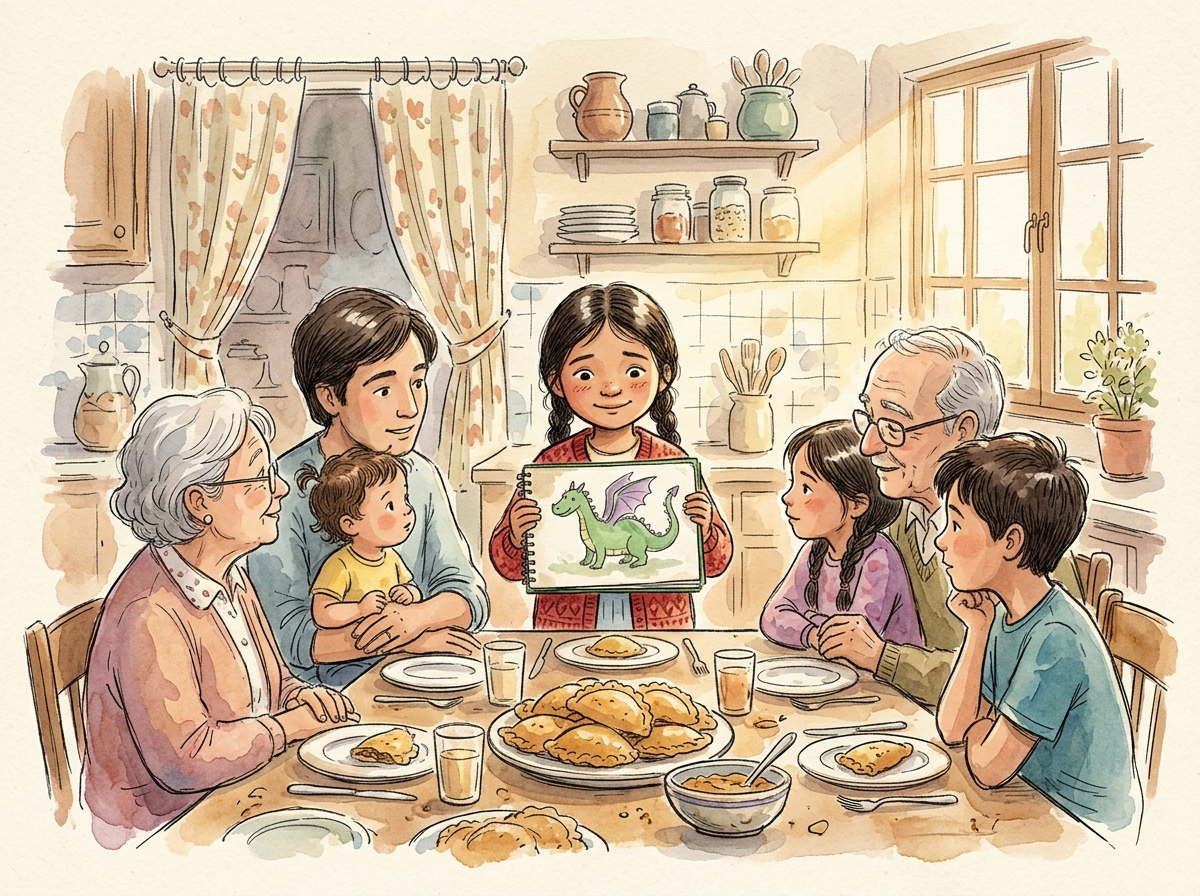
And that was the truth. She had no memories of the country where she'd been born. What she had instead were her parents—Mom, who sang off-key while making Saturday pancakes, and Dad, who could fix absolutely anything except the wobbly kitchen table, which he'd been "getting to" for three years. She had her little brother, Jem, who was seven and obsessed with bugs and also adopted, from South Korea. She had her dog, Biscuit, who was adopted too, from the shelter on Route 9, and who snored louder than Dad.
She had a life. A full, noisy, completely real life.
But Derek's question stuck to her like gum on a shoe. It followed her through science and lunch and all the way home, where she dropped her backpack by the door and went straight to the kitchen.
Mom was there, chopping onions with watery eyes.
"How was school?" Mom asked.
"Fine."
Mom looked at her the way moms do when "fine" means the opposite of fine. But she didn't push. She just said, "Jem found a centipede in the basement and wants to keep it as a pet. I told him he had to write a persuasive essay first."
Yara almost smiled. Almost.
She went up to her room and sat on her bed, staring at the rolled-up poster board she'd brought home. The heritage project was due Friday. Five days to fill a board with... what?
On her bookshelf, between a stack of fantasy novels and a geode from a family trip to the Smoky Mountains, sat a small wooden box. Yara reached for it, even though she knew every item inside by heart. She opened the lid.
A photograph of a woman with deep brown eyes and high cheekbones, holding a baby wrapped in white cloth. Her birth mother. Yara didn't know her name. The adoption agency had given the photo to her parents, and her parents had given it to Yara on her eighth birthday, when she'd started asking questions.
Beneath the photo was a piece of fabric—soft, cream-colored cotton with a border of red and gold thread. It was a piece of a netela, a traditional Ethiopian shawl. The agency said she'd been wrapped in it when she arrived at the orphanage.
And at the bottom of the box, a small card in her parents' handwriting: Yara — your name means "small butterfly" in Amharic. You flew a long way to find us, and we were waiting.
Yara held the fabric against her cheek. It smelled like nothing now—no trace of wherever it had been before. But it was soft, and it was hers.
The next morning, she still had a blank poster board.
At breakfast, Dad was reading something on his tablet while Jem examined a beetle he'd found on the porch. The centipede, apparently, had been denied residency after a very passionate but ultimately unsuccessful essay.
"Dad," Yara said, swirling her cereal around. "Where am I from?"
Dad put down his tablet. He didn't tilt his head or narrow his eyes. He just looked at her, steady and warm.
"Well," he said, "you're from a hospital in Addis Ababa. And you're from an airplane that flew through the night. And you're from the backseat of a very old Honda Civic that your mom and I drove home from the airport at two in the morning, both of us crying because we were so happy we couldn't see straight."
Jem looked up from his beetle. "You're also from this house, because you've lived here your whole life basically."
"I've lived here since I was ten months old," Yara said.
"That's basically your whole life," Jem said with the unshakable confidence of a seven-year-old.
Dad leaned forward. "Someone ask you about this?"
"We have a heritage project. I don't know what to put on my board."
Dad nodded slowly. "You know what? I think you've got more heritage than most people. You've got two stories, kiddo. The one that started before us, and the one that started with us. Both of them are yours."
That afternoon, Yara went to the public library. She found books about Ethiopia—about the ancient churches carved into rock, the coffee ceremonies, the long-distance runners, the Amharic alphabet with its beautiful curving letters. She learned that Ethiopia was one of the only African countries never colonized by a European power. She learned about injera, the spongy flatbread that people used instead of utensils, tearing off pieces to scoop up stews and vegetables.
She learned the Amharic word for family: beteseb.
She sat at the library table for a long time, surrounded by open books, and felt something shift inside her. Like a door she hadn't known was closed had cracked open, just a little, and light was coming through.
She didn't have memories of Ethiopia. She probably never would. But she could learn its stories. She could carry them alongside the stories she already knew—the story of Mom and Dad driving through the dark, the story of Biscuit eating an entire Thanksgiving pie off the counter, the story of Jem's first day of kindergarten when he smuggled a caterpillar in his pocket and it crawled out during circle time.
Those were her stories too. All of them, woven together.
On Friday, the hallway was lined with poster boards. Derek's Irish board was impressive—he'd even taped a tiny bag of dried herbs to it for some reason. Maya Chen had traced her family back six generations in San Francisco. Omar Hassan had a huge map showing his family's journey from Somalia to Minnesota to Maple Creek.
Yara's board was different from what she'd expected to make.
In the center, she'd placed the photograph—not the original, but a color copy, because some things were too precious to tape to poster board. Around it, she'd drawn a map of Ethiopia with colored pencils, marking Addis Ababa with a gold star. She'd written three facts about the country in careful block letters and had even attempted to write her name in Amharic script, which looked a little wobbly but recognizable.
Then, flowing outward from that center like branches from a trunk, she'd added everything else. A photo of her family at the beach, everyone sunburned and laughing. Jem's drawing of Biscuit—it looked like a potato with legs, but it was made with love. A napkin from their favorite pizza place. A pressed leaf from the maple tree in the front yard, the one Dad had planted the week she came home. A small square of cream-colored fabric with red and gold thread.
At the top of the board, in her best handwriting, she'd written: WHERE I'M FROM — by Yara.
And at the bottom: I'm from Ethiopia. I'm from a Honda Civic at 2 a.m. I'm from Saturday pancakes and a wobbly table and a dog who snores. I'm from two stories, and both of them are mine.
Ms. Ramirez stopped in front of Yara's board during the hallway walk and pressed her hand to her heart. She didn't say anything. She didn't need to.
Derek stopped too. He read the whole board, slowly, his lips moving a little. When he finished, he turned to Yara.
"That's really cool," he said. And then, after a pause: "Sorry about the other day. The questions and stuff. That was kind of a lot."
Yara blinked. She hadn't expected that. "It's okay," she said. And she meant it—not because the questions hadn't stung, but because she'd found her answers, and the answers were bigger and fuller than any single question could hold.
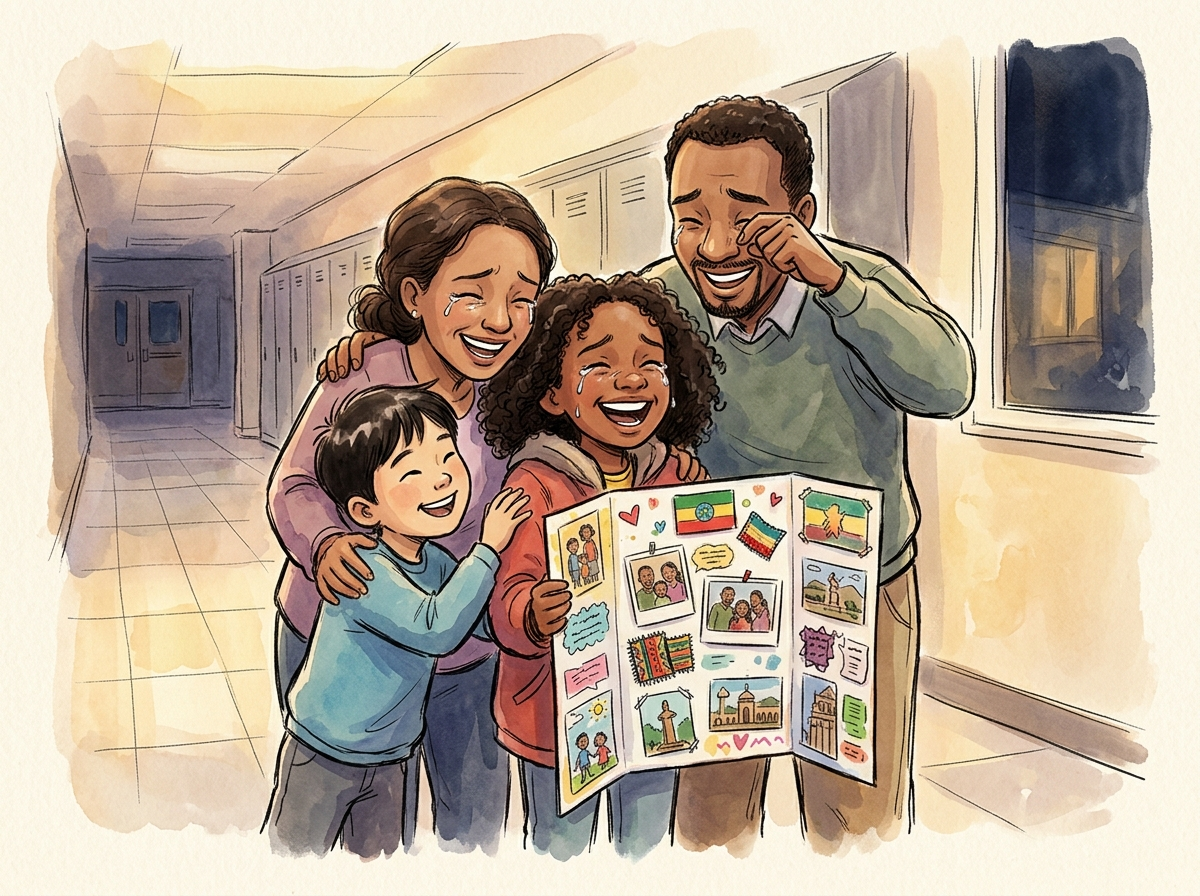
That night, her parents came for the hallway exhibition. Dad read her board three times. Mom made it through once before she started crying, which made Dad cry, which made Jem cry even though he didn't know why, which made Yara laugh, which made everyone laugh.
They stood there in the school hallway, this family assembled from different corners of the world, laughing and crying at the same time, and Yara thought that if anyone asked her right then—Where are you really from?—she would say:
Right here. I'm from right here.