Day of the Dead Marigolds
Fable
Ages 6–8 · 10 min
To honor a great-grandmother she has never met, Lupita must plant a bag of marigold seeds in the garden for her family's Day of the Dead ofrenda.
Lupita pressed her nose against the kitchen window and watched Abuelita carry a big cardboard box across the backyard. It was the last day of October, and the air smelled like cinnamon and something sweet baking in the oven.
"Abuelita, what's in the box?" Lupita called, pushing open the back door.
Lupita pressed her nose against the kitchen window and watched Abuelita carry a big cardboard box across the backyard. It was the last day of October, and the air smelled like cinnamon and something sweet baking in the oven.
"Abuelita, what's in the box?" Lupita called, pushing open the back door.
Her grandmother set the box down on the patio table and wiped her forehead. "Come see, mija."
Lupita peered inside. There were candles, a wooden picture frame, a small clay bowl, and — tucked in the corner — a paper bag full of something bright orange.
"Marigold seeds," said Abuelita, holding up the bag. "For the ofrenda. Tomorrow is Día de los Muertos."
Lupita knew about Día de los Muertos. Every year, her family built a beautiful altar in the living room with photos and food and flowers to remember people who had passed away. She loved the sugar skulls and the pan de muerto and the way the whole house glowed with candlelight.
But this year, Abuelita had something different in mind.
"This year," Abuelita said, "I want to add someone special to our ofrenda. My grandmother — your bisabuelita. Her name was Rosalinda."
Lupita tilted her head. "I don't think I know about her."
"No," said Abuelita softly. "I haven't talked about her enough. That's my fault." She pulled out the wooden picture frame and turned it over. Inside was a small black-and-white photograph of a woman with dark braided hair and a wide, wide smile. She was standing in what looked like a garden — an enormous garden — with flowers reaching up past her waist.
"She looks happy," said Lupita.
"She was the happiest person I ever knew," said Abuelita. "And I thought, this year, maybe you could help me plant her marigolds."
Lupita had never planted anything before. But she liked the idea of doing something for someone in her family, even someone she'd never met.
"Okay," she said. "Show me how."
They knelt together in the garden bed beside the fence, where the afternoon sun made the dirt warm under Lupita's knees. Abuelita showed her how to poke a little hole in the soil with her finger, drop in a seed, and cover it gently — like tucking it into bed.
"Bisabuelita Rosalinda taught me to plant just like this," said Abuelita. "She said you have to be gentle with seeds because they're sleeping, and you don't want to wake them up too fast."
Lupita giggled. "Seeds don't sleep, Abuelita."
"That's what I told her! And she said, 'Then why are they so quiet?'"
Lupita laughed harder and dropped another seed into the earth. "Was she funny like that all the time?"
"All the time," said Abuelita. "She could make anyone laugh. Even the mail carrier. Even the grumpy man at the market who never smiled at anybody. She'd say one little thing, and suddenly — pfft — he'd be laughing into his apron."
Lupita patted the soil over her seed and imagined this woman, this Rosalinda, making a grumpy man laugh so hard he had to hide his face.
"What else?" Lupita asked.
Abuelita sat back on her heels and thought for a moment. "She was brave. Oh, Lupita, she was so brave. When she was young, she walked three miles to school every single day — across a creek and up a rocky hill — and she never once complained. And when she grew up, she moved to a whole new city where she didn't know anyone. She started her own garden in a tiny little yard no bigger than this one. People thought she was crazy. But by the end of the first year, her garden was the most beautiful one on the whole street."
Lupita looked at the photograph again, propped up against the cardboard box. The enormous garden. The flowers up to Rosalinda's waist.
"Is that the garden? In the picture?"
Abuelita nodded. "She grew everything. Tomatoes, peppers, herbs, sunflowers. But marigolds were her favorite. She called them little suns."
Lupita looked down at the row of tiny bumps in the soil where her seeds were hidden. "Little suns," she whispered.
They planted the whole bag. Lupita's fingernails were caked with dirt, and her knees had little pebble prints pressed into them, and she didn't care one bit.
As they worked, Abuelita kept talking. She told Lupita how Rosalinda used to sing while she cooked — loud and off-key, so the neighbors could hear through the walls. She told her how Rosalinda kept a journal full of little drawings of every plant she grew, with notes like "This one is stubborn but I love it anyway." She told her how Rosalinda once stayed up all night with a sick neighbor's baby so the neighbor could sleep.
"She sounds amazing," said Lupita quietly.
"She was," said Abuelita. "And you know what's funny? You remind me of her."
Lupita blinked. "I do?"
"The way you laugh — from your belly, like nothing in the world matters except whatever's funny right now. Rosalinda laughed exactly like that. And the way you notice things. Little things. Like how you always point out when the clouds look like animals, or when a ladybug lands on someone's shoe. Rosalinda was like that. She paid attention to the world."
Lupita felt something warm bloom in her chest, like a little sun of her own.
That evening, they built the ofrenda together. Lupita helped arrange the candles and set out plates of food — tamales and pan de muerto and a little dish of mango, because Abuelita said that was Rosalinda's favorite. They hung papel picado from the shelf, the tissue paper cutouts swaying whenever someone walked past.
And right in the center, Lupita placed the photograph of Bisabuelita Rosalinda in her garden, surrounded by the glow of three small candles.
"Do you think she can see it?" Lupita asked.
Abuelita put her arm around her. "I think she can. And I think she's very glad to finally meet you."
Lupita stared at the photograph for a long time — at the braided hair, the wide smile, the flowers reaching toward the sky. She didn't feel sad, exactly. She felt something stranger and softer than sad. She felt like she missed someone she had never known, and at the same time, like she had known them all along.
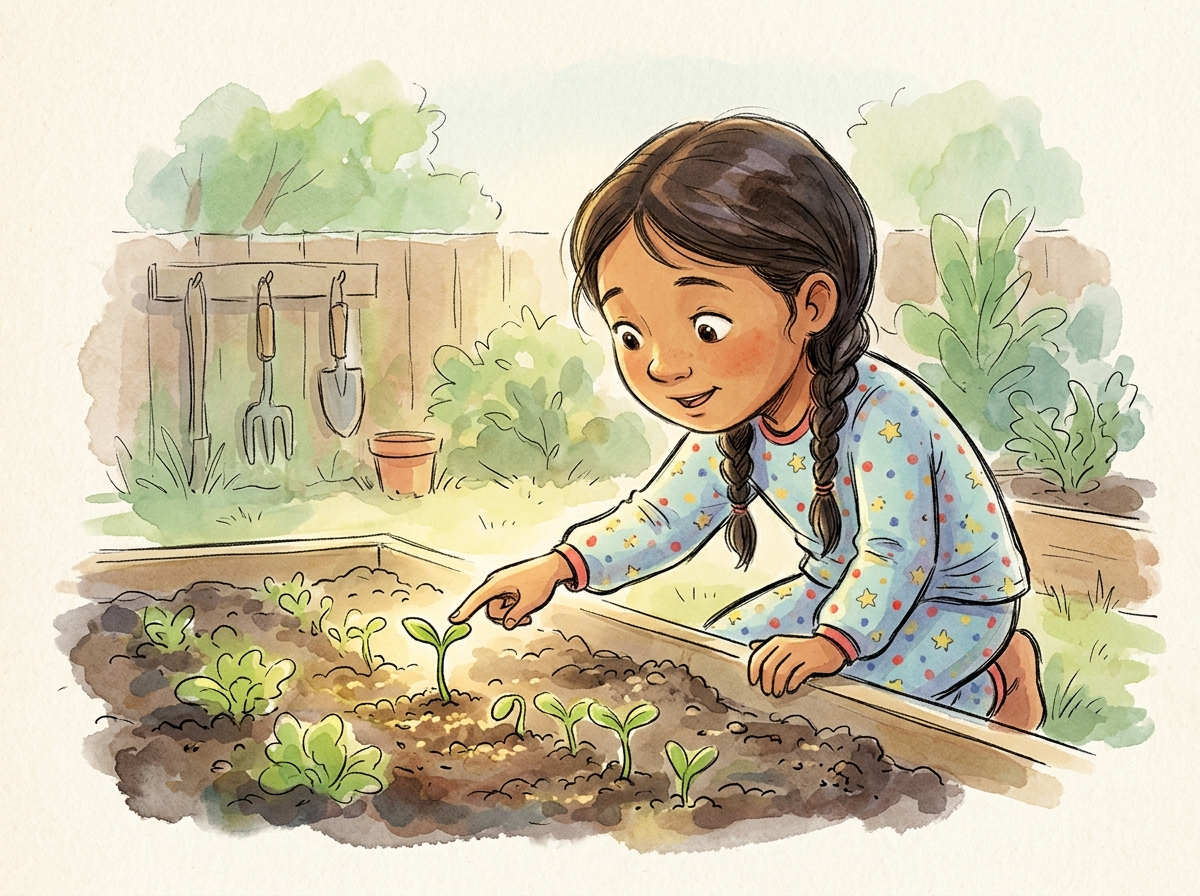
Three weeks later, on a bright Saturday morning, Lupita ran to the garden bed before she even ate breakfast.
Green. Little green sprouts, thin as threads, were poking up through the soil in a wobbly row.
"ABUELITA!" she shouted. "ABUELITA, COME LOOK!"
Abuelita came out in her bathrobe, holding her coffee, and when she saw the sprouts, she pressed her hand to her heart.
"There they are," she said softly. "Little suns."
Lupita knelt down carefully, the way Abuelita had shown her, and looked at the tiny green shoots reaching upward. They were so small. So quiet. But they were alive, and they were growing, and they had come from seeds that Lupita had tucked into the earth with her own two hands.
She thought about Bisabuelita Rosalinda walking three miles to school and never complaining. She thought about her starting a garden in a tiny yard where nobody believed anything would grow. She thought about her singing off-key and making grumpy people laugh and drawing stubborn plants in a journal.
And she thought about how, even though Rosalinda was gone, here were her favorite flowers — coming up out of the ground on a bright Saturday morning, planted by a great-great-granddaughter she'd never met but maybe, somehow, already knew.
Lupita touched one of the sprouts very gently with her fingertip.
"Hi," she whispered. "I'm Lupita. I think you and I are going to be good friends."
The little green sprout swayed in the morning breeze, almost like it was nodding.
And somewhere, Lupita was sure of it, someone was laughing — from the belly — like nothing in the world mattered except whatever was wonderful right now.