What Happened to the Dinosaurs?
Fable
Ages 6–8 · 9 min
When her three-year-old brother Gus asks where the dinosaurs went, Della knows it is her moment to explain exactly what happened.
Della's little brother, Gus, was three years old and didn't know anything.
Well, that wasn't exactly true. He knew how to stack blocks. He knew how to make spaghetti fall on the floor. And he knew how to follow Della around the house asking "Why?" about every single thing, all day long, until she wanted to hide inside the coat closet.
Della's little brother, Gus, was three years old and didn't know anything.
Well, that wasn't exactly true. He knew how to stack blocks. He knew how to make spaghetti fall on the floor. And he knew how to follow Della around the house asking "Why?" about every single thing, all day long, until she wanted to hide inside the coat closet.
But today was different. Today, Gus had asked a good question.
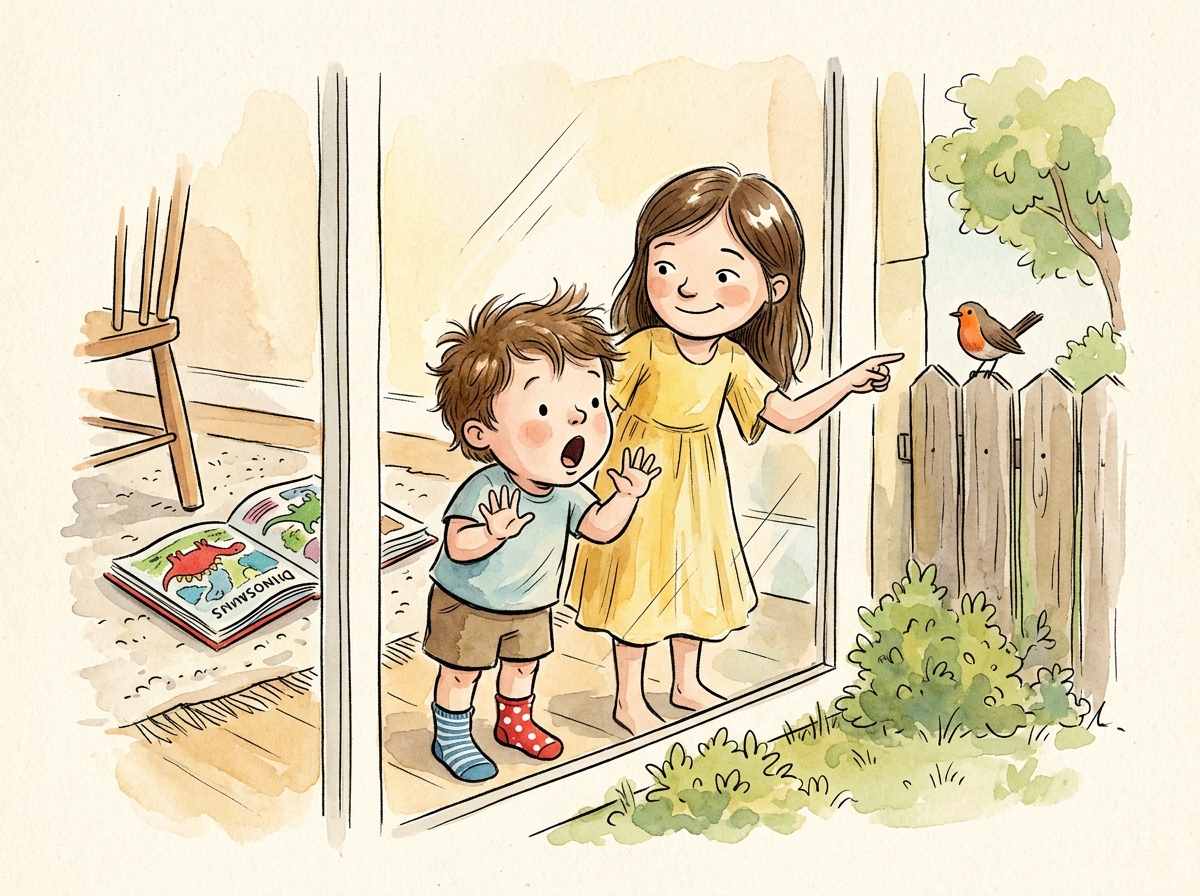
They were sitting on the living room rug with Gus's big book of dinosaurs open between them. Gus pointed at a picture of a Tyrannosaurus Rex — the page was a little bit sticky because Gus had touched it with syrup hands — and he said, "Della, where did the dinosaurs go?"
Della sat up very straight.
She had been waiting for this question her entire life.
"Well, Gus," she said, in her most important voice. "I know exactly what happened to the dinosaurs. So just sit there and listen, and don't interrupt, and definitely don't put that book in your mouth."
Gus took the book out of his mouth.
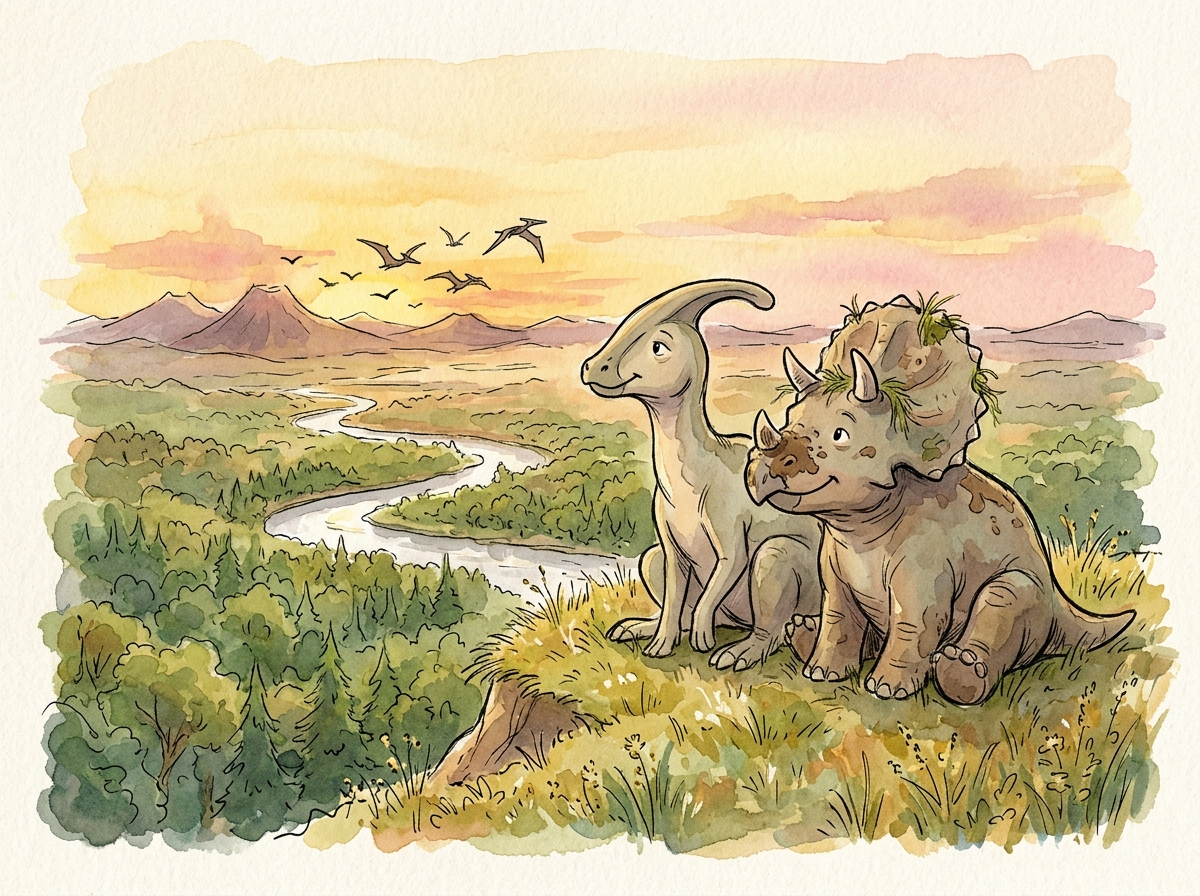
"Okay," said Della. "So. A long, long, long time ago — like, way before Grandma was born — the dinosaurs were everywhere. They were in the forests and the swamps and the rivers. Big ones, little ones, spiky ones, flying ones. The whole planet was just packed with dinosaurs."
"Packed," repeated Gus, because he liked that word.
"And the biggest, most important dinosaur of all," Della continued, "was the Tyrannosaurus Rex. She was in charge."
"She?"
"Yes, she. The T. Rex was a girl, and she was in charge of all the other dinosaurs. She told them where to walk and what to eat and when it was time for bed."
Gus's eyes got very wide. "Like Mama?"
Della thought about this. "Yes. Exactly like Mama. But with bigger teeth."
She turned the page. There was a Triceratops, a Stegosaurus, and a long-necked Brachiosaurus that took up two whole pages because it was so tall.
"So one day," Della said, "a giant, ENORMOUS rock came flying through space."
"A rock?"
"A rock. A space rock. It was called an asteroid, and it was as big as…" Della looked around the room. "As big as this whole house. No — as big as the school. No — even BIGGER. It was as big as a mountain!"
Gus gasped.
"And it was heading straight for Earth," Della whispered. "And it was going really, really fast."
Gus grabbed Della's arm. "Did the dinosaurs see it?"
"Some of them did. The Brachiosaurus — the one with the really long neck — she looked up and said, 'Hey, everybody! There's a giant rock coming!'"
"And then what?"
"Well, the T. Rex said, 'Nobody panic. I'm in charge, and I'll figure this out.' And the Triceratops said, 'Maybe we should move.' And the Stegosaurus said — well, the Stegosaurus didn't say much because her brain was very small. But she looked worried."
Gus nodded seriously.
"So the T. Rex tried to think of a plan. She said, 'What if we all blow on it? Like birthday candles? Maybe we can blow the rock away.' So all the dinosaurs took a deep breath and blew as hard as they could."
Della puffed out her cheeks and blew. Gus puffed out his cheeks and blew too, even though there was no asteroid in the living room.
"But it didn't work," said Della. "The rock was too big and too far away. You can't blow away a mountain, Gus."
"Oh," said Gus sadly.
"Then the Triceratops said, 'What if we hide under the trees?' And the T. Rex said, 'The trees aren't big enough.' And the Pterodactyl — that's the flying one — said, 'What if I fly up there and push it?' And the T. Rex said, 'Your arms are too small.' And the Pterodactyl said, 'YOUR arms are too small!' And the T. Rex got very quiet, because that was a sore subject."
Gus laughed — a big, hiccuppy laugh.
"So they argued for a while," Della said. "And while they were arguing, the rock got closer. And closer. And closer."
Della leaned in.
"And then — BOOM."
Gus jumped.
"The rock hit the Earth, and there was dust and fire and the sky went dark. Not nighttime dark. Darker than that. Like someone put a blanket over the whole world. And it got cold. And the plants stopped growing. And there was nothing left to eat."
The living room was very quiet.
Gus looked down at the book. He touched the picture of the T. Rex very gently with one finger.
"Did the dinosaurs… die?" he asked in a tiny voice.
Della paused. She looked at her little brother's face. His bottom lip was doing that thing where it stuck out a little.
"Well," she said slowly. "The big dinosaurs — the T. Rex and the Triceratops and the Brachiosaurus and all of them — they couldn't make it. It was too cold and too dark and there wasn't enough food. They tried really hard. The T. Rex tried the hardest, because she was in charge. But sometimes even when you try your very hardest, you can't stop what's coming."
Gus blinked.
"BUT," said Della, holding up one finger, "here's the part nobody tells you."
Gus leaned in.
"Some of the little dinosaurs — the really small, feathery ones — they were tough. They found seeds and bugs to eat. They huddled together to stay warm. And they kept going. And over a long, long, long time — longer than you can even imagine — those little feathery dinosaurs changed. They got smaller. They grew better feathers. They learned to fly higher and sing songs."
Della pointed out the window to the backyard, where a robin was sitting on the fence.
"You see that bird right there?"
Gus looked.
"That," said Della, "is a dinosaur."
Gus's mouth fell open.
"All birds are dinosaurs, Gus. Every single one. The chickens at the farm. The pigeons at the park. Even the weird ones at the zoo that stand on one leg. They're all dinosaurs that kept going."
Gus scrambled to the window and pressed his face against the glass. The robin hopped along the fence and then flew away.
"It flied!" Gus yelled. "The dinosaur flied!"
"Flew," said Della. "The dinosaur flew."
"FLEW!" shouted Gus.
He ran back to the book, flipped through the pages, and pointed at every dinosaur. "This one turned into a bird? This one? What about this one?"
"Not all of them," said Della. "Just the little feathery ones. The ones who didn't give up."
Gus sat back on the rug and was quiet for a moment. Della could tell he was thinking, because his forehead got all scrunchy.
"Della?" he said.
"What?"
"If I was a dinosaur, I would be a little one."
Della looked at her little brother — three years old, syrup on his fingers, his socks not matching, his eyes big and serious.
"Yeah, Gus," she said. "You would be."
And then she turned the page so they could keep reading, because there were still forty-seven more dinosaurs to talk about, and Della had strong opinions about every single one.