What Does the Moon Do All Day?
Fable
Ages 6–8 · 9 min
While the world praises the Sun, the Moon begins its secret work of pulling the ocean tides and wonders if anyone will ever notice.
Everybody talks about the Sun.
"Good morning, Sun!" the roosters crow.
Everybody talks about the Sun.
"Good morning, Sun!" the roosters crow.
"Beautiful day!" the flowers say, stretching their petals wide.
"Thank you for the sunshine!" the children shout, running barefoot through the sprinklers.
The Sun gets paintings and poems and songs. The Sun gets sunglasses named after it. The Sun gets a whole screen on the weather report.
And the Moon?
The Moon gets "Goodnight."
That's it. Just... goodnight.
Now, the Moon didn't complain about this. Not out loud, anyway. But one Tuesday morning, after everyone had gone to sleep and the stars had dimmed and the sky turned that soft pinkish-blue color it gets right before dawn, the Moon sat on the edge of a cloud and thought:
Does anyone even wonder what I do all day?
Because the Moon did not just disappear. The Moon did not crawl into a hole. The Moon did not sleep in a drawer like a pair of socks.
The Moon had a whole entire day.
First thing every morning, while the world was waking up and putting on shoes and burning toast, the Moon floated over to the ocean.
"Morning, Moon!" said the ocean, because the ocean always remembered.
"Morning, Ocean," said the Moon. "Ready?"
And together they practiced the tides. The Moon would pull gently, and the water would swell and stretch toward the shore. Then the Moon would ease back, and the water would slide away again, leaving little gifts on the sand — shells and sea glass and one very confused crab named Leonard.
"A little to the left today," Leonard grumbled, adjusting his shell.
"Sorry, Leonard," said the Moon.
This took a lot of concentration. If the Moon pulled too hard — WHOOSH — the waves would splash right over the boardwalk and into Mrs. Finnegan's fish shop. If the Moon didn't pull enough, the tide pools would dry up, and the little starfish would get very cranky.
So the Moon had to get it exactly right. Every single day.
Nobody saw this part.
After the tides were set, the Moon liked to visit the animals who were just waking up.
There was a baby owl named Pip who had stayed up all night for the very first time and was now absolutely exhausted but too excited to sleep.
"Moon! Moon! I caught a moth! Well, almost. It got away. But I ALMOST caught it!"
"That's wonderful, Pip," the Moon said softly. "You should rest now."
"But I'm not even tired!" said Pip, whose eyes were already half-closed.
The Moon hummed a low, gentle hum — not a song exactly, more like the feeling of a song — and Pip's little head tucked under his wing.
"Goodnight, Pip," the Moon whispered.
"It's morning," Pip mumbled.
"I know," said the Moon. "But goodnight anyway."
By midday, when the Sun was showing off — blazing and beaming, making everyone squint — the Moon was doing the quiet work.
The Moon checked on the bats in the barn, hanging upside down in their cozy rows like little furry umbrellas. The Moon made sure the fireflies had enough rest for tonight's show. The Moon reminded the crickets to tune their legs.
"Do-re-mi," sang the crickets, rubbing their tiny knees together.
"Lovely," said the Moon. "Maybe a little less screechy on the high notes."
The crickets tried again. Better.
Then the Moon floated over the forest and found a fox curled up in her den with four tiny kits.
"How are they?" the Moon asked.
The fox yawned. "This one won't stop wiggling." She nudged the smallest kit with her nose. "He thinks nighttime is for playing."
"Well," said the Moon, smiling, "he's not entirely wrong."
In the afternoon, the Moon did something very important that absolutely nobody knew about.
The Moon practiced its shapes.
Because here's the thing — the Moon didn't always look the same. Sometimes the Moon was full and round, bright as a silver coin. Sometimes the Moon was just a tiny sliver, thin as a fingernail clipping. Sometimes the Moon was half-and-half, like someone had drawn a line right down the middle.
And that didn't just happen.
The Moon had to plan it. Every night's shape had to be just right, changing little by little, night after night, in a perfect, patient pattern.
The Moon would hold up different curves to the light and check them carefully.
"Too round for tonight... too skinny... ah, this one."
It was like picking out exactly the right outfit, except the outfit was your whole entire self.
Some nights the Moon picked the big, bright full shape — the one that made wolves tip their heads back and howl, the one that made shadows on bedroom walls look like dancing elephants.
Some nights the Moon chose the thinnest crescent — just a whisper of light, a little wink in the dark, as if to say, I'm still here, even when you can barely see me.
Late in the afternoon, the Moon did one more thing.
The Moon visited children.
Not all of them. Just the ones who happened to look up.
Because if you've ever glanced at the sky during the day — maybe on your way to school, maybe while swinging really high on the swings — you might have seen something surprising.
The Moon. Right there. In the daytime. Pale and white and quiet against the blue.
Most people walked right past.
But some kids — the noticers, the wonderers, the ones who looked up instead of down — would stop. And point. And say:
"Hey... is that the Moon?"
And the Moon would feel a warm glow spread from the inside out, like a hug made of starlight.
Yes, the Moon thought. It's me. I've been here the whole time.
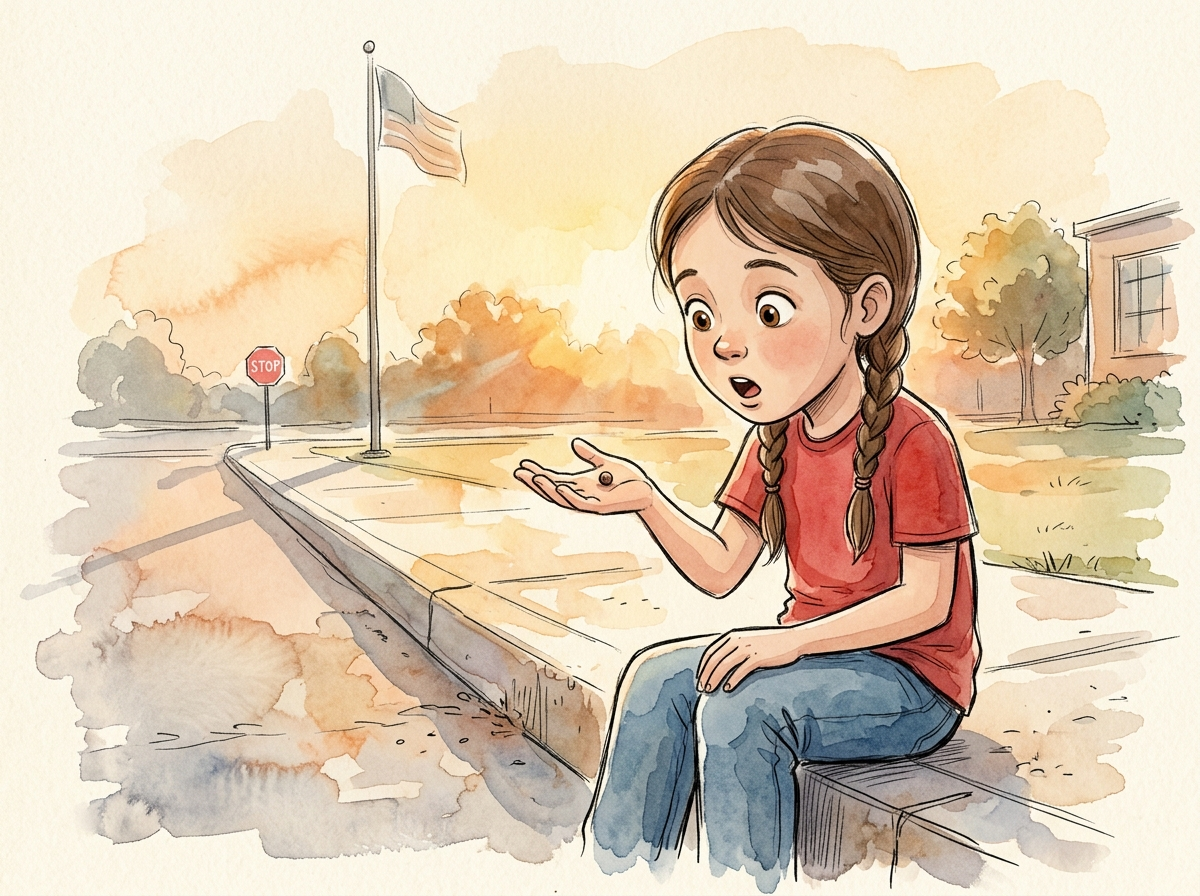
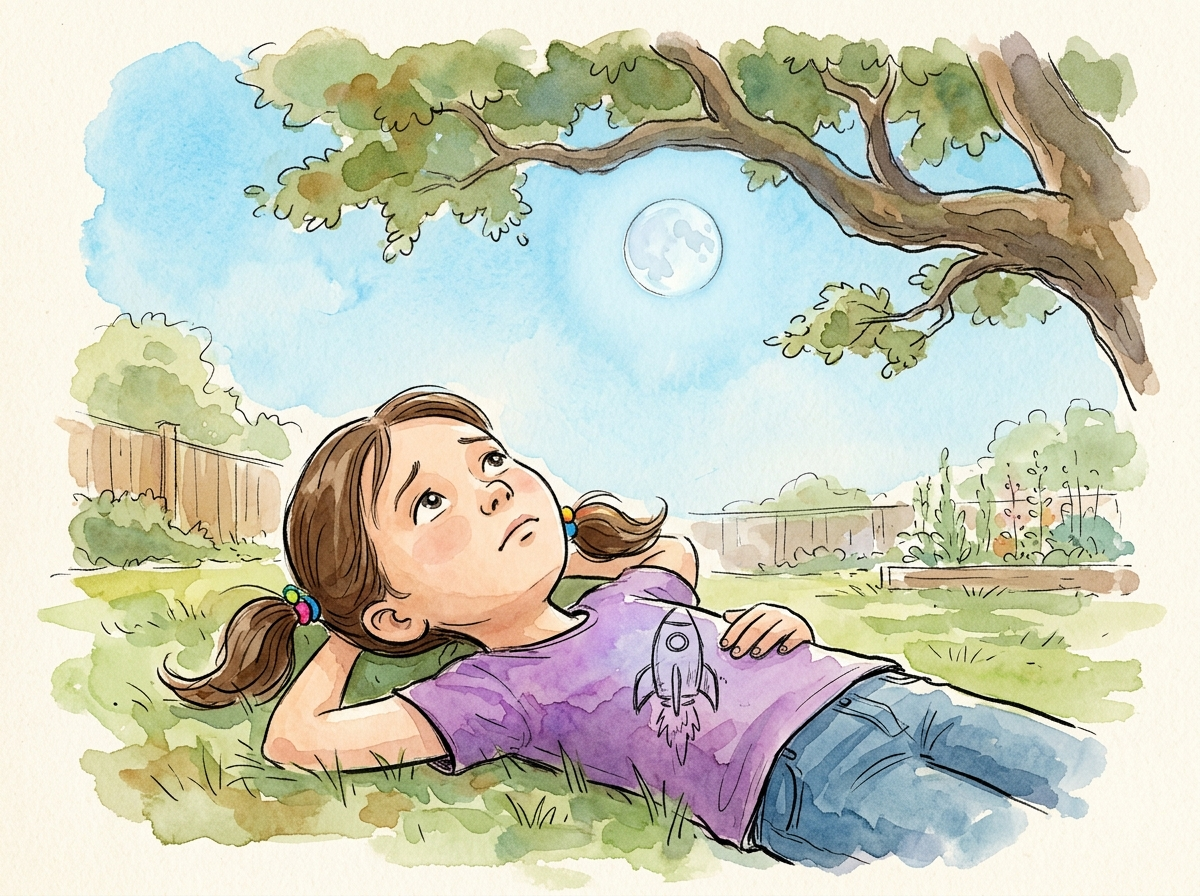
One Tuesday afternoon, a girl named Maya was lying in the grass in her backyard, looking up. She'd had a hard day. Her best friend had played with someone else at recess. Her shoelace had broken. She'd gotten yogurt on her favorite shirt — the purple one with the rocket ship.
And there, right above the old oak tree, was the Moon. Faint and pale and lovely in the afternoon sky.
Maya stared at it for a long time.
"Hey, Moon?" she said quietly. "What do you do all day?"
The Moon couldn't answer. Not in words, anyway. The Moon couldn't say, I move oceans and sing owls to sleep and tune crickets and pick out my shape for the night and watch over the world while everyone gives the Sun all the credit.
But the Moon did something else.
The Moon glowed. Just a tiny bit brighter. Just for a second.
And Maya smiled. She didn't know why, exactly. But she felt like someone was keeping her company. Someone who didn't need to be loud or bright or the center of attention. Someone who just showed up, day after day, doing their job, whether anyone noticed or not.
"Thanks, Moon," Maya said.
She went inside, changed her shirt, and called her best friend on the phone.
That evening, when the sky turned dusky and the Sun finally dipped below the horizon — dramatically, of course, with big splashes of orange and pink — the Moon rose up and took its place.
The stars came out. The crickets started their concert. Pip the owl woke up and immediately began hunting moths. The fox kits tumbled out of their den. The ocean swelled and sighed.
And the Moon shone.
Not because anyone asked. Not because anyone was watching. But because that's what the Moon did. Every night, and every day in between.
Somewhere below, Maya looked out her bedroom window and waved.
"Goodnight, Moon," she said.
And then she added something new:
"See you tomorrow."
The Moon glowed.