Three Grandparents
Fable
Ages 6–8 · 10 min
After his grandma remarries, Teddy has a new grandpa named Richard and a new great-grandma named Dolores, but he has absolutely no idea what to call them.
Teddy had a problem. Not a math problem or a lost-shoe problem or even a forgot-my-lunch-box problem. This was a bigger kind of problem — the kind that sat in his stomach like a butterscotch candy he'd swallowed whole.
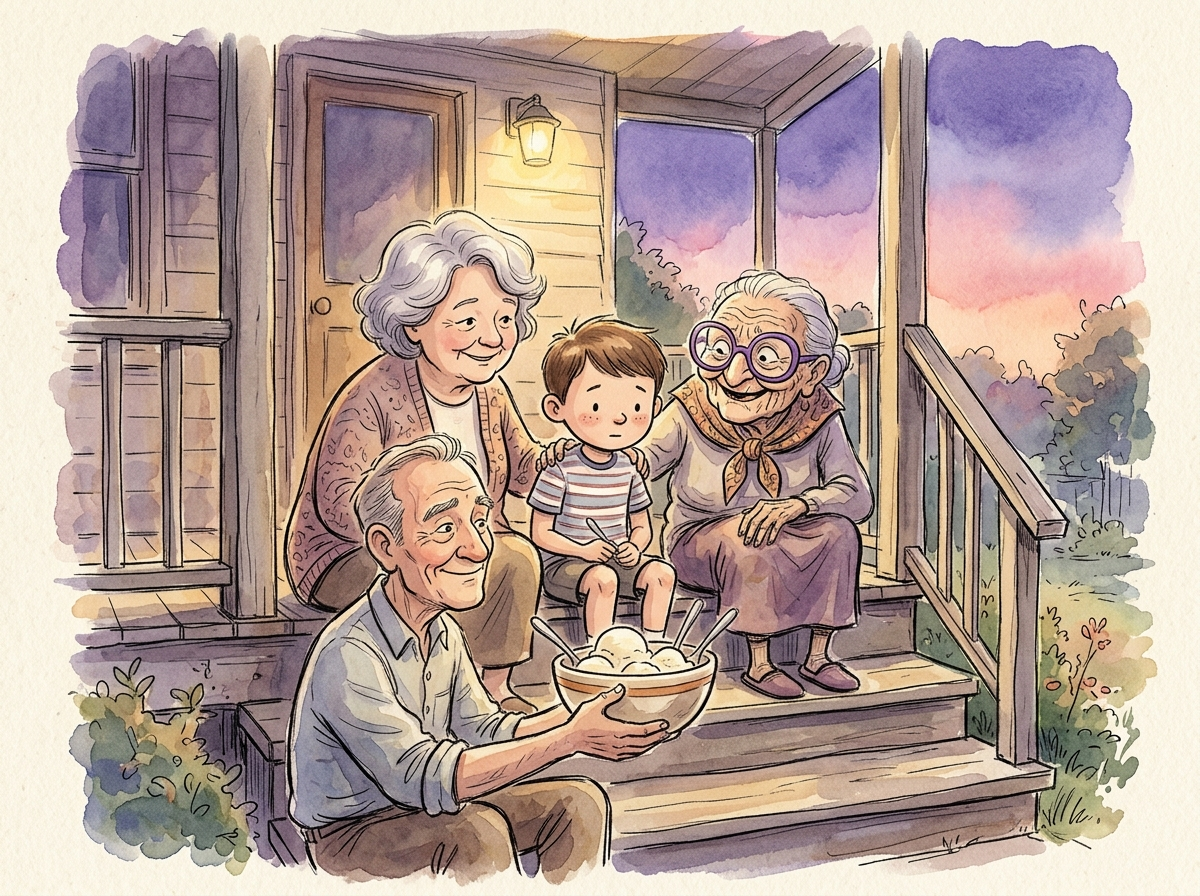
His dad's mom, Grandma June, had married someone new. His name was Richard. And Richard had a mom who was still alive, a very old lady named Dolores who wore purple glasses and smelled like peppermint.
Teddy had a problem. Not a math problem or a lost-shoe problem or even a forgot-my-lunch-box problem. This was a bigger kind of problem — the kind that sat in his stomach like a butterscotch candy he'd swallowed whole.
His dad's mom, Grandma June, had married someone new. His name was Richard. And Richard had a mom who was still alive, a very old lady named Dolores who wore purple glasses and smelled like peppermint.
So now, when Teddy went to visit his dad's side of the family, there weren't two grandparents anymore. There were three.
And Teddy had absolutely no idea what to call any of them.
It started at the wedding. Teddy had worn a clip-on tie and his shoes were too tight, and when Grandma June kissed Richard and everyone clapped, Teddy clapped too, because that seemed like the right thing to do.
Afterward, Richard knelt down and said, "Hey there, Teddy! I guess I'm your grandpa now, huh?"
Teddy's mouth opened. Nothing came out. He already had a grandpa — Grandpa Walt, who lived in Florida and sent him birthday cards with five-dollar bills taped inside. Was Richard his grandpa too? Could a person just have two grandpas? Was there a limit?
"You can call me whatever you like," Richard said, smiling.
That didn't help at all. Teddy could think of a million things to call him. Richard. Mr. Richard. Sir. Hey. Um. None of them sounded right.
Then the very old lady with the purple glasses shuffled over. She pinched Teddy's cheek — actually pinched it — and said, "Ohhh, so THIS is the little one! I'm Dolores, sweetheart. Richard's mother. I suppose that makes me your great-grandmother!"
Teddy looked up at her. She was very short and very wrinkled and her purple glasses were enormous.
Great-grandmother?
He already had two great-grandmothers. One was in heaven and one was in Wisconsin, which his mom said was practically the same distance.
Now there were three grandparents on this side alone, and Teddy didn't know what to call a single one of them.
The first visit to Grandma June and Richard's new house was a disaster.
Not a real disaster — nobody got hurt and nothing caught fire. But Teddy spent the whole afternoon dodging conversations like a spy in a movie.
When he needed the bathroom, instead of asking, he just wandered around opening doors until he found it.
When Richard offered him lemonade, Teddy said "Yes please" very quickly without calling him anything, then scurried away.
And when Dolores — who was visiting too, sitting in a big green armchair like a tiny queen on a throne — asked Teddy to come tell her about school, Teddy pretended he didn't hear.
He wasn't trying to be rude. His stomach just squeezed every time he had to talk to one of them, because every sentence felt like a trap. Like there was a blank space where a name should go, and he didn't know how to fill it.
"Could you ask _ to pass the rolls?"
"Thank you, _."
"I love you, _."
Blank. Blank. Blank.
At dinner, Teddy sat between his dad and Grandma June. Richard sat across from him, and Dolores sat at the head of the table, her purple glasses reflecting the candles.
"Teddy," said his dad, "would you ask Richard to pass the salad?"
There it was. The trap.
Teddy froze. His ears went hot.
"Could you... could you pass the salad... please?" he said to the air somewhere between Richard and the salt shaker.
Richard passed it. "Here you go, buddy," he said cheerfully.
Teddy stared at his plate. The butterscotch feeling was back.
After dinner, Teddy sat on the porch steps. The sky was turning purple — almost exactly the color of Dolores's glasses. He pulled at a loose thread on his sock and tried to figure things out.
The screen door creaked, and Grandma June sat down beside him. She didn't say anything at first. She just sat. Grandma June was good at just sitting.
"I don't know what to call them," Teddy said finally, very quietly.
Grandma June nodded, like this was a perfectly reasonable thing to say. "Hmm," she said. "That is a tricky one."
"If I call Richard 'Grandpa,' is that weird? Because of Grandpa Walt?"
"Does it feel weird?" Grandma June asked.
"Yes. But calling him 'Richard' also feels weird. That's what grown-ups call him. And calling him nothing feels the MOST weird because then I just stand there like—" Teddy made a frozen face, his mouth open and his eyes wide.
Grandma June laughed. Not a making-fun laugh, but a warm one. "You know," she said, "when I was little, I had an aunt who married a man named Frederick. I didn't know what to call him either. So I called him 'Uncle French Fry.'"
Teddy stared at her. "You did NOT."
"I absolutely did. For eleven years. He loved it."
Teddy laughed — a real laugh, the kind that pops out before you can stop it.
The screen door creaked again. This time it was Dolores, moving slowly, holding a cup of tea that rattled against its saucer. She lowered herself onto the step on Teddy's other side, which took a while.
"What's so funny?" she asked.
"Uncle French Fry," said Teddy.
"I beg your pardon?"
Grandma June explained, and Dolores let out a hoot so loud that Teddy jumped.
"Oh, that's WONDERFUL!" Dolores said. "You know, my grandchildren call me Lola. Because when my first grandbaby tried to say 'Dolores,' it came out 'Lola,' and it stuck like glue."
"Lola," Teddy repeated. It was easy to say. It was fun to say, actually. Like a little song. Lo-la.
"You can call me that too, if you want," Dolores said. She adjusted her purple glasses. "Or you can call me Dolores. Or 'Hey You.' Or 'Your Majesty.'" She winked. "I answer to all of them."
Teddy smiled. The butterscotch feeling in his stomach was getting smaller.
The screen door creaked a third time, and Richard came out holding a bowl of ice cream with three spoons. "Room for one more?" he asked.
He sat on the step below them and held up the bowl. Teddy took a spoon.
For a minute, they all just ate ice cream and watched the purple sky get darker.
"I don't know what to call you," Teddy told Richard. It came out easier this time, like the words had been practicing.
Richard nodded slowly. "You know what my granddaughter calls me?"
"What?"
"Pop-Pop."
Teddy considered this. "I could try that," he said carefully. "Or... what about just Pop?"
Richard's eyes crinkled. "Pop," he said, like he was tasting the word. "I like that. I like that a LOT, actually."
"Okay," said Teddy. "Pop."
"And I'm Lola," said Dolores.
"And I'm still Grandma June," said Grandma June. "Just so we're clear."
"Grandma June, Pop, and Lola," said Teddy, and something clicked into place — like when you finally find the right puzzle piece and it just fits. Three names. Three people. Three grandparents.
Not too many. Just right.
The next morning, Teddy came downstairs and found all three of them in the kitchen. Grandma June was making pancakes. Richard — Pop — was squeezing oranges. And Lola was sitting at the table in her purple glasses, doing the crossword puzzle in pen, because she said pencils were for cowards.
"Good morning, Grandma June," said Teddy.
"Morning, sunshine."
"Good morning, Pop."
Richard beamed so big that Teddy thought his face might actually crack open. "Good morning, Teddy!"
"Good morning, Lola."
"Good morning, Your Majesty," Dolores corrected, peering over her glasses.
Teddy laughed.
And the butterscotch feeling was completely, entirely, absolutely gone.