The Understudy Menorah
Fable
Ages 6–8 · 8 min
Six days before Hanukkah, Mira accidentally breaks her family's silver menorah on the kitchen floor.
Mira found the menorah in pieces on the kitchen floor.
It was a Tuesday afternoon, six days before Hanukkah, and she had been reaching for the crackers on the second shelf when her elbow bumped the cabinet door, which bumped the counter, which sent the beautiful silver menorah sliding right off the edge.
Mira found the menorah in pieces on the kitchen floor.
It was a Tuesday afternoon, six days before Hanukkah, and she had been reaching for the crackers on the second shelf when her elbow bumped the cabinet door, which bumped the counter, which sent the beautiful silver menorah sliding right off the edge.
Crash.
The menorah lay in three pieces on the tile. One of the branches had snapped clean off, and the shamash — the tall helper candle holder in the middle — was bent sideways like it was trying to look around a corner.
"Oh no," Mira whispered. "Oh no, oh no, oh no."
This wasn't just any menorah. This was the menorah. The one Grandma Ruth had brought from her mother's house. The one that came out every single Hanukkah in its own special blue velvet bag. The one that made the whole living room glow like something from a painting.
Mira's mom came in when she heard the crash.
For a long moment, neither of them said anything. Mom picked up the pieces carefully and set them on the counter. She tried fitting the branch back on. It wobbled and fell off again.
"I'm sorry," Mira said, and her voice came out very small.
Mom took a deep breath. "It was an accident, sweetheart. We'll see if someone can fix it after the holiday. But for now..." She looked at the broken menorah and sighed. "We'll need to find another one."
The next day after school, Mira and Mom went to three different stores. The first store had sold out completely. The second store had one menorah left, but it was enormous and cost more than Mira's bicycle. The third store had menorahs, but they were electric — little plug-in ones with orange plastic bulbs instead of real flames.
"We could use that one," Mom said, not very convincingly.
Mira shook her head. It didn't feel right. Hanukkah was supposed to have real fire. Little dancing flames you could watch while you sang the blessings. A plug-in menorah was like a rubber duck trying to be a real duck. It looked like one, but something important was missing.
They drove home with no menorah at all.
That night, Mira couldn't sleep. She kept thinking about Hanukkah without the silver menorah. She kept thinking about Grandma Ruth, who always said, "The light is the important part, Mira-bell. Everything else is just furniture."
Mira sat up in bed.
The light is the important part.
She threw off her covers, turned on her desk lamp, and started looking around her room. She found a ball of clay from art class, a handful of birthday candles left over from her party in September, and a piece of wood she'd been saving from a broken bookshelf because it was shaped like a boat.
She brought everything to the kitchen table and sat down.
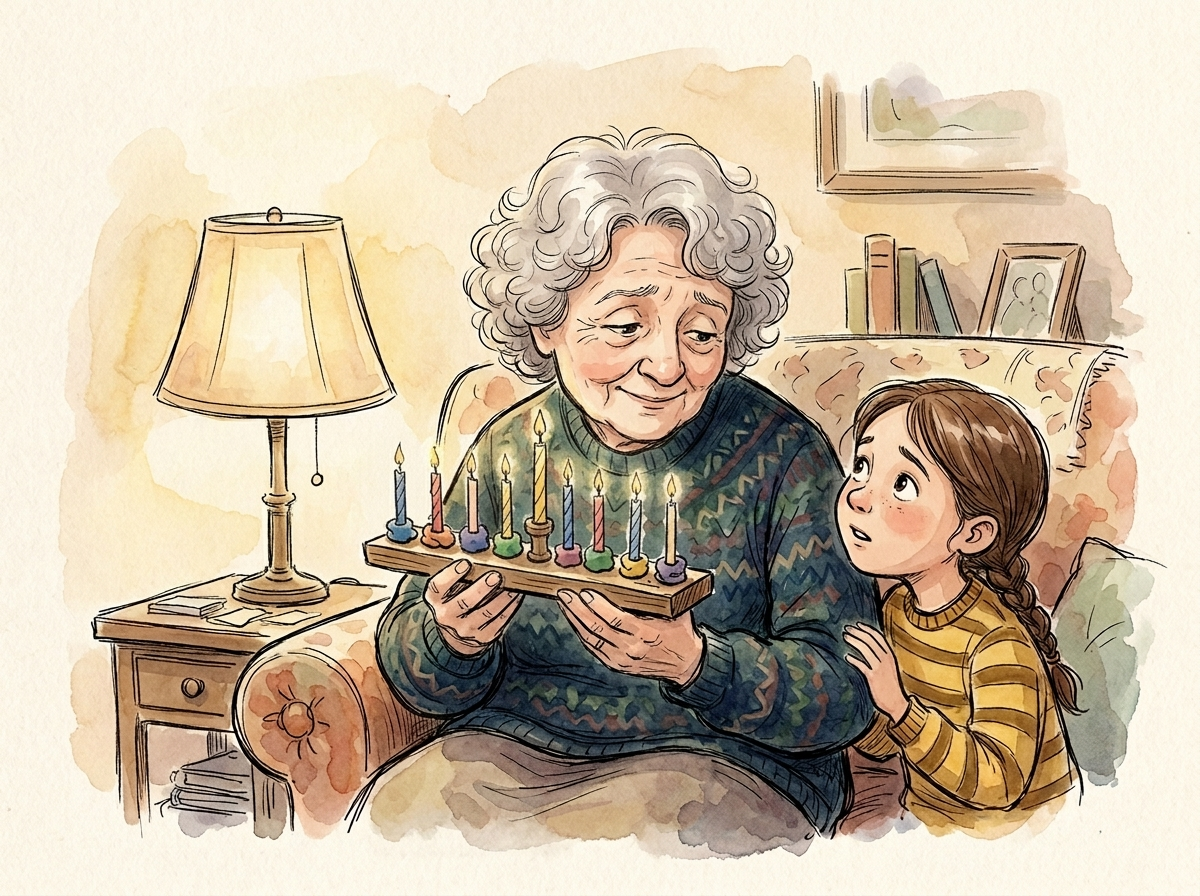
The piece of wood was flat on the bottom and about as long as her forearm. She poked nine little holes in a line of clay, then pressed the clay firmly onto the wood. She stuck a birthday candle in each hole. The candles were striped — pink and white and yellow — and they were all slightly different heights, which made the whole thing look like a row of children standing on tiptoe.
For the shamash in the middle, she stacked two pieces of clay to make it taller than the rest.
When she was done, she looked at it.
It was, without question, the ugliest menorah she had ever seen.
The wood was rough and still had a little sticker on the bottom that said "MADE IN CANADA." The clay was lumpy. The birthday candles leaned in different directions like they were each trying to have their own conversation. One of them was slightly chewed because Mira had accidentally put it in her mouth while she was thinking.
She almost threw the whole thing away.
But then she imagined the first night of Hanukkah with nothing at all — no candles, no flames, no blessings — and she left it right there on the table.
Mom found it in the morning.
"Mira," she said slowly. "Did you make this?"
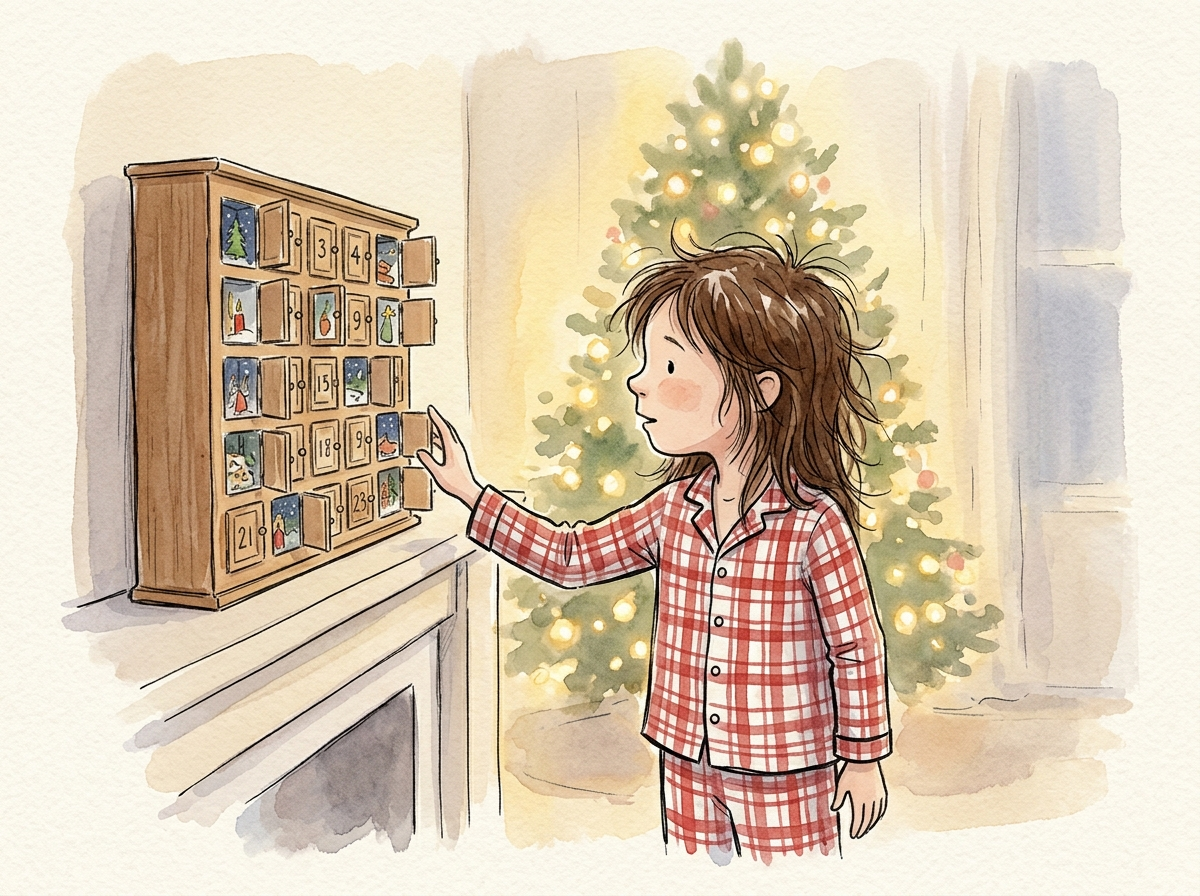
Mira came into the kitchen, still in her pajamas. "It's not very good."
Mom tilted her head and looked at it from different angles, the way she looked at paintings in museums. "It has nine candle holders. And the shamash is in the middle and taller than the rest."
"The candles are birthday candles," Mira said. "They'll probably burn down in about four minutes."
"Then we'll need more birthday candles," Mom said.
On the first night of Hanukkah, Mira set her homemade menorah in the window. Dad raised his eyebrows when he saw it, but he didn't say a word about the sticker or the lumpy clay or the chewed candle. He just stood next to Mom and Mira, and together they sang the blessing.
Mira lit the shamash. The little birthday candle caught immediately, burning bright and eager. She used it to light the first candle.
Two tiny flames danced in the window.
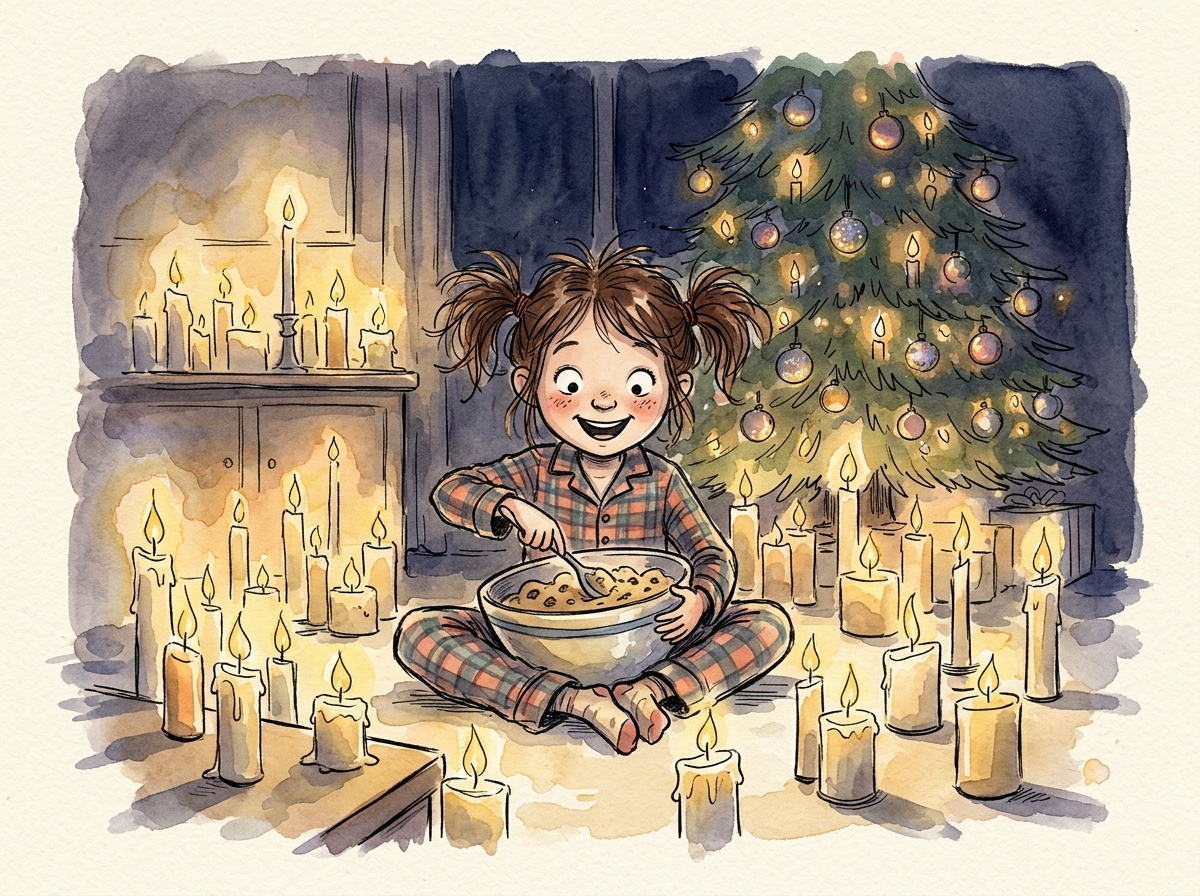
They burned fast — birthday candles always do — but for those few minutes, the room glowed. Not like a painting, maybe. More like a secret. A warm, small, flickery secret.
"Huh," said Dad. "That's actually really nice."
On the second night, Mira's older cousin David came over for latkes. When he saw the menorah, he burst out laughing.
"What is that?"
Mira's cheeks went hot. "It's a menorah."
"It looks like an art project that got lost," David said.
"It looks like Hanukkah," said Mom, in her voice that meant that's enough, David.
They lit three candles. David watched the little flames and got quiet. After a minute, he said, "The striped candles are actually kind of cool."
On the fourth night, Grandma Ruth came.
Mira had been nervous about this all week. She almost hid the homemade menorah and put out the electric plug-in one instead. But something stopped her.
Grandma Ruth walked in, hung up her coat, kissed everyone twice, and then spotted the menorah on the windowsill.
She went very still.
Mira held her breath.
Grandma Ruth picked it up and turned it over in her hands. She saw the lumpy clay. She saw the birthday candles, the rough wood, the little sticker. She ran her thumb along the edge of it.
"Mira-bell," she said. "Tell me about this."
So Mira told her everything. The elbow and the cabinet and the crash. The three stores. The night she couldn't sleep. The clay from art class and the birthday candles from September and the piece of wood shaped like a boat.
Grandma Ruth listened to every word. Then she set the menorah back on the windowsill, very gently, as if it were made of silver.
"You know," Grandma Ruth said, "my mother's menorah — the silver one — that wasn't her first menorah either. Her first menorah was made from a tin can and some bent nails. She made it when she was about your age, because her family didn't have one."
Mira stared. "Really?"
"Really. And she kept that tin-can menorah her whole life, right next to the silver one. She said it was the one that mattered most, because she made it when there was nothing else."
Grandma Ruth put her arm around Mira. "Should we light the candles?"
They sang the blessing together — Mom, Dad, Grandma Ruth, and Mira. Mira lit the shamash and touched it to each candle, one by one. Five little birthday candles and the shamash, all burning at once, striped and cheerful and leaning every which way.
The flames were small. They didn't last very long.
But while they burned, Mira watched them dance and flicker in the window, sending their glow out into the dark winter street. And standing there with her family around her, she thought that maybe this funny little menorah — with its chewed candle and its lopsided clay and its sticker that said MADE IN CANADA — was the most beautiful thing she'd ever made.
Not because it was pretty.
Because it was there.