The Tamale Morning
Fable
Ages 6–8 · 9 min
A cardboard rocket ship is waiting in the backyard for Catalina to paint its flames, but the whole family has been called into the kitchen for Tamale Day.
Catalina woke up to the sound of pots banging in the kitchen, which was not her favorite way to wake up on a Saturday.
She pulled her blanket over her head and groaned.
Catalina woke up to the sound of pots banging in the kitchen, which was not her favorite way to wake up on a Saturday.
She pulled her blanket over her head and groaned.
"Catalina! ¡Levántate!" Abuela's voice came sailing down the hallway like a bird that would not stop singing. "We start the masa in twenty minutes!"
Catalina knew exactly what that meant. It was Tamale Day.
Tamale Day happened every year before Christmas, and every year it was the same thing: everybody crowded into Abuela's tiny kitchen, corn husks soaking in every bowl and bucket they owned, and someone — usually Tío Luis — getting dried chile on his fingers and then rubbing his eye and yelling about it.
It took all day.
Catalina had plans. Actual plans. She was going to finish building her cardboard rocket ship in the backyard. She had already taped on the fins yesterday, and today she was going to paint the flames and add the cockpit window. She had been thinking about it all week.
She shuffled into the kitchen in her socks, her hair going in four different directions.
"Abuela, do I have to help? I have a really important project."
Abuela was standing at the counter, her apron already dusted with flour. She had her big blue pot out — the one so heavy that Papá had to lift it onto the stove.
"Mija, tamales are not a one-person job. They are not even a two-person job." Abuela held up a corn husk and waved it like a little flag. "Everybody helps. That is how it works."
"But —"
"You can do your project after."
"But it takes ALL DAY."
Abuela just smiled, which was her way of saying the conversation was over.
Catalina slumped into a chair at the kitchen table and rested her chin in her hands. Through the window, she could see her cardboard rocket sitting in the yard, waiting for her. The unpainted fins. The missing window. It was right there.
The front door opened with a bang, and in came Tío Luis carrying two grocery bags, followed by Catalina's older cousin Marco, who was fourteen and usually had headphones on. Today, even Marco didn't have headphones. Behind them came Tía Berta with a foil-covered tray, and Catalina's little brother Emilio, who was five and already had something sticky on his face.
"The team is here!" Tío Luis announced, dropping the bags on the counter. "Who's ready to make a thousand tamales?"
"It's not a thousand," Catalina muttered.
"It feels like a thousand," Marco said, and for one moment, Catalina and Marco agreed on something, which almost never happened.
Abuela started giving orders. She was short and round and her gray hair was pulled back in a bun, but when Tamale Day began, she became a general.
"Luis, you shred the pork. Berta, the red chile sauce — you remember how I showed you? Marco, you soak the husks. Catalina, come here. You help me with the masa."
Catalina dragged herself to the counter. Abuela pushed a giant metal bowl toward her, filled with soft corn dough that looked like a cloud made of sand.
"Mix," Abuela said. "Use your hands."
Catalina pushed her fingers into the masa. It was cool and squishy and kind of... actually kind of satisfying. Like the world's biggest stress ball. She squeezed a fistful and it oozed between her fingers.
"Now we add the lard," Abuela said, scooping in a big white blob. "And a little broth. And you keep mixing."
Catalina mixed. And mixed. Her arms started to get tired, which she mentioned three times.
"When I was your age," Abuela said, "I mixed the masa for my abuela. And I complained, too." She winked. "But I kept mixing."
The kitchen got louder. Tío Luis was telling a story about the time he accidentally made tamales with sugar instead of salt, and Tía Berta kept saying "That did NOT happen," and Tío Luis kept saying "It absolutely did." Papá arrived and started helping shred the pork, sneaking little bites when he thought nobody was looking, but everybody was looking.
"I saw that," Abuela said without turning around.
Mamá came in carrying extra foil and immediately started organizing the counter, because that was what Mamá did — she organized things.
Emilio was given the job of counting corn husks, which he was not very good at because he kept losing track and starting over. "One, two, three, five, ten, a hundred!"
"Close enough," said Marco.
Then came the spreading.
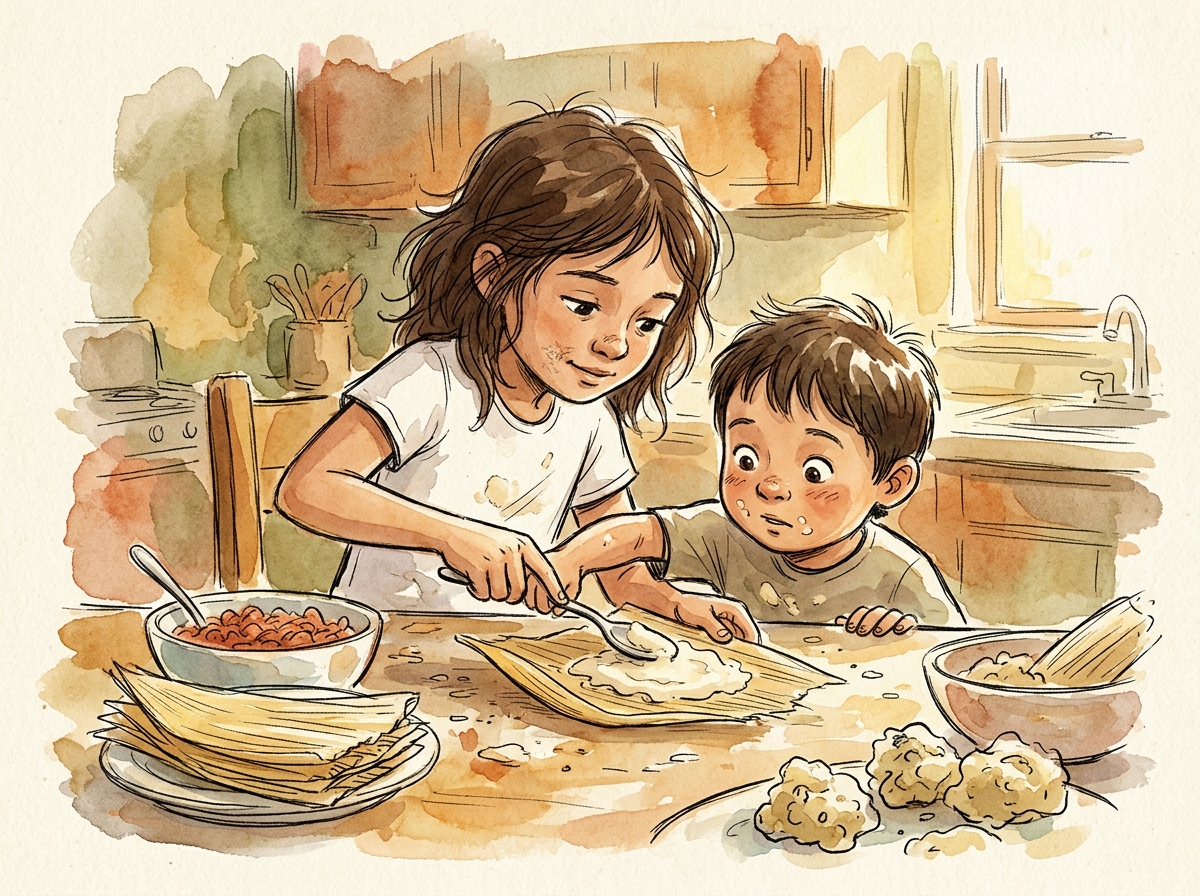
Everyone sat around the table, and Abuela showed them — like she did every year — how to lay out a corn husk, spread a thin layer of masa with the back of a spoon, add a little line of red pork filling down the center, and fold it up like a present.
Catalina's first one looked like a burrito that had been in a fight.
"Hmm," said Abuela, examining it. "It has personality."
"It looks like a sock," said Marco.
"YOUR face looks like a sock," Catalina said.
"Both of your faces are beautiful," said Mamá. "Keep spreading."
Catalina tried again. This time she used less masa and spread it more carefully, right to the edges but not over them, the way Abuela's hands did it — quick and smooth, like she was painting. The second tamale looked better. The third one looked almost good.
"Mira," Abuela said, holding up Catalina's fourth tamale. "Now you're getting it."
Something small and warm lit up in Catalina's chest.
She kept going. Spread, fill, fold. Spread, fill, fold. Her hands found a rhythm. Around the table, everyone was doing the same thing, and they were all talking and laughing and bumping elbows. Tío Luis got chile on his finger and then rubbed his eye.
"EVERY YEAR!" he shouted, stumbling to the sink.
"Every year," Abuela confirmed.
Emilio tried to make a tamale, but mostly he just smooshed masa on the table and then ate it. Catalina showed him how to spread it on the husk, guiding his little hand with hers.
"Like this, see? Not too thick."
Emilio's tamale looked like a lump, but he held it up with both hands like it was a trophy. "I MADE ONE!"
"You made one," Catalina said, and she meant it.
The tamales went into the big blue pot in layers, standing up like little soldiers. Abuela covered them with more husks and a damp towel and a heavy lid, and then she turned on the heat.
"Now," Abuela said, "we wait."
The kitchen was a disaster. There was masa on the counter, the floor, the chairs, and somehow on the ceiling — nobody could explain the ceiling. But the house smelled like corn and chile and something deep and warm that Catalina didn't have a word for.
She looked out the window at her rocket ship, still sitting in the yard. The afternoon sun was hitting it sideways, making the cardboard glow gold.
She could go work on it now while the tamales steamed.
She looked back at the kitchen, where Tío Luis was teaching Emilio a clapping game and Marco was actually laughing at something Tía Berta said, and Abuela was sitting in her chair with her eyes closed and a little smile on her face, resting her hands — hands that had made tamales for sixty years.
Catalina got a wet rag and started wiping down the table.
"I'll do the counter too," she said.
An hour and a half later, Abuela lifted the lid, and steam rose up like a cloud escaping. She pulled out the first tamale, unwrapped it slowly, and the whole family leaned in.
It was perfect. Soft and warm, the masa tender, the pork rich and red.
Everyone got one. They stood around the kitchen eating, not even bothering with plates, peeling back the husks and biting in.
Catalina ate hers in the backyard, sitting on the step next to her rocket ship. The tamale was still hot, and she had to blow on each bite. It tasted the way Abuela's kitchen smelled — like something that took all day and the whole family.
She looked at the rocket's unpainted fins.
"Tomorrow," she told it, and took another bite.