The Samosa Argument
Fable
Ages 6–8 · 9 min
A family-wide fight over whether Nani's samosas should be crispy or soft is the only thing standing in the way of cousin Zara's wedding.
Sana loved three things more than anything in the world: her grandmother's kitchen, her cousin Zara's laugh, and samosas.
Not just any samosas. Her Nani's samosas. The golden, perfectly spiced, potato-and-pea-filled triangles that made the whole house smell like a warm hug.
Sana loved three things more than anything in the world: her grandmother's kitchen, her cousin Zara's laugh, and samosas.
Not just any samosas. Her Nani's samosas. The golden, perfectly spiced, potato-and-pea-filled triangles that made the whole house smell like a warm hug.
And now, Cousin Zara was getting married.
This was the most exciting thing that had ever happened in Sana's entire life — which, to be fair, had only been seven years long, but still. There would be dancing and henna and flowers and fairy lights and hundreds of samosas for the wedding feast.
At least, that was the plan.
Until the argument started.
It began on a Sunday afternoon, in Nani's kitchen, where the whole family had gathered to plan the wedding menu.
"The samosas must be crispy," said Sana's dad, tapping the table like a judge with an invisible gavel. "Crunchy. Golden. When you bite in — crack! — like a firecracker."
"Absolutely not," said Auntie Ruba, Zara's mother, waving a wooden spoon. "Soft samosas. Tender pastry. That is the proper way. That is the way Ammi made them when I got married."
"Soft samosas?" Sana's dad looked like someone had told him the sky was green. "Ruba, with all respect, soft samosas are just — they're just sad little pillows."
"SAD LITTLE PILLOWS?" Auntie Ruba's voice went so high that the cat jumped off the windowsill.
Nani sat quietly in her chair, peeling potatoes, saying nothing.
Sana looked at Zara. Zara looked at Sana. They both looked at the ceiling.
"Here we go," Zara whispered.
By Monday, the argument had spread like spilled mango juice.
Uncle Faisal called from London to say that crispy was the only civilized option. Auntie Noor sent a voice message — eleven minutes long — about how soft samosas were a tradition and anyone who disagreed was basically insulting their ancestors.
Sana's older brother Hamza didn't care about samosas at all, but he picked crispy just to annoy Auntie Ruba, which Sana thought was very unhelpful.
By Tuesday, the family WhatsApp group had forty-seven unread messages. Someone had made a poll. The poll made things worse.
By Wednesday, Auntie Ruba called Sana's dad a "crunch-obsessed tyrant."
By Thursday, Sana's dad called Auntie Ruba "the Queen of Soggy Pastry."
By Friday, Auntie Ruba said maybe the families should just have separate wedding dinners.
Zara stopped laughing.
Sana noticed.
"What if there's no wedding?" Zara said quietly. They were sitting on Nani's back steps, watching the sun melt into the rooftops like butter in a hot pan.
"There has to be a wedding," Sana said. "You've already picked your outfit. It has sequins."
"But Mum and your dad aren't even talking. They're fighting over samosas, Sana. Samosas!" Zara put her chin on her knees. "I just wanted everyone to be together and happy. That's the whole point of a wedding."
Sana's stomach twisted — and not because she was hungry, though she was always a little bit hungry.
She had to do something.
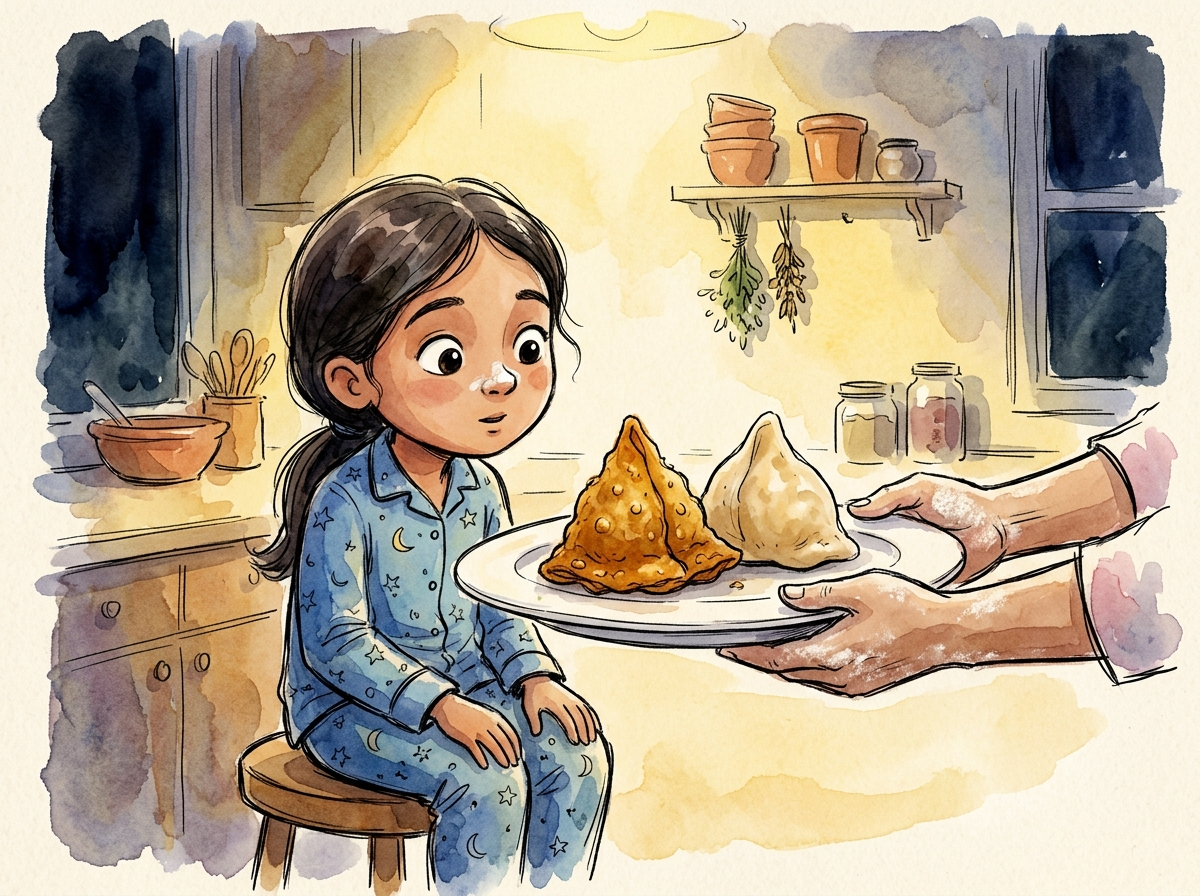
That night, Sana crept into Nani's kitchen. Nani was there, as she always was in the evenings, rolling dough under the pale yellow light.
"Nani," Sana said, climbing onto the stool beside her. "Whose samosas are better? Crispy or soft?"
Nani smiled — the kind of smile that had a secret tucked inside it, like filling inside pastry.
"Come," Nani said. "Help me cook."
She didn't answer the question. Instead, she handed Sana a small ball of dough.
"Roll it thin," Nani said, "and we'll fry it crispy."
Sana rolled and Nani fried, and out came a samosa that crackled and crunched, shattering into delicious golden flakes.
"Now," said Nani, handing her another ball of dough, "roll it a little thicker."
Sana rolled again. This time, Nani fried it for less time, and out came a samosa that was soft and pillowy, the pastry tender and warm, folding gently around the spiced filling like a blanket.
Nani put both samosas on a plate in front of Sana.
"Taste," she said.
Sana bit into the crispy one. Crack. Oh, it was wonderful. The crunch, the spice, the way the shell broke apart and mixed with the soft potato inside.
Then she bit into the soft one. Oh. It was like biting into a cloud that someone had filled with the most delicious thing in the world. Warm and comforting and perfect.
Sana chewed slowly.
"Nani... they're both good."
"Hmm," said Nani, and that secret smile came back.
"They're both really good."
"Same filling," Nani said, tapping Sana's nose with a floury finger. "Same spices. Same love. Same hands made them."
Sana looked at the two samosas on the plate. One crispy. One soft. Both delicious. Both Nani's.
And suddenly, she had an idea so brilliant it practically glowed.
The next morning was Saturday, and Sana called an emergency family meeting. She stood on a chair in Nani's living room — because when you are seven and everyone else is tall, you need a chair.
"I have something to say," Sana announced.
"Sana, beta, get down from the chair—" her dad started.
"No. I am TALKING."
The room went quiet. Even Auntie Ruba looked impressed.
"Zara is sad," Sana said. "She's worried the wedding won't happen because you're all fighting about samosas. And that's — that's just silly."
"Now wait a minute—" Uncle Faisal began from the phone screen propped on the bookshelf.
"Uncle Faisal, you are on mute," Sana said. He was not on mute, but he stopped talking anyway.
Sana took a big breath. "Last night, Nani made me both kinds. Crispy AND soft. And they were BOTH the best samosas I ever had. Because Nani made them. With the same hands and the same love."
She looked around the room.
"So why can't we have both at the wedding?"
Silence.
Auntie Ruba opened her mouth. Then closed it.
Sana's dad scratched his head.
"Both?" he said.
"Both," Sana said. "Crispy ones on one side of the table. Soft ones on the other side. And people can eat whichever ones they want. Or they can eat BOTH. Because that's what a family is. You don't all have to like the same thing. You just have to show up at the same table."
Then Nani, from her chair in the corner, started clapping. Soft, slow claps, with her floury hands, sending little white clouds into the air.
Zara started clapping too. Then Hamza. Then — one by one — everyone.
Auntie Ruba looked at Sana's dad. Sana's dad looked at Auntie Ruba.
"I... suppose both could work," Auntie Ruba said.
"I suppose soft samosas aren't... entirely terrible," Sana's dad admitted.
"THEY ARE DELICIOUS AND YOU KNOW IT," Auntie Ruba said, but she was smiling now, and Sana's dad was smiling too, and then they were both laughing, and then everyone was laughing, and Sana felt the twist in her stomach finally, finally unwind.
Three weeks later, Zara got married.
The fairy lights twinkled. The henna was beautiful. Zara's sequined outfit sparkled like a constellation. And the music played so loud that Sana could feel it in her teeth.
On one side of the long, long table sat tall golden towers of crispy samosas — crunchy and shattering and perfect.
On the other side sat warm, pillowy mountains of soft samosas — tender and comforting and perfect.
And in the middle — right where the two plates met — sat Sana, with one of each in her hands, taking enormous, happy bites.
Zara danced past, laughing her big wonderful laugh, and grabbed a soft one. Then a crispy one. Then another soft one.
"Best wedding ever?" Sana shouted over the music.
Zara grinned, her mouth full of samosa, sequins catching the light.
"Best wedding EVER."