The Red C
Fable
Ages 9–11 · 14 min
After making flashcards and studying all week, Brendan gets a big red C on his test that he knows isn't fair.
The C
Brendan had studied. He wanted to make that perfectly clear to anyone who would listen, including himself.
The C
Brendan had studied. He wanted to make that perfectly clear to anyone who would listen, including himself.
He had studied on Tuesday after soccer practice, with his textbook propped open against the kitchen table while his little sister, Maya, made a tower out of goldfish crackers beside him. He had studied on Wednesday night, lying on his bed with his notes spread across the comforter like a paper quilt. He had even studied Thursday morning before school, mouthing vocabulary words into the bathroom mirror while toothpaste foam collected at the corners of his lips.
So when Mrs. Huang walked down the rows on Friday afternoon, laying tests face-down on each desk with that calm, unreadable expression she always wore, Brendan wasn't nervous. Not even a little. He was ready.
He flipped his paper over.
And there it was.
A C.
Not a C-plus. Not even a C that looked like it was trying to crawl toward a B. Just a plain, ordinary, nothing-special C, circled in red ink at the top of the page.
Brendan stared at it. He stared at it the way you stare at a vending machine that just ate your dollar and gave you nothing back. He stared at it the way you stare at a sky that starts raining the exact second you step outside.
That can't be right.
He looked around the classroom. Devin Parker was pumping his fist under his desk — probably an A. Sofia Medina was already tucking her test neatly into her folder — no big deal, she always got A's. Behind him, Tyler Pratt was crumpling his test into a ball, which meant Tyler got a Tyler grade, and Tyler didn't care.
But Brendan cared.
Brendan had studied.
The walk home felt longer than usual. His backpack seemed heavier, like the test had gained actual weight in there, dragging against his shoulders. The autumn leaves crunched under his sneakers, and normally he loved that sound — that crispy, satisfying crackle — but today it just sounded like noise.
His mom was at the kitchen counter when he came in, chopping something that smelled like onions and garlic.
"How was your day?" she asked, not looking up. The normal question. The every-day question.
"Fine," Brendan said. The normal answer.
He went straight to his room, dropped his backpack on the floor, and lay on his bed staring at the ceiling. There was a small crack up there shaped like a river, and he followed it from one end to the other, thinking.
The thing was, he wasn't a kid who didn't try. That was what burned. Tyler Pratt didn't study, and Tyler got D's, and Tyler was fine with it because Tyler's whole deal was not caring. But Brendan wasn't Tyler. Brendan had sat at his very own desk, gone over every chapter, highlighted things in yellow and green, made flashcards — actual flashcards, with his own hands — and he had known the material. He had felt like he knew it.
So what happened?
He pulled the test out of his backpack and spread it on his desk like a detective examining evidence. He forced himself to look at every single question, even though each red X felt like a tiny bee sting.
Question 4: What were the three main causes of colonial expansion?
He had written two. He'd been so sure there were only two. But there, in Mrs. Huang's precise handwriting, was the note: Missing: economic competition between European powers.
Question 9: Explain the difference between a colony and a protectorate.
He had mixed them up. Completely. He'd defined a colony as a protectorate and a protectorate as a colony, like putting your shoes on the wrong feet and walking around all day wondering why everything felt off.
Question 14: He'd just... skipped it. How had he skipped an entire question? He could almost see himself during the test, flipping the page, his eyes jumping from 13 to 15 like 14 didn't exist.
Brendan dropped his forehead onto the desk and groaned.
At dinner, Maya was talking about a caterpillar she'd found at recess that was, according to her, "the most beautiful caterpillar in the history of the world and possibly the universe." Their dad was nodding along seriously, asking important caterpillar questions, like what color it was and whether it had a name.
"Brendan, you're quiet," his mom said.
"Just tired."
His dad looked at him over the top of his glasses. "Tired-tired, or something-on-your-mind tired?"
Brendan poked at his rice. "I got a C on my social studies test."
He said it fast, like ripping off a bandage. The words hung in the air between the salt shaker and the water pitcher.
Maya gasped dramatically. "A C?"
"Maya," their mom said quietly.
"I studied," Brendan added. "I really studied. Like, a lot."
His dad set down his fork. "Okay."
"I just... I don't get it. I did everything right. I went over the chapters, I made flashcards, I—"
"Okay," his dad said again. Not in a dismissive way. In a tell-me-more way.
"It's not fair."
His mom sat back in her chair. "What do you want to do about it?"
Brendan frowned. "What do you mean?"
"I mean, what do you want to do? You got a grade you didn't expect. So what's next?"
He hadn't thought about next. He'd been too busy being stuck in now — in the frustration, the confusion, the heavy feeling of putting effort into something and having it not work.
"I don't know," he said honestly.
"That's okay," his mom said. "You don't have to know tonight."
The next morning was Saturday, and Brendan woke up still thinking about it. The C sat in his brain like a rock in a shoe.
He pulled out the test again. This time, he didn't just look at the wrong answers. He looked at the right ones too. Questions 1, 2, 3 — all correct. Questions 5 through 8 — correct. He'd nailed the entire section on trade routes. He'd gotten the timeline perfect. Out of twenty-two questions, he'd gotten fifteen right.
Fifteen right. Seven wrong.
He picked up his textbook and opened it to Chapter 7. There was his highlighting — bright yellow and green streaks across the pages, like a parrot had attacked the book. He'd highlighted a lot. Whole paragraphs. Half-pages. He'd highlighted so much that nothing stood out, because when everything is highlighted, nothing is.
He flipped to the section on colonies and protectorates. There it was, plain as day, the exact definition he'd gotten backward. He'd read it. He knew he'd read it. But reading it and understanding it were apparently two different things, and nobody had told him that before — or maybe they had, and he'd highlighted that advice without actually learning it, too.
He sat there for a while, thinking.
Then he got up, found a blank sheet of notebook paper, and did something he had never done before. He wrote down every single question he got wrong, and next to each one, he wrote why he got it wrong.
#4 — I didn't learn all three causes. I only memorized two and assumed that was all of them.
#9 — I mixed up the definitions because they sound similar and I didn't take time to really understand the difference.
#14 — I skipped it by accident. I need to check that I answered every question before turning in the test.
When he finished, he looked at the list. Seven mistakes. Three were because he'd memorized without understanding. Two were careless reading errors. One was the skipped question. And one — question 19 — was genuinely hard, a connection between two concepts that he still wasn't sure he understood, even now.
He took that last one and spent twenty minutes with the textbook, reading slowly, not highlighting anything, just... thinking about it. Turning the idea around in his head like a puzzle piece he was trying to fit into place. When it finally clicked, he felt a small spark in his chest, like a match being struck.
Oh. That's what that means.
On Monday, Brendan stayed after class. The other kids filed out, backpacks bouncing, voices rising in the hallway like a flock of birds being released.
"Mrs. Huang?"
She looked up from her desk. "Yes, Brendan?"
He held up his test. "I went through all my wrong answers this weekend. I think I figured out what I did wrong on most of them. But I'm still not totally sure about number nineteen. Could you explain that one more?"
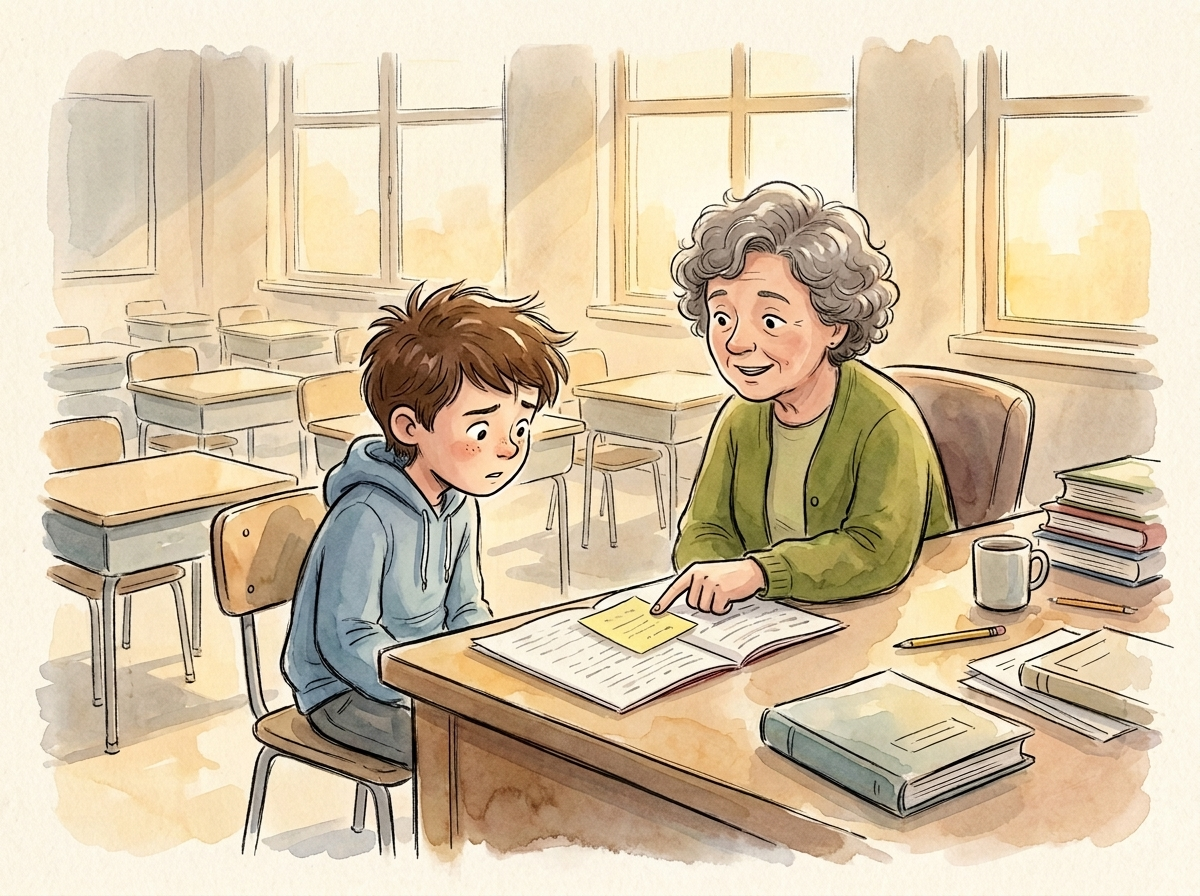
Mrs. Huang's eyebrows lifted — not a lot, but enough. She pulled a chair around to the side of her desk. "Sit down," she said. "Let's look at it together."
They spent fifteen minutes going through the question. Mrs. Huang drew a little diagram on a sticky note, connecting two ideas with an arrow, and suddenly the concept that had been foggy became sharp and clear, like wiping steam off a mirror.
"Can I ask you something?" Brendan said.
"Of course."
"When I study next time — is there a better way? Because I studied a lot for this test, and I still got a C."
Mrs. Huang leaned back and thought about it. Really thought about it, which Brendan appreciated, because it meant she was taking him seriously.
"Studying a lot and studying well aren't always the same thing," she said. "You might try closing the book and explaining the material out loud, as if you're teaching it to someone else. If you can't explain it, you don't really know it yet."
Brendan nodded slowly.
"And Brendan?" she added as he stood up to leave. "Coming in here to ask these questions? That matters more than you think."
Walking home that afternoon, Brendan's backpack felt normal again. The test was still in there, still a C. That hadn't changed. His grade in the class was still lower than he wanted. That hadn't changed either.
But something else had shifted — something harder to name. It was like he'd been standing in front of a locked door all weekend, rattling the handle, and today he'd finally stopped and looked down and noticed the key had been in his pocket the whole time.
The autumn leaves crunched under his sneakers.
He loved that sound.