Sixteen Words
Fable
Ages 9–11 · 13 min
After a summer of practicing her apology, Fiona Chen sees Maya in the fifth-grade hallway and the sixteen words she memorized are now stuck in her throat.
Forgiven
Fiona Chen had practiced the words forty-six times.
Forgiven
Fiona Chen had practiced the words forty-six times.
She'd practiced in the shower, where the steam swallowed her voice. She'd practiced into her pillow at night, the fabric turning her careful sentences into muffled nonsense. She'd practiced in front of her dog, Ralph, who had thumped his tail approvingly no matter what she said, which was not especially helpful.
Now it was the first Tuesday of fifth grade, and Maya Rojas was standing twelve feet away at the water fountain, and Fiona's practiced words had turned into a thick knot somewhere between her stomach and her throat.
I'm sorry for what I said last year. It was wrong. You didn't deserve it.
That was the speech. Three sentences. Sixteen words. She'd counted.
The thing about what happened last year was that it hadn't been one big, dramatic moment. It wasn't like in movies where the mean kid dumps a lunch tray on someone's head and evil laughter echoes through the cafeteria. It had been quieter than that. Worse than that, maybe.
It started when Maya moved to Westbrook Elementary in January and got assigned the seat next to Fiona in Mrs. Hannigan's class. Maya was shy, with big brown eyes and a habit of drawing tiny horses in the margins of her notebooks. She laughed at Fiona's jokes. She shared her colored pencils—the nice ones, the kind with thirty-six colors including "robin's egg blue" and "burnt sienna."
And Fiona, for reasons she'd spent the whole summer trying to understand, had decided that Maya was too easy a target to resist.
It wasn't hitting. It wasn't even yelling. It was the slow, quiet kind of cruelty that Fiona had learned was somehow more acceptable because no teacher could quite catch it.
She'd lean over during group work and whisper, "Nobody actually wants you in this group, just so you know." She'd wait until Maya said something in class, then catch Priya Bakshi's eye and smirk. She'd invite everyone in their row to her birthday party—everyone except Maya—and make sure Maya could hear every detail of the plans.
The worst part, the part that had crawled into Fiona's chest and built a nest there over the summer, was the look on Maya's face each time. Not angry. Not even sad, exactly. Just... accepting. Like Maya had already decided this was what she deserved.
Fiona didn't know why she'd done it. She'd turned it over and over like a Rubik's Cube she couldn't solve. Was she jealous? Was she bored? Was she just rotten deep down, like a shiny apple that looks fine until you bite into the brown part?
Her mom said people are complicated, which was a true thing that helped exactly zero percent.
The water fountain clicked off. Maya wiped her mouth with the back of her hand, turned, and saw Fiona.
Something flickered across Maya's face—a flinch, quick as a minnow—before she rearranged her expression into careful blankness.
That flinch hit Fiona like a soccer ball to the chest.
"Hi," Fiona said.
"Hi," Maya said.
The hallway hummed with the sounds of early September: sneakers squeaking, lockers clanging, someone down the hall arguing about whether a hot dog was a sandwich. Normal sounds. Easy sounds. Fiona wished she could dissolve into them.
"Can I—do you have a second?" Fiona asked.
Maya clutched her notebook—the one with the tiny horses, Fiona noticed, a new one with a blue cover—and nodded. Just barely.
They stepped to the side of the hallway, near the corkboard covered in faded summer reading certificates. Fiona took a breath. The knot in her throat tightened.
I'm sorry for what I said last year. It was wrong. You didn't deserve it.
"Maya, I'm sorry," Fiona said. "For last year. For the things I said to you and... and the way I treated you. It was really, really wrong. And you didn't deserve any of it. Not even a little."
That was more than sixteen words, but they were out, and they were true, and Fiona's hands were shaking.
Maya blinked. She looked down at her notebook, then back up at Fiona.
"It's okay," Maya said quietly.
Fiona waited for the relief to come. The whoosh of lightness she'd imagined during all those pillow-practice sessions. The weight lifting. The chapter closing.
It didn't come.
"It's... okay?" Fiona repeated.
Maya nodded. "Yeah. It's okay." She gave a small, careful smile. "I'll see you around." And she walked away down the hall, her sneakers making soft sounds on the tile, and disappeared around the corner by the library.
Fiona stood there.
It didn't feel fixed.
At lunch, Fiona sat with Priya and their friend Devon, but she couldn't focus on their conversation about the new PE teacher or whether the cafeteria pizza had gotten worse. It had. This was objectively true. But she kept glancing across the lunchroom to where Maya sat with two girls Fiona didn't know, laughing about something on a phone screen.
"You okay?" Priya asked, waving a baby carrot in front of Fiona's face.
"Yeah," Fiona said. "Hey, Priya? Last year, when I'd make that face at you when Maya talked in class... why'd you go along with it?"
Priya's chewing slowed. She put the carrot down. "I don't know," she said. Then, more honestly: "Because I didn't want you to do it to me, I guess."
That sat between them like a stone.
"I'm sorry I put you in that position," Fiona said.
Priya picked the carrot back up. "Yeah," she said. "Okay. Thanks." She paused. "Did you talk to Maya?"
"This morning. She said it was okay."
"That's good, right?"
Fiona frowned. "I think she said it was okay because it was easier than saying what she actually felt."
Priya considered this. "Probably, yeah."
The next few weeks were strange.
Fiona didn't push. She didn't follow Maya around or try to force friendship, because she'd read enough books to know that apologizing doesn't mean you're owed anything back. But she changed the things she could change.
When the class had to form groups for their ecosystem project, and Fiona saw Maya glance around nervously, Fiona said—loudly enough for everyone to hear—"Maya, do you want to join our group? Priya said you're amazing at drawing food webs."
Maya hesitated. "Sure," she said. Carefully.
During the project, Fiona noticed things. She noticed how Maya's tiny horses had gotten better over the summer—they had actual muscles now, and manes that looked like they'd blow in the wind. She noticed that Maya knew an incredible amount about tide pools. She noticed that when Maya was comfortable, really comfortable, she made the worst puns Fiona had ever heard.
"What did the ocean say to the shore?" Maya asked one afternoon while they were gluing pictures onto their poster.
"What?" Devon asked.
"Nothing. It just waved."
Devon groaned. Priya threw a glue stick cap at her. Maya grinned, and for one second, she caught Fiona's eye, and the grin didn't falter.
But other times, Fiona would say something—a normal, harmless comment—and she'd see Maya tense. Just for a moment. Just a flicker. The flinch of someone whose body remembers things their brain is trying to forgive.
Fiona noticed every single one.
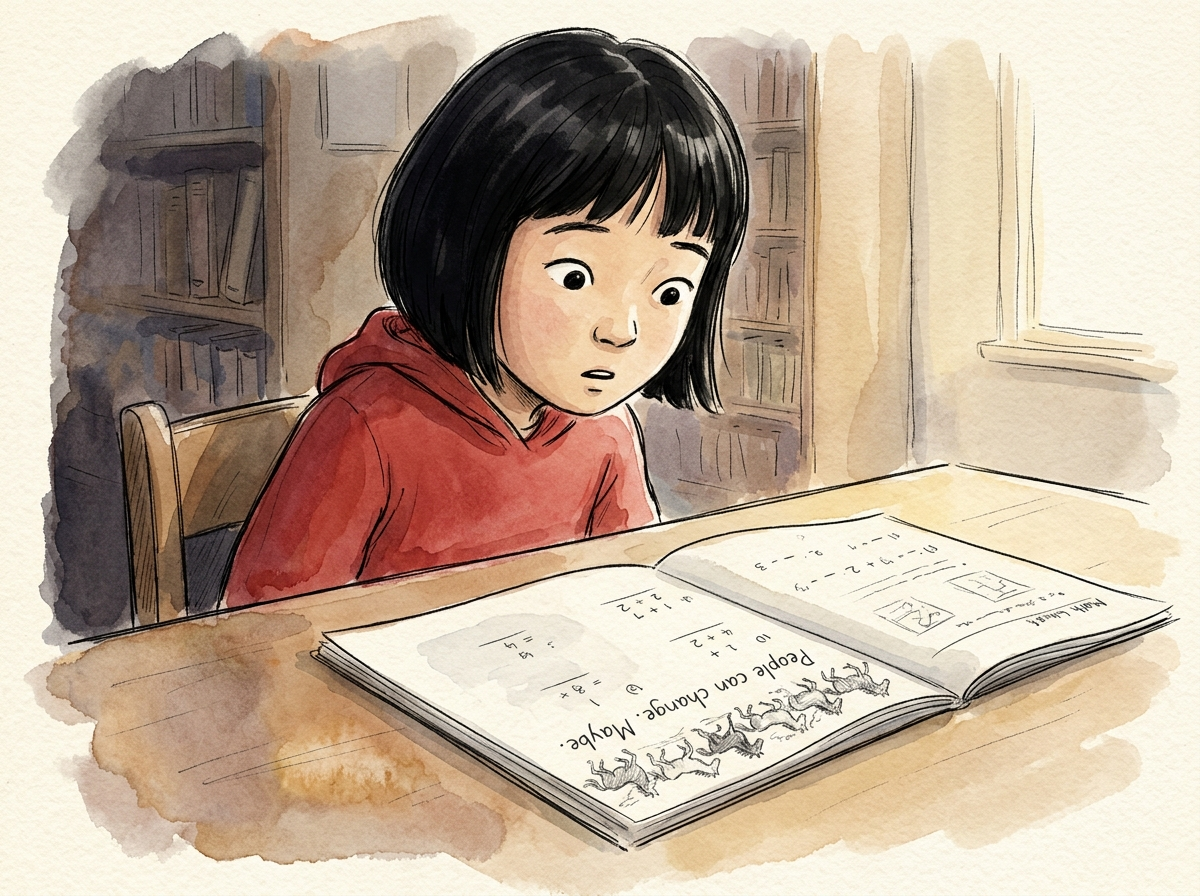
One rainy Thursday in October, they were working in the library, and Maya got up to sharpen her pencil. Her notebook was open on the table, and Fiona didn't mean to look, but her eyes caught on the margin of Maya's math worksheet.
Tiny horses. A whole herd of them, running across the bottom of the page. And underneath, in Maya's neat handwriting: People can change. Maybe.
Fiona looked away before Maya came back.
That night, she sat on her bed with Ralph's warm head on her knee and thought about the two most important words she'd read that day.
Not people can change.
Maybe.
Maybe meant the door wasn't closed. Maybe meant Maya was watching, and thinking, and deciding. Maybe meant that trust wasn't a thing you could hand back to someone with a three-sentence speech in a hallway. It was something that had to be rebuilt slowly, like those tiny horses Maya drew—one careful line at a time.
And maybe, Fiona realized, the uncomfortable feeling she still carried wasn't a sign that the apology hadn't worked. Maybe it was supposed to be there. Maybe it was the weight of understanding—truly understanding—that her words had mattered. That they'd left marks. That "I'm sorry" was not an eraser.
It was a beginning.
The next day at school, the rain had stopped and the playground was damp and shining. Maya was sitting on the bench by the oak tree, drawing in her notebook. Fiona walked over—not with an apology this time, not with a speech, but with a granola bar and a question.
"Can I sit here? I wanted to ask you about tide pools. You said there are sea slugs that basically steal weapons from other animals? That's the most unhinged thing I've ever heard and I need details."
Maya looked at her for a long moment. Fiona could almost see it happening—the weighing, the quiet courage it took to give someone a second chance when the first chance had hurt.
"They're called nudibranchs," Maya said. "Sit down. This is going to blow your mind."
Fiona sat.
She didn't feel forgiven. Not completely. Not yet.
But she felt something that might be the first plank of a bridge, stretching across the space between I'm sorry and I trust you, and she understood, maybe for the first time, that the building would be slow.
And that she'd show up for every single day of it.
Ralph would have thumped his tail.