The Planet That Got Demoted
Fable
Ages 6–8 · 9 min
Far away at the edge of the solar system, Pluto the planet has no idea that a group of scientists on Earth is holding a vote to take away his title.
Once upon a time — and I mean a very long time ago, like before your grandma was born, before her grandma was born, before anyone's grandma was born — there was a small, icy world at the very edge of the solar system.
His name was Pluto.
Once upon a time — and I mean a very long time ago, like before your grandma was born, before her grandma was born, before anyone's grandma was born — there was a small, icy world at the very edge of the solar system.
His name was Pluto.
And he was a planet.
At least, he thought he was.
"I am absolutely a planet," Pluto would say to no one in particular, because, honestly, there wasn't anyone nearby to hear him. That's the thing about living at the edge of the solar system. It's quiet. Very, very quiet.
But Pluto didn't mind. He had his moons — five of them! — and his favorite was Charon, who was so big that some folks said they were more like dance partners than a planet and a moon. They spun around each other, slow and steady, like two best friends holding hands and twirling in the snow.
And every single day — well, every 248 years, which is how long it took him to go around the Sun — Pluto did his job. He followed his path. He kept spinning. He was part of the family.
And oh, what a family.
There was Mercury, who was small and fast and always bragging about being closest to the Sun. There was Venus, who was beautiful but, frankly, a little too hot-tempered. Earth was nice enough, though a bit obsessed with those tiny creatures crawling all over it. Mars was rusty and dramatic. Jupiter was... enormous. Just enormous. Saturn had those ridiculous rings and knew it. Uranus rolled around like a bowling ball. And Neptune was cold and blue and mysterious, and happened to be Pluto's next-door neighbor.
Neptune wasn't the friendliest neighbor.
"Your orbit is weird," Neptune would say.
"It's not weird," Pluto would reply, with dignity. "It's unique."
"You literally cross into MY lane sometimes."
"I like to visit."
"That's not how orbits work."
But Pluto didn't let it bother him. He was a planet. He'd been a planet since 1930, when a young man named Clyde Tombaugh spotted him through a telescope and shouted something that probably sounded like "WOOOOO!" — though no one wrote that part down.
For seventy-six years, Pluto enjoyed being the ninth planet. Children made dioramas with him in them. Teachers taught songs about him. He was in the textbooks, right there at the end, like the period at the end of a very good sentence.
Pluto was small, yes. He knew that. Jupiter was so big you could fit all the other planets inside it and still have room for snacks. Pluto was smaller than Earth's moon. He was smaller than seven moons in the solar system, actually, but who was counting?
(Jupiter was counting. Jupiter was always counting.)
Then came the day.
August 24th, 2006.
A group of very serious scientists on Earth — they called themselves the International Astronomical Union, which is a name so long it barely fits in your mouth — held a big meeting. And they voted.
They voted on what makes a planet a planet.
And when they were done, they made an announcement:
"Pluto is no longer a planet."
Now.
Let me tell you what Pluto did when he heard this.
He didn't scream. He didn't cry. He didn't throw a tantrum like Mercury does when solar flares mess up his Tuesday.
He just floated there, in the dark, quiet cold, and said:
"...Excuse me?"
Charon drifted a little closer. "What did they say?"
"They said I'm not a planet anymore."
"That's ridiculous. What are you, then?"
"They're calling me a... dwarf planet."
There was a long pause. A very long, very cold, very far-away pause.
"What does that even mean?" asked Charon.
"I think it means I'm still planet-ish. But not planet-enough."
Pluto tried very hard to keep his dignity. He really did. But if you've ever been left out of something — a game at recess, a birthday party, a team you really wanted to be on — you know that there's a feeling that comes with it. A feeling like you've shrunk, even if you haven't moved at all.
The other planets had opinions, of course.
Saturn flicked one of its rings. "Tough break, little guy."
Mars just shook its head. "The humans are always reclassifying things. Last week they said I might have had water. Make up your minds, people."
Jupiter said nothing. Jupiter just sat there, being enormous, which was somehow worse.
But then something happened that Pluto didn't expect.
Letters started coming.
Not real letters, of course — Pluto didn't have a mailbox. But down on Earth, something wonderful was happening. Children were angry. Not at Pluto. For Pluto.
They wrote letters to scientists. They made posters. They wore t-shirts that said "PLUTO IS STILL A PLANET IN MY HEART." One girl in Las Vegas convinced her entire state to declare March 13th "Pluto Planet Day."
Teachers kept Pluto in their songs.
Kids kept Pluto in their dioramas.
And when anyone asked, "How many planets are there?" at least one kid in every classroom would raise their hand and say, "Nine. There are nine."
Pluto felt that. Even from three billion miles away, he felt it.
"Charon," he said one day.
"Yeah?"
"Do you think it matters? The label?"
Charon thought about this for a long time, the way moons do.
"You're still the same size you've always been," Charon said. "You still have five moons. You still take the longest trip around the Sun of anybody. You're still made of ice and rock and something wonderful that nobody fully understands. A bunch of scientists in a room didn't change any of that."
"But the textbooks—"
"Forget the textbooks. Do you feel like a planet?"
Pluto considered this. He looked out at the stars, billions and billions of them, stretching out forever in every direction. He felt the Sun, tiny and far away but still warm enough to find him. He felt Charon beside him, steady and loyal, always there.
"I feel like Pluto," he said. "And I think that's probably enough."
And it was.
Because here's the thing about Pluto. After he got demoted, more people knew his name than ever before. More people talked about him, argued about him, and loved him than in all his years of being a so-called "real" planet. A spacecraft called New Horizons flew all the way out to visit him in 2015, and when it sent back photos, the whole world gasped.
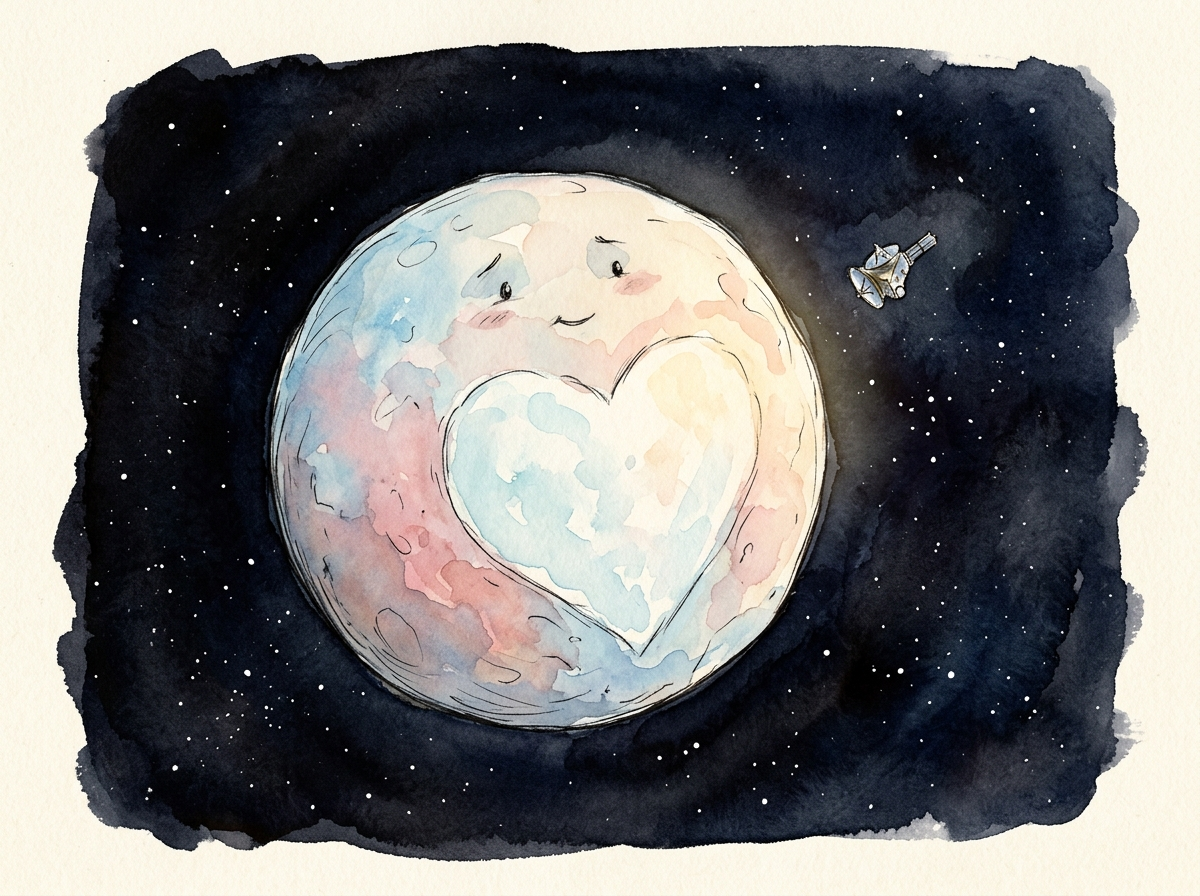
There, on Pluto's surface, was a giant heart.
A heart. Right there on his surface, made of ice and nitrogen, as big as the state of Texas, shaped like a Valentine, as if Pluto had been carrying it all along, just waiting for someone to come close enough to see it.
Saturn didn't have a heart on it. Jupiter didn't. None of them did.
Just Pluto.
"Well," said Neptune, who had been watching from next door. "That's annoyingly adorable."
Pluto just smiled — or did whatever a dwarf planet does when it's feeling proud — and kept spinning, kept orbiting, kept being exactly who he was.
Small. Far away. A little bit odd.
And absolutely, completely, without-a-doubt beloved.
So if anyone ever tells you Pluto isn't a planet, you can tell them this:
Pluto doesn't need a label to know what he is. He's the little world with the big heart, dancing with his best friend at the edge of everything, perfectly happy to be himself.
And honestly?
That's better than any title.