The Patty Cake Shop
Fable
Ages 9–11 · 12 min
A developer arrives with an offer to tear down Grandma Vie’s Patty Cake Shop, the place where eleven-year-old Zara has spent every Saturday of her life baking.
The bell above the door had a particular way of ringing at Grandma Vie's Patty Cake Shop — not a sharp, modern ding, but a warm, slightly crooked ting-a-ling that sounded like it was happy to see you. Zara had been hearing that bell her whole life, all eleven years of it, and she could tell by the sound alone whether someone was pushing the door open gently or swinging it wide with purpose.
Today, she swung it wide.
The bell above the door had a particular way of ringing at Grandma Vie's Patty Cake Shop — not a sharp, modern ding, but a warm, slightly crooked ting-a-ling that sounded like it was happy to see you. Zara had been hearing that bell her whole life, all eleven years of it, and she could tell by the sound alone whether someone was pushing the door open gently or swinging it wide with purpose.
Today, she swung it wide.
"Grandma! I'm here!"
The shop was small, tucked between a laundromat and a barbershop on Kellner Street. The walls were painted sunshine yellow — though the paint had faded over the years to something softer, like the inside of a banana peel. Behind the glass counter sat rows and rows of golden patties: beef, chicken, vegetable, and Grandma Vie's legendary callaloo-and-cheese, which she said she invented "by accident and by grace."
Grandma Vie appeared from the kitchen, dusting flour off her hands onto her apron. She was a tall woman with silver locs piled high on her head like a crown, and she moved through her shop the way a captain moves through a ship — like every square inch of it belonged to her bones.
"Zara, baby. Come. The dough won't knead itself."
This was their Saturday routine. Every week since Zara turned eight, she'd ride her bike six blocks from her apartment to the shop, tie on her apron — the small blue one with the embroidered hummingbird — and help Grandma Vie bake. She'd press circles out of dough, spoon in the seasoned fillings, crimp the edges with a fork. The kitchen was always warm, always fragrant, always loud with the radio playing old reggae that made Grandma Vie sway her hips while she worked.
"You remember the fold?" Grandma Vie asked, watching Zara's hands.
"Grandma," Zara said, pretending to be offended. "I invented the fold."
"Oh, you invented it now?" Grandma Vie laughed, big and round, and the laugh filled up the kitchen the way the scent of Scotch bonnet peppers filled up the air. "Child, I was folding patties before your mother was even a thought in my head."
"And now I fold them better than you," Zara said, grinning.
Grandma Vie swatted her gently with a dish towel. "The confidence on this one. Lord help me."
They worked side by side, flour dusting their arms, and the morning passed the way Saturday mornings were supposed to pass — slow and golden and smelling like turmeric.
The man showed up at noon.
Zara noticed him because he didn't set off the bell properly. He opened the door like he was measuring it, slow and careful, and the bell barely whispered. He wore a gray suit, carried a leather folder, and smiled with all his teeth but none of his eyes.
"Good afternoon," he said. "I'm looking for the owner. Mrs. Violet Grant?"
Grandma Vie came out from the kitchen, wiping her hands. She looked at the man the way she looked at unripe mangoes — with patience, but without much interest.
"That's me."
"Mrs. Grant, my name is Martin Hale. I represent Pinnacle Development Group." He opened his leather folder on the counter, right next to the tray of fresh patties, and spread out papers with drawings on them. Zara leaned over. The drawings showed a tall, shiny building made of glass and steel, the kind that looked like it belonged in a completely different neighborhood. A completely different planet, actually.
"We're planning a mixed-use development for this block," Mr. Hale said, still smiling that smile. "Retail on the ground floor, luxury apartments above. Very exciting. We're prepared to offer you a very generous settlement for your lease."
He said a number. It sounded like a lot to Zara, but she watched Grandma Vie's face and saw that it didn't land there the way Mr. Hale expected.
"This shop has been here thirty years," Grandma Vie said quietly.
"And what a run it's been!" Mr. Hale said, like he was congratulating her on finishing a race. "But the neighborhood is changing, Mrs. Grant. Progress. Growth. You could take this money and retire comfortably. Travel. Relax."
Grandma Vie looked at him for a long moment. "Mr. Hale, do you know what a patty is?"
He blinked. "I — yes, it's a type of pastry—"
"It's not a type of pastry." Grandma Vie's voice was soft but heavy, the way stones are soft when the river has been running over them for years. "It's a piece of home. Every person who walks through that door — that crooked little door — they're not just buying lunch. They're buying a memory. A taste of where they came from. You can't put that in a glass building."
Mr. Hale's smile tightened. "I understand the sentimental value. I do. But sentimentality doesn't pay the bills, and this offer won't be on the table forever." He placed a business card on the counter. "Think about it."
After he left, Grandma Vie stood very still, her hand resting on the counter. Zara had never seen her grandmother look like that — not angry, not sad exactly, but something in between. Like a tree that just felt the first swing of an axe.
"Grandma? Are you okay?"
Grandma Vie blinked, and then she was back. She straightened up, adjusted her locs, and said, "Come. We have patties to make."
But Zara noticed she didn't turn the radio back on.
That night, Zara couldn't sleep. She lay in bed staring at the glow-in-the-dark stars on her ceiling and thought about the glass building in Mr. Hale's drawings. It had no color. No crooked door. No bell. She thought about Mr. Hale saying the word progress like it was something you couldn't argue with, like weather.
She thought about Grandma Vie's hands, how they knew exactly how much filling to scoop, exactly how hard to press the fork, exactly when the patties were done without ever setting a timer. Thirty years of knowing. You couldn't put thirty years of knowing into a leather folder.
Zara sat up in bed and grabbed her notebook.
On Monday, Zara brought her plan to school. At lunch, she sat with her three best friends — Keiko, Marcus, and Divya — and spread her notebook open on the cafeteria table between their trays.
"We need to save my grandma's shop," she said.
"How?" Marcus asked, already in, because Marcus was always already in.
"We make people remember why it matters."
That week, Zara became a general. After school each day, the four of them biked to the shop. Keiko, who was the best artist in their grade and possibly the entire school, painted a banner on butcher paper: GRANDMA VIE'S PATTY CAKE SHOP — 30 YEARS OF FLAVOR, 30 YEARS OF LOVE. Divya, who had her own tablet and knew how to edit videos, filmed Grandma Vie in the kitchen — her hands working the dough, the golden patties emerging from the oven, the way customers' faces changed when they took that first bite. Marcus went door to door on Kellner Street, talking to every shop owner, every regular, everyone who'd ever eaten a patty from behind that glass counter.
"You know Miss Vie's shop?" he'd say. "They want to tear it down."
And every single person said some version of the same thing: "They can't."
Zara collected their words. Mr. Bernard from the barbershop said, "Vie's patties got me through my wife's chemo. Every Tuesday, she'd eat one and smile." Mrs. Okafor from three blocks over said, "When I first moved here from Nigeria, I didn't know anyone. Vie gave me a patty and said, 'Welcome home.' I've been coming ever since." Thirteen-year-old twins Devon and Dante said, "It's the only place that still feels like our neighborhood."
Divya edited it all together into a video. Zara wrote the title herself: Don't Let Them Erase Grandma Vie's.
Grandma Vie didn't know about any of it. She kept making patties, kept swaying to the radio — though Zara noticed she'd started looking at Mr. Hale's business card when she thought no one was watching. Each time, Grandma Vie would pick it up, turn it over in her flour-dusted fingers, then set it back down and return to her dough. It made something tighten in Zara's chest — not quite fear, but the shadow of it.
The video spread fast. Twenty thousand views in two days. Then fifty thousand. Then a local news reporter showed up at the shop with a camera crew, and Grandma Vie, bewildered but dignified in her flour-dusted apron, said to the camera: "I don't need to be famous. I just need to be here."
That Saturday, the line outside the Patty Cake Shop stretched around the block. People Zara had never seen before waited forty minutes for a callaloo-and-cheese patty. A city councilwoman came and ate two. A food blogger came from Manhattan and called it "the most important restaurant in the borough."
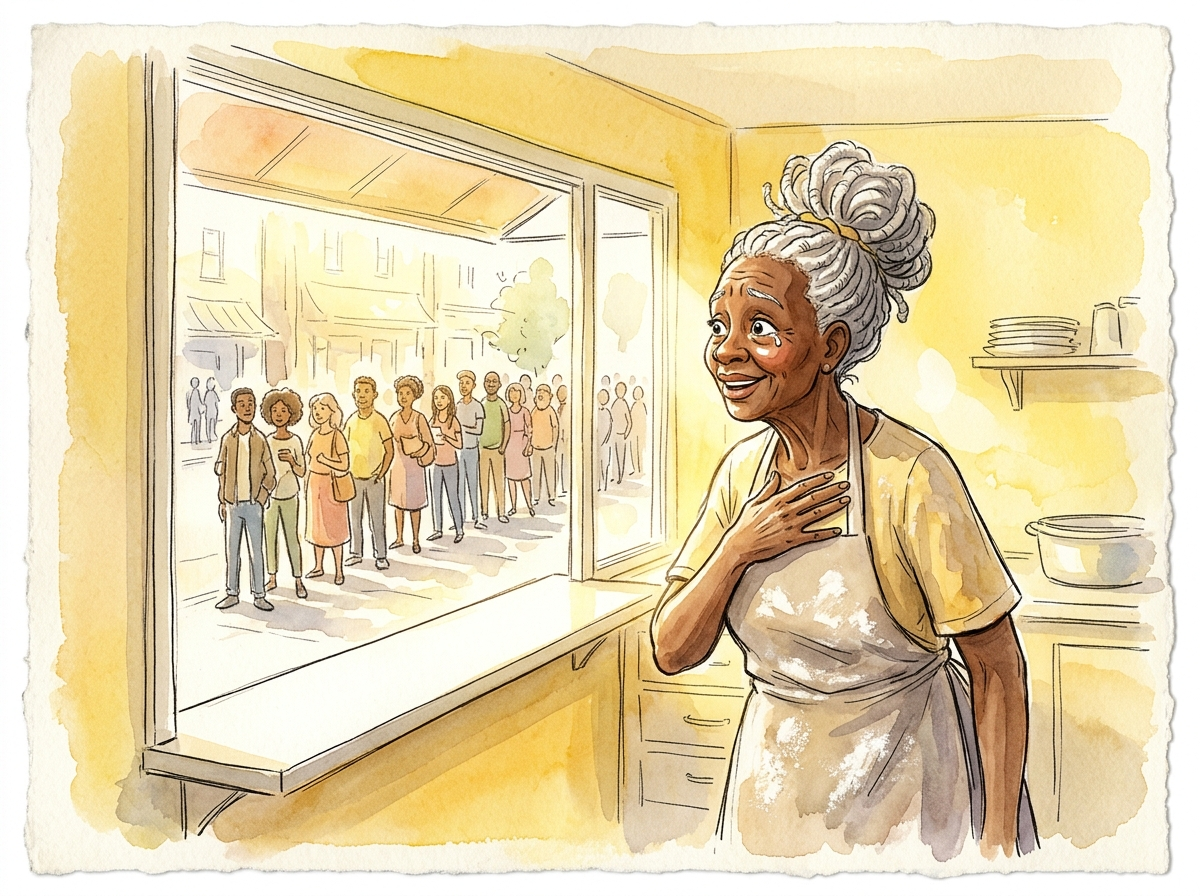
Zara worked the counter all morning, boxing up patties, making change, saying "thank you" until her voice went hoarse. Grandma Vie moved through the kitchen faster than Zara had ever seen, pulling tray after tray from the oven, and at one point she stopped and looked out through the service window at the line of customers winding past the door, and her eyes were bright, and she pressed her hand to her chest, just for a moment, before getting back to work.
And on Monday morning, Mr. Hale came back.
But this time, the bell didn't whisper. The door flew open and the bell sang its full, crooked ting-a-ling, because right behind Mr. Hale came a crowd — Mrs. Okafor, Mr. Bernard, Devon and Dante, Keiko and Marcus and Divya, and at least thirty other people who squeezed into the tiny shop until it was wall-to-wall.
Mr. Hale looked around. His leather folder hung at his side, unopened.
"Mrs. Grant," he started.
"Mr. Hale," Grandma Vie said, and this time her voice wasn't soft and heavy. It was light. Sure. Like a bell that knew exactly how it was supposed to ring. "I thought about your offer. And my answer is no."
He opened his mouth. Closed it. Looked at all the faces looking back at him. Looked at the banner Keiko had painted, now hanging proudly in the window. Looked at the tray of fresh patties, golden and steaming.
"I see," he said.
And he left.
The shop erupted. People cheered, clapped, hugged. Mr. Bernard started a reggae song, and Grandma Vie — despite herself — began to sway.
Zara stood behind the counter, flour on her apron, the hummingbird stitching right over her heart. Grandma Vie caught her eye across the crowded room and pointed a flour-dusted finger at her.
"You," she said.
Zara grinned. "Me."
Grandma Vie pulled her into a hug that smelled like turmeric and Scotch bonnet and thirty years of love.
"The fold," Grandma Vie whispered into her hair. "You really did learn it."
And the bell above the door kept ringing and ringing as more people came, because that's what a door is supposed to do — stay open.