The Paleontologist's First Dig
Fable
Ages 6–8 · 10 min
On the boring side of a junior dig site, Dex keeps working alone in her dusty square until her brush catches on a smooth, curved object buried in the dirt.
Dex had been digging for exactly twenty-three minutes.
She knew because she'd been counting. Twenty-three minutes of scraping her little brush against dry, crumbly dirt in the hot sun, and all she'd found so far was a rock that looked like a potato and a beetle that crawled across her boot and didn't even say thank you.
Dex had been digging for exactly twenty-three minutes.
She knew because she'd been counting. Twenty-three minutes of scraping her little brush against dry, crumbly dirt in the hot sun, and all she'd found so far was a rock that looked like a potato and a beetle that crawled across her boot and didn't even say thank you.
The other kids on the junior dig had already wandered off to the shade tent where Dr. Gupta was showing them plaster casts of a triceratops skull. Dex could hear them laughing and asking questions, their voices carrying across the flat, dusty dig site like birds hopping from rock to rock.
But Dex stayed in her square.
Every junior digger got their own square — a small patch of ground marked off with string and little orange flags. Dex's square was at the very edge of the site, far from the important spots where the real paleontologists worked with their fancy tools and serious faces.
"You probably won't find anything out there," a boy named Marcus had told her when she picked it. "That's the boring side."
Dex had shrugged. She liked the boring side. It was quiet. You could hear things on the boring side — the wind brushing over the ground, the tiny tik-tik-tik of pebbles shifting. You could notice things.
Twenty-four minutes now.
She dragged her brush in slow, careful strokes, just the way Dr. Gupta had shown them. Gentle, she reminded herself. Like you're brushing a sleeping cat.
And then her brush caught on something.
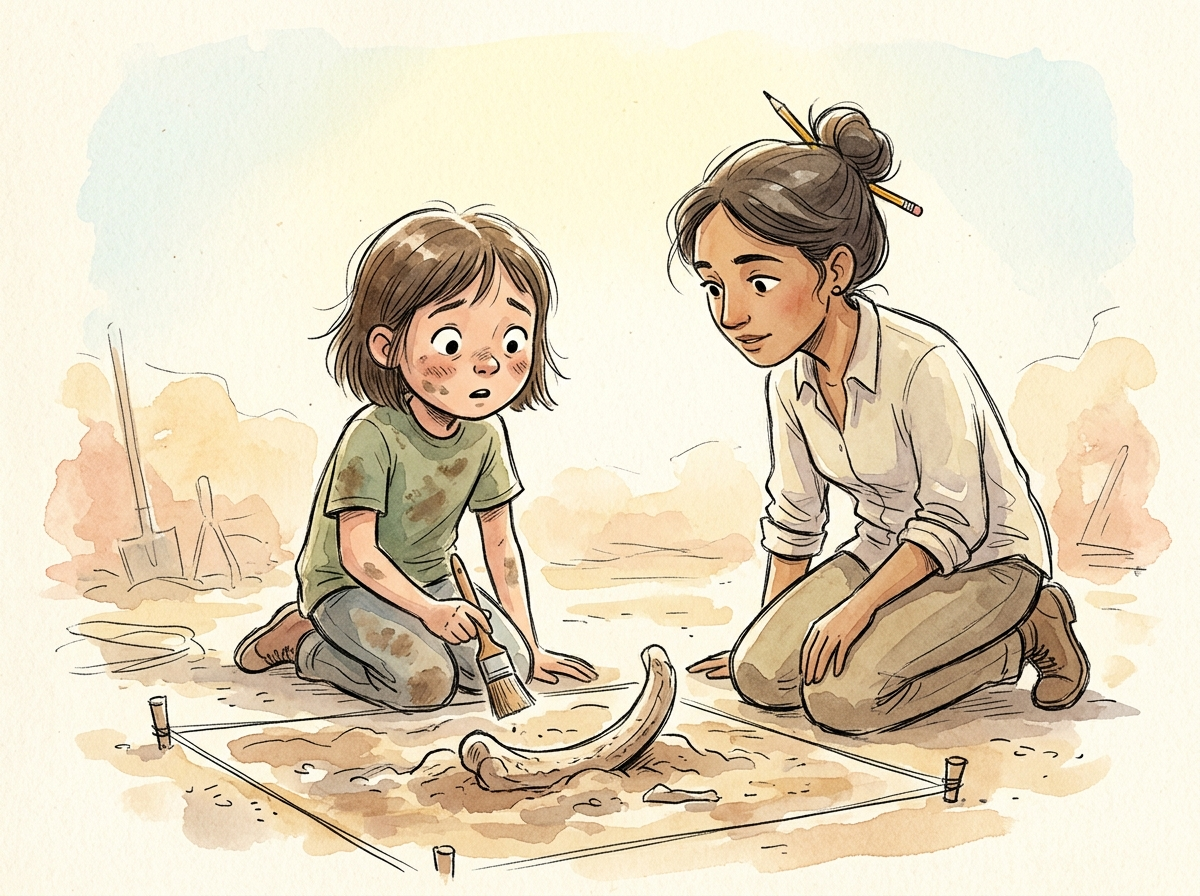
Not a rock-something. Not a root-something. Something smooth and curved, just barely poking out of the pale dirt like the tip of a whale coming up for air.
Dex stopped breathing.
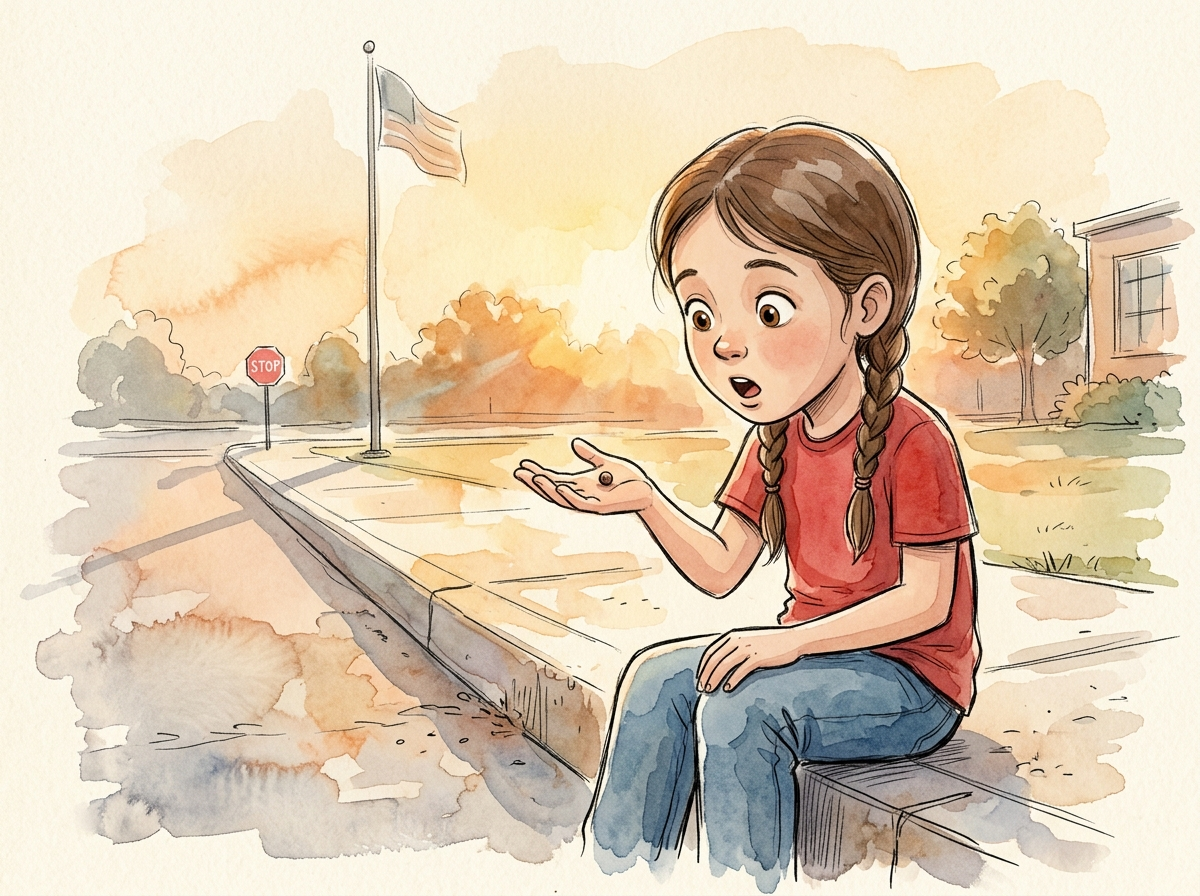
She set down her brush and leaned closer. With her fingers — very, very slowly — she pushed the loose dirt away from the edges. The thing was about as long as her pinky finger, a creamy tan color, with a texture that was different from anything else in the ground around it.
Dex's heart was hammering so loud she was sure the beetle could hear it, wherever it had gone.
She picked up her brush again and worked around the shape, sweeping dirt away grain by grain. More of it appeared. It curved gently, like a small, smooth branch — but it wasn't a branch. Branches had bark and rough spots and sometimes little bumps where smaller branches broke off.
This was something else.
"Dr. Gupta?" Dex called. Her voice came out squeaky, so she tried again. "Dr. Gupta!"
Dr. Gupta came walking over, her big sun hat bobbing with each step. She was carrying a clipboard and had three pencils stuck in her bun like little yellow antennae.
"What've you got, Dex?"
"I don't know," Dex whispered. "But I think — I think it might be —"
Dr. Gupta knelt down beside the square. She pulled her glasses from the top of her head to her nose and leaned in close. For a long, long moment, she didn't say anything.
Then she looked at Dex.
"Keep going," Dr. Gupta said. And her voice was quiet too — the way people get quiet in libraries and museums and around sleeping babies. "Nice and slow."
Dex's hands were shaking a little, but she kept brushing. Dr. Gupta stayed right there, watching. Not touching. Not taking over. Just watching.
More of the shape came free from the dirt. It was definitely curved, and now Dex could see it connected to something wider and flatter underneath, still buried.
By now, the other kids had noticed. Marcus came over first, then a girl named Priya, then all the rest, crowding around the orange flags of Dex's square.
"What is it?" Marcus asked.
"Is it a dinosaur?" said Priya.
"Give her room," Dr. Gupta said, holding up one hand. "The digger needs room."
The kids stepped back — but only a tiny bit.
Dex kept working. The sun was hot on the back of her neck. A bead of sweat rolled down her nose and dropped right onto the dirt next to the shape, making a tiny dark circle. She brushed and brushed, and slowly the wider, flatter part began to show itself.
It was a bone.
A real bone.
Not a plaster cast in a museum. Not a picture in a book. A real bone from a real animal that had lived so long ago that the whole world had been different — different trees, different rivers, different sky.
"I think," Dr. Gupta said carefully, "that might be part of a rib. From the size and the curvature... possibly from a hadrosaur. A duck-billed dinosaur."
"A hadrosaur?" Dex repeated. The word felt enormous in her mouth, like biting into something too wonderful to chew.
"We'll need to do a lot more work to be sure," Dr. Gupta said. "Identifying fossils takes time. We'll need to excavate further, map the location, compare it to known specimens." She paused, and then she smiled. "But Dex — this is a genuine find."
Something happened inside Dex's chest that she didn't have a word for. It was warm, like cocoa, but fizzy, like soda, and it made her eyes sting just a little, in a good way.
The other kids started cheering. Priya grabbed Dex's arm and shook it. Marcus stared at the bone with his mouth hanging open.
"That's on the boring side," he said, like he couldn't believe it.
Dr. Gupta pulled out a small orange flag — a special one — and handed it to Dex. "You mark it," she said. "It's your find."
Dex pressed the flag into the ground right next to the bone. Her flag. Her square. Her find.
Then Dr. Gupta told the group what would happen next, and this was the part that surprised Dex most. They wouldn't pull the bone out. They wouldn't clean it off right away or stick it in a box and take it home. Instead, the real paleontologists would come and spend days — maybe even weeks — carefully uncovering more of the area around it. They'd take photographs from every angle. They'd draw diagrams. They'd use tiny picks and dental tools and brushes even smaller than Dex's. They'd wrap the bone in a plaster jacket to protect it before it ever left the ground.
"Paleontology is patience," Dr. Gupta said. "The bone waited seventy million years for us. We can take our time with it."
Seventy. Million. Years.
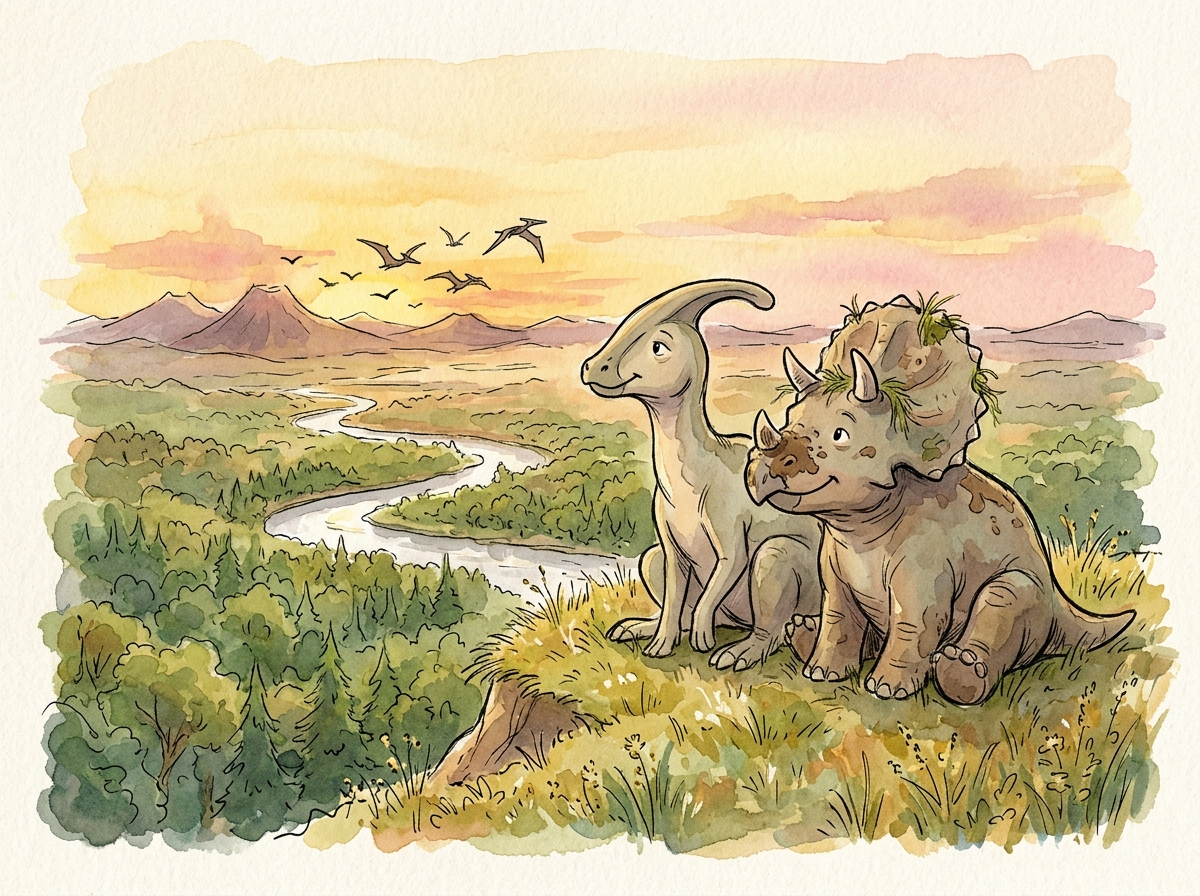
Dex looked down at the curved shape poking out of the earth. Seventy million years ago, this rib had been inside a living, breathing animal. A hadrosaur, maybe, munching on plants by a river, swishing its big flat tail, calling out in sounds that no human ear had ever heard. And then time did what time does — it piled up, layer after layer, turning the bone to stone, burying it deeper and deeper, until a girl with a brush and a whole lot of patience came along and found it.
That afternoon, on the bus ride back, the other kids crowded around Dex.
"How did you know where to dig?" Priya asked.
"I didn't," Dex said.
"Were you about to give up?" Marcus asked.
Dex thought about that. About the twenty-three minutes and the potato rock and the rude beetle. About how quiet it had been on the boring side, how she'd heard the tik-tik-tik of the pebbles and felt the brush catch on something smooth.
"No," she said. "I wasn't about to give up."
She looked out the bus window at the dig site shrinking behind them — the flat, dusty ground that held secrets so deep and so old it made her dizzy to think about. Her little orange flag was still there, catching the late afternoon sun, waving in the wind like it was saying: Here. Right here. Come look at what she found.
That night, Dex set her brush on her bedside table. It was still dusty. She didn't clean it off.
She wanted to remember exactly what it felt like — that moment when the brush caught on something and the whole world shifted, just a little, like the earth itself was whispering:
Keep going.