The Night He Couldn't Sleep
Fable
Ages 6–8 · 11 min
Unable to sleep in his family's dark cabin, a boy named Abe creeps downstairs to read a book about George Washington by the light of a fire he is not supposed to build.
The cabin was quiet, and that was the problem.
When things got quiet, Abe's mind got loud.
The cabin was quiet, and that was the problem.
When things got quiet, Abe's mind got loud.
He lay on his straw mattress in the loft, staring up at the rough wooden beams above him. His older sister Sarah breathed slow and steady on the other side of the loft. Below, his father's snoring rumbled through the floorboards like a bear arguing with a thunderstorm. His stepmother — the kind one, the one who actually smiled at him — had stopped her rocking chair at least an hour ago.
Everyone was asleep. Everyone except Abraham Lincoln, age ten, who had a question stuck in his head like a splinter he couldn't dig out.
How far away is the moon?
He'd been thinking about it since supper, when he'd hauled water from the creek and caught the moon's reflection wobbling on the surface. He'd tried to scoop it up, just to see what would happen, and of course it shattered into a hundred silver pieces. But it got him wondering. If the moon could fit in a bucket of water, how big was it really? And how far away?
He squeezed his eyes shut and tried to sleep.
It didn't work. It never worked.
His feet were cold. His brain was hot. And somewhere downstairs, tucked on the shelf his stepmother had built, there was a book.
Not just any book. A new one. Well, new to him. His stepmother had brought it when she'd married his father — The Life of George Washington — and she'd set it on the shelf and said, "That one's for anyone who wants it."
She'd looked right at Abe when she said it.
He sat up slowly. The straw rustled beneath him, and he froze. Sarah shifted, mumbled something about a chicken, and went still again.
Abe swung his long, skinny legs over the edge of the loft and found the ladder with his toes. He was tall for ten — taller than boys two years older — and he had to be careful not to bang his knees on every rung as he climbed down. The ladder creaked once, and he held his breath so long he thought his lungs might pop.
His father's snoring didn't even hiccup.
The cabin was dark as the inside of a boot. But Abe knew every inch of this small room — the table with the wobbly leg, the three-legged stool, the fireplace where a few embers still glowed orange, barely alive. He crossed the dirt floor barefoot and silent, feeling the cool earth press between his toes, until his fingers found the shelf.
There. The book. He could feel the leather cover, the bumpy spine, the pages soft as old cloth.
He pulled it down and held it against his chest like something precious, because it was.
Now came the tricky part: light.
Abe crouched by the fireplace and studied the embers. A few still pulsed with heat, glowing like tiny red hearts. He reached for the kindling pile — just a few small sticks, not enough that anyone would notice in the morning — and laid them carefully on the embers. He leaned down and blew, gentle and steady, the way his mother had taught him before she died. Before everything changed.
Blow soft, Abe. Coax it. Fire's like a story — you can't rush it, or it goes out.
A tiny flame caught. Then another. The sticks crackled to life, and suddenly the hearth threw a wobbly circle of golden light across the floor.
Abe stretched out on his stomach, propped himself up on his elbows, and opened the book.
The words were small and the light was unsteady. He had to squint. Some of the words were unfamiliar — inauguration, constitution, sovereignty — and he had to sound them out in a whisper so quiet it was more like breathing.
"In-aw-gyoo-RAY-shun."
He said it three times until it felt comfortable in his mouth, like a stone worn smooth by a river.
The story pulled him in. George Washington had been a boy once, too. Not a president, not a general, not a face on anything — just a kid who liked horses and got into trouble and had a father who was strict and a mother who worried. Washington had wanted to go to sea when he was young, wanted to sail away from Virginia and see the whole world, but his mother had said no.
Abe read that part twice.
He understood wanting to go somewhere else.
He loved his family. He loved the woods and the creek and the way Indiana smelled after rain — like the whole world had just taken a bath. But sometimes, when he looked down the dirt road that led away from their cabin, he felt a pulling in his chest, like a rope tied to his ribs, tugging him toward something he couldn't name.
The fire crackled. A log shifted, sending up a brief fountain of sparks. Abe didn't even flinch. He was in Virginia now, watching young George Washington learn to survey land, drawing careful maps of places no one had bothered to measure before.
He made sense of things, Abe thought. He looked at something wild and unmapped and said, "I'm going to understand this."
A floorboard groaned behind him.
Abe's heart jumped into his throat. He twisted around, expecting his father's stern face — the look that said You're wasting firewood, you're wasting time, there's work tomorrow, a boy who reads when he should sleep is a boy who'll drag his feet behind a plow.
But it wasn't his father.
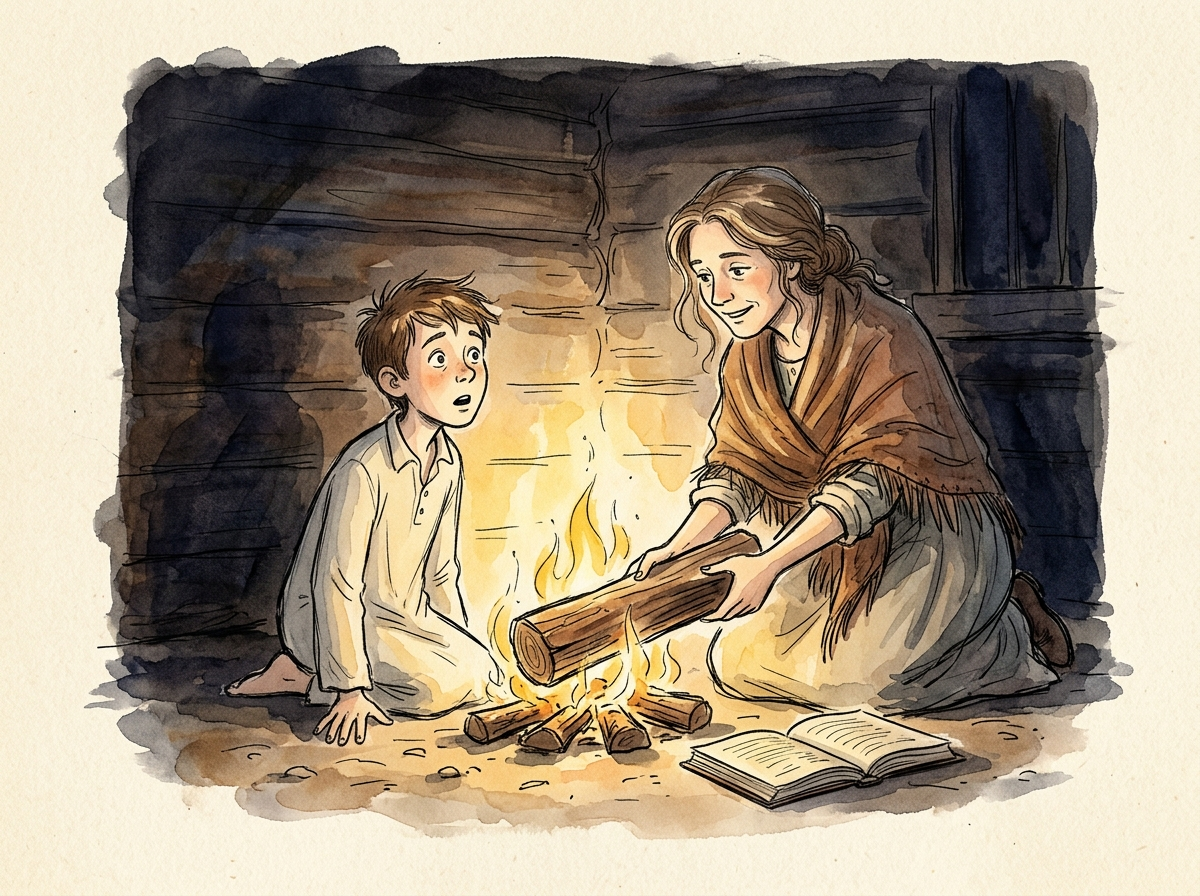
His stepmother stood at the foot of the ladder, wrapped in her shawl, her hair loose around her shoulders. She looked at him. She looked at the book. She looked at the little fire he'd built.
Abe opened his mouth to explain, to apologize, to promise he'd go straight back to bed.
She held up one finger. Wait.
She moved to the woodpile, selected a split log — a good one, dry and solid — and set it on his little fire. The flames leaped up, grateful, and the circle of light doubled in size.
Then she pulled the three-legged stool close to the hearth, sat down, and wrapped her shawl tighter.
"Well?" she said softly. "Where are you in it?"
Abe blinked. "He's — Washington's just learned to be a surveyor. He's measuring land in the Shenandoah Valley."
"Is it good?"
"It's so good."
She smiled. "Then don't let me stop you."
Abe looked at her for a moment — this woman who had walked into their sad, messy cabin after his mother died and hadn't tried to replace anyone, hadn't tried to make him into a different boy, had just brought books and a shelf to put them on and said these are for anyone who wants them.
He turned back to the page.
He read on, and the night stretched around them like a warm blanket. Washington was crossing the Allegheny River in winter, ice cracking and groaning beneath him. Washington was losing battles and learning from every single loss. Washington was sitting in a tent, exhausted, writing letters by candlelight while his army starved and froze, and he kept going — not because he wasn't afraid, but because giving up would mean the thing he believed in would die.
Abe's fire popped and hissed. Outside, an owl called — two low notes, patient and wise.
"Stepmother?" he whispered.
"Hmm?"
"Do you think..." He paused. The question felt too big for a ten-year-old in a dirt-floor cabin in the middle of Indiana. But the night was dark and safe, and she was listening, and so he asked it. "Do you think somebody like me could ever do something like that? Something that matters?"
She was quiet for a moment. Not the kind of quiet that means no. The kind of quiet that means someone is taking your question seriously.
"Abe," she said, "you built a fire in the middle of the night so you could teach yourself words nobody taught you, about a man who changed the world. And you want to know if you could do something that matters?"
She reached over and rested her hand on the top of his head, just for a second.
"Keep reading," she said.
So he did.
He read until the fire burned low again, until the words blurred and the book grew heavy in his hands. He read until his eyelids drooped and his head nodded forward and the last thing he saw before he slept was a sentence about Washington standing on a hill at dawn, looking out over a country that didn't exist yet, believing in it anyway.
Abe fell asleep right there on the dirt floor, the book open beneath his cheek, the fire's last embers painting his face in fading gold.
His stepmother looked at him for a long moment. Then she draped her shawl over his shoulders, set another log on the fire — because a boy who reads himself to sleep on the floor deserves to stay warm — and climbed back up to bed.
In the morning, his father would shake his head at the wasted firewood. There would be water to haul and fences to mend and a whole long day of work under the Indiana sun.
But that was morning.
Right now, it was the middle of the night, and a boy who couldn't sleep had found a book, and a fire, and one person who understood that those two things together could build something even bigger than a cabin.
Something that hadn't been built yet.
Something that was just beginning.