The Light We Carried Home
Fable
Ages 6–8 · 10 min
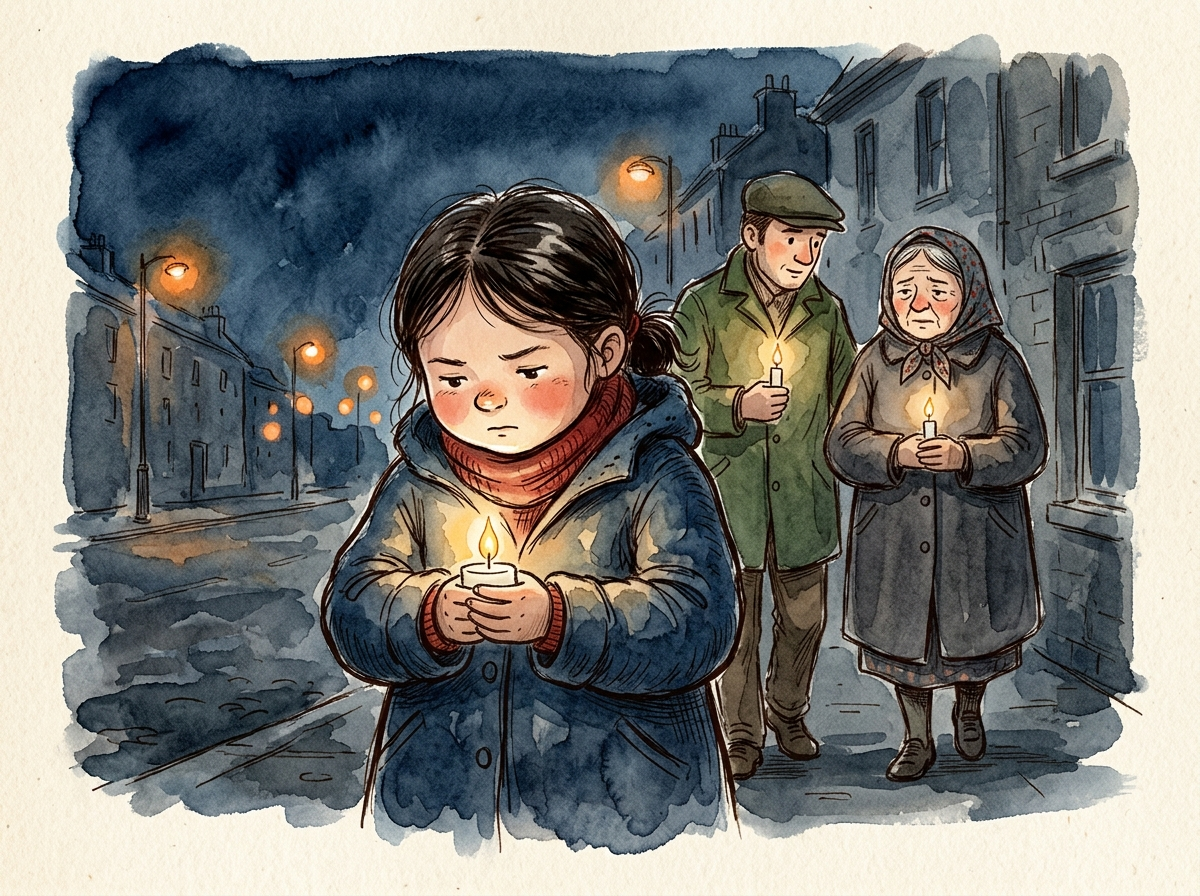
On Easter Eve, Mila's family walks a candle flame home from church through a cold, windy night. One by one, every candle goes out but hers.
The church was warm and smelled like flowers and old wood, and Mila's legs were tired from standing. It was Easter Eve — the latest she had ever stayed up — and the whole church had been dark, truly dark, until Father Thomas lit one single candle at the front.
From that one candle, a hundred little flames were born.
The church was warm and smelled like flowers and old wood, and Mila's legs were tired from standing. It was Easter Eve — the latest she had ever stayed up — and the whole church had been dark, truly dark, until Father Thomas lit one single candle at the front.
From that one candle, a hundred little flames were born.
Father Thomas touched his candle to Mrs. Antonelli's candle. Mrs. Antonelli touched hers to Mr. Okoro's. Mr. Okoro touched his to Grandma Lina's. And Grandma Lina — with her soft, wrinkled hands — leaned down and touched her flame to the small white candle that Mila was holding.
"There you go, little one," Grandma Lina whispered. "Hold it steady."
Mila watched her wick catch fire. A tiny golden teardrop appeared, and the wax beneath it started to soften and glow. She cupped her other hand around it, the way she'd seen her father do.
"Now," said Papa, leaning close, his own candle making shadows dance across his chin, "we carry our light home."
This was the tradition. Every Easter Eve, their family walked the candle flame all the way from St. Anne's Church back to their house on Prospect Street. Grandma Lina said her mother had done it, and her mother's mother had done it, and probably somebody's great-great-great-grandmother had done it on a dirt road somewhere far away, a long time ago.
The flame was supposed to make it all the way home. That was the thing. You weren't supposed to let it go out.
"Ready?" said Mama, pulling Mila's coat up around her neck with one hand, guarding her own candle with the other.
Mila nodded.
They stepped outside, and the night swallowed them.
It was cold — the kind of cold that April sometimes keeps in its back pocket, the kind that sneaks up after a warm day and pinches your ears. The sky was blue-black and the stars were out, small and hard like chips of ice.
And the wind was blowing.
Not a big wind. Not a storm wind. Just a steady, cool breath that came down Maple Avenue and pushed against them like an invisible hand.
Mila's flame shivered.
She hunched over it immediately, making a cave with her body and her coat. "Papa," she whispered, as if speaking too loudly might blow it out.
"You're doing great," Papa said. He was walking on the side where the wind came from, trying to block it. His candle was longer than hers, and his flame bent sideways but held on.
Mama walked on her other side, and Grandma Lina walked behind, and together they made a kind of wall. A family-shaped wall against the dark.
They passed the parking lot. They passed the big oak tree where Mila's friend Jonah had once gotten his kite stuck. The sidewalk was empty. The streetlights buzzed overhead with their cold orange light, but between them were patches of real darkness, and in those patches, Mila's little candle was the brightest thing in the world.
"How far is it?" Mila asked.
"Six blocks," said Mama.
Six blocks had never sounded so far.
At the corner of Maple and Third, the wind picked up. It came in a gust that flattened Papa's flame right against the wax and — pff — just like that — his went out.
A tiny ribbon of smoke curled up from his wick and disappeared.
"Oh no," Mila said.
But Papa didn't look upset. He just leaned over and touched his wick to Mila's flame, and a moment later his candle was burning again.
"See?" he said. "That's why we walk together."
They kept going. Past the barber shop with its red-and-white striped pole. Past the laundromat where the machines were still tumbling someone's clothes, round and round, even though no one was inside. Past the little free library box on Mrs. Chen's lawn.
Grandma Lina started humming. It was a song Mila didn't know the name of, something old and low and warm. It made the walking feel less long, like the song was pulling them forward gently, the way a current pulls a leaf down a stream.
At Fifth Street, Mila stepped on a crack and stumbled. Her candle lurched. The flame stretched thin — so thin she could almost see through it — and for one terrible second she thought it was gone.
But it wasn't gone.
It came back, round and gold, like it had just been holding its breath.
"Brave little flame," Grandma Lina said from behind her.
Mila smiled. She liked that. A brave little flame.
They turned onto Prospect Street. Mila could see their house now — the dark shape of it at the end of the block, the porch railing, the big front window like a closed eye. Everything was waiting.
And then — because the night wasn't done testing them — the biggest gust yet came barreling down the street. It rattled a stop sign. It sent a paper cup skittering across the road. It pushed against Mila so hard she had to lean into it.
Mama's candle went out.
Grandma Lina's candle went out.
Papa's candle — which had already gone out once and come back — went out again.
The only light left was Mila's.
She dropped to her knees right there on the sidewalk. She curled over her candle like she was protecting a baby bird that had fallen from a nest. She pressed her coat around it and tucked her chin down and closed her eyes and held her breath.
The wind pushed against her back. It tugged at her hair. It whistled past her ears like it was trying to find a way in, trying to find that tiny flame and blow it into nothing.
Mila could feel the heat on her cupped hands. Still there. Still warm.
She waited.
The gust passed. The way gusts do — they come, they push, they move on to bother someone else.
Slowly, Mila opened her eyes.
The flame was there. Small. Shaking a little. But there.
"Mila," Mama whispered, kneeling beside her. There was something in Mama's voice — surprise, and something deeper than surprise. Something like pride.
One by one, they came to her. Mama touched her wick to Mila's flame, and it caught. Papa touched his to Mama's, and it caught. Grandma Lina touched hers to Papa's, and it caught.
Four flames again. All of them born from the one Mila had saved.
Grandma Lina put her hand — warm even in the cold — on the back of Mila's head. She didn't say anything. She didn't need to.
They walked the last block together. Four flames bobbing in the darkness like a tiny parade. Mila's arms were tired and her knees had sidewalk-grit on them and her nose was running, and she had never felt so awake in her entire life.
Papa opened the front door. They stepped inside, where it was warm, where it smelled like the cinnamon bread Mama had made that afternoon for Easter morning.
On the kitchen table sat the big glass lantern they used every year. It was old — Grandma Lina said it had come from the other country, the one with the dirt roads and the great-great-great-grandmothers.
Mila lifted her candle and set it inside the lantern.
The flame steadied. Without the wind, it grew calm and tall, and it threw long golden shapes across the walls and the ceiling and the faces of her family. The whole kitchen seemed to come alive — the copper pots on the shelf, the Easter eggs they'd painted that afternoon (Mila's had a wobbly bunny on it), the little wooden cross above the doorway.
"It made it," Mila said quietly, looking at the flame.
"It made it," Papa said.
Grandma Lina lowered herself into her chair with a long, happy sigh. "It always does," she said. "One way or another."
Mama brought out the cinnamon bread and cut thick slices, even though it was supposed to be for morning, and nobody said a word about it because some moments are too important for rules about breakfast food. They sat around the table in the lantern light, eating warm bread with butter melting into it, and outside the window the night was enormous and dark and full of wind.
But in here, there was light.
Mila's eyelids started to get heavy. The warmth of the kitchen, the bread in her belly, the late hour — it was all catching up to her. She rested her head on her arms on the table and watched the flame in the lantern through half-closed eyes.
"Can we do this every year?" she murmured. "Even when I'm a hundred?"
"Even when you're a hundred," Grandma Lina said.
Papa carried her to bed. She was almost asleep when he set her down, but not quite — she could still see, through her doorway and down the hall, the faint golden glow from the kitchen.
Still burning.
She closed her eyes and fell asleep smiling, and in her dreams, she was walking down a long, dark road carrying a small and stubborn flame, and she was not afraid, and she was not alone.