The Midnight Mural
Fable
Ages 9–11 · 13 min
To claim the post office wall she won for her mural, Sid must sneak out at midnight and cross nine blocks alone before the deadline expires.
Out
Sid had one idea. It required going outside at midnight without anyone knowing.
Out
Sid had one idea. It required going outside at midnight without anyone knowing.
She'd been thinking about it for six days — ever since the letter arrived. The letter that Mom had read silently at the kitchen table, then folded back into its envelope, then slid into the junk drawer between the takeout menus and the dead batteries.
Sid knew what it said because she'd read it at 11:47 PM that same night, standing barefoot on the cold kitchen tile with a flashlight between her teeth.
It was from the Eastwood Community Arts Council. Her mural proposal — the one she'd spent three weeks sketching, the one with the foxes and the wildflowers climbing up a crumbling brick wall — had been selected. They wanted to paint it on the side of the old post office on Birch Street. There was just one thing: the artist had to attend an interview at the council office. The deadline to schedule was June 14th.
Today was June 13th.
Mom hadn't mentioned it. Not once.
Sid knew why. Mom worried. Mom worried about everything. She worried about Sid walking to school even though it was four blocks. She worried about Sid using the stove even though Sid had been making her own eggs since she was eight. She worried about the neighborhood and the traffic and the strangers and the weather and the dark and anything else that existed in the world beyond their front door.
"You're eleven," Mom would say, in that voice that meant the conversation was a locked door. "There's plenty of time for all that later."
But there wasn't plenty of time. There was until tomorrow.
So Sid made a plan. Not a complicated plan. She wasn't trying to sneak across the country. She just needed to get to Birch Street — nine blocks away — take a photo of herself standing in front of the old post office wall, and email it to the council's after-hours submissions address along with a message that said: I'm Sid Ochoa, I'm the artist, and I'm ready.
She'd worked it all out. Midnight was quiet. Birch Street was well lit. She'd be gone twenty minutes, tops.
At 11:50 PM, Sid lay in bed fully dressed — sneakers, hoodie, her phone in one pocket and her house key in the other. She listened. The TV in Mom's room had gone silent twenty minutes ago. The house settled and ticked around her like a sleeping animal.
At 11:58, she eased her bedroom door open. Down the hallway. Past the bathroom. Past Mom's door, which was open exactly four inches because Mom liked to listen for sounds in the night — sounds like, for instance, an eleven-year-old sneaking out.
Sid held her breath and moved like fog.
The front door was the tricky part. It had a chain lock that rattled, a deadbolt that clunked, and a screen door that screamed like a pterodactyl every single time it opened. Sid had prepared for this. During the afternoon, while Mom was on her work call, she'd rubbed a candle along the screen door hinge. She'd practiced the deadbolt with slow, even pressure. The chain she'd left unlatched after dinner, praying Mom wouldn't notice.
Mom hadn't noticed.
Click. The deadbolt turned like butter. Sid eased the screen door open and — silence. Beautiful, golden silence.
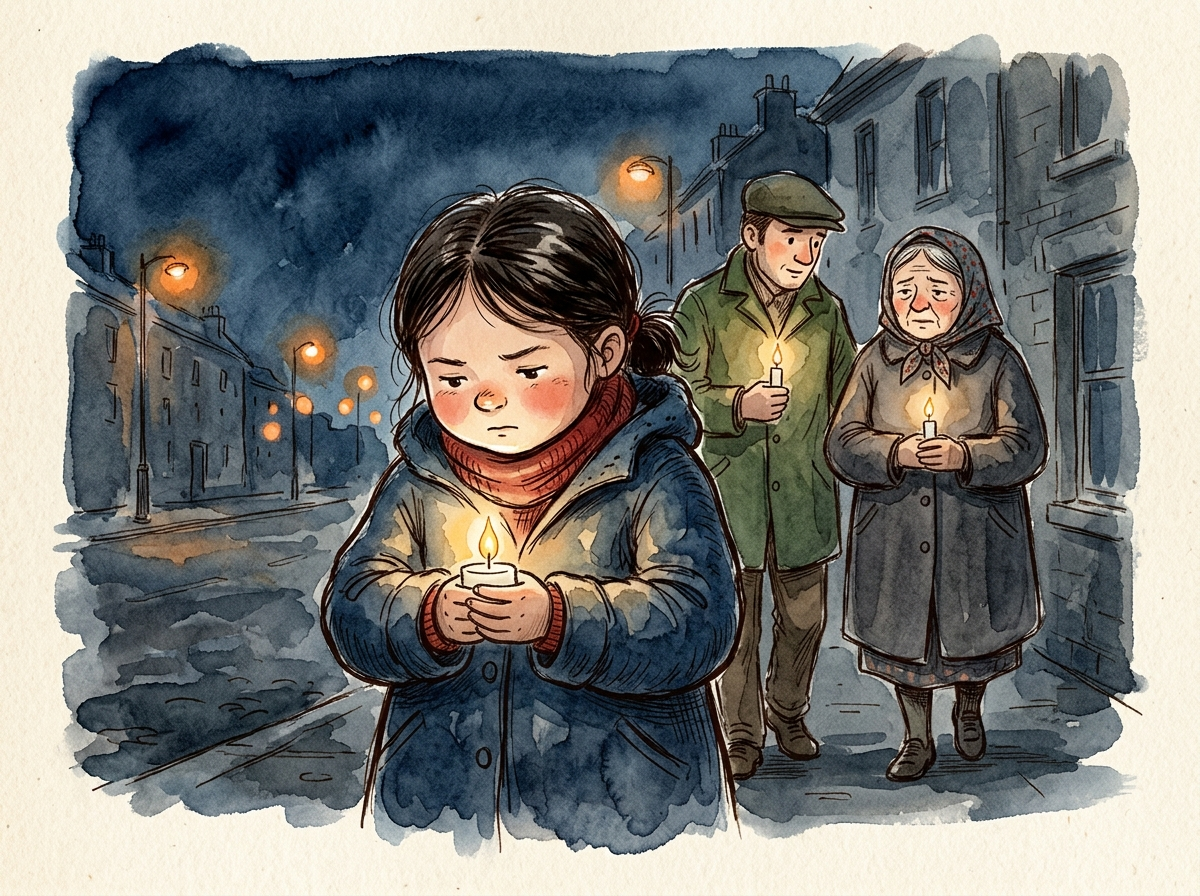
The night air hit her face, and it was like stepping into another world. The street was blue and silver under the streetlights. Every house on Marigold Lane sat still and dark. A cat she'd never seen before sat on Mr. Patterson's car and watched her with moon-colored eyes.
Sid walked.
Her footsteps sounded enormous. Every scuff on the sidewalk echoed like a drumbeat. She passed the Garcias' house, the empty lot with the shopping cart in it, the corner where the big oak tree made a cave of shadows.
She was scared.
She admitted this to herself clearly and completely. Her heart was doing something weird and fast in her chest, and her palms were sweating, and every sound — a distant car, a dog barking three streets over, the wind moving through somebody's wind chimes — made her flinch.
But she kept walking.
Block two. Block three. She crossed Elm Avenue, looking both ways twice, then a third time for good measure. A car passed, and she stepped behind a mailbox, feeling ridiculous and also not ridiculous at all.
By block five, something started to shift. The fear was still there, but it was sharing space now with something else — something bright and fizzy and electric. She was outside. At midnight. By herself. The world was the same world she walked through every day on the way to school and back, but it had transformed into something stranger and more beautiful, like a familiar photograph with the colors inverted.
She noticed things she'd never seen in daylight. The way the laundromat's neon sign buzzed and flickered, turning the sidewalk pink. The way someone had drawn a tiny chalk dragon on the curb outside the barbershop. The way the stars — actual stars — were visible above the gap between the hardware store and the pharmacy.
By block seven, she was smiling.
By block eight, she was practically running.
And then — Birch Street.
The old post office sat on the corner like a patient, tired giant. Its brick wall — the one facing the parking lot — was massive. Thirty feet wide, maybe fifteen feet tall, faded and cracked and beautiful in its blankness. Sid stood in front of it and tried to imagine her foxes there. Her wildflowers. The colors she'd planned — burnt orange and violet and a green so deep it would look like you could fall into it.
She could see it. She could really see it.
She pulled out her phone, held it at arm's length, and took a photo. In the picture, she was small and the wall was huge and the streetlight made everything glow amber. She looked, she thought, like exactly what she was — a kid with a big idea, standing in front of a big wall, in the middle of the night.
She typed the email carefully, attached the photo, and hit send.
Done.
She stood there for another minute, just looking. Just breathing. The night air smelled like warm pavement and something sweet from the overgrown lot next door. Then she turned around and walked home.
The return trip was different. Easier. The streets were the same streets, but they felt more familiar now, like she'd introduced herself and they'd decided she was okay. The cat was still on Mr. Patterson's car. It blinked at her. She blinked back.
She slipped through the front door, relocked the deadbolt, refastened the chain. Down the hallway. Past the bathroom. Past Mom's door —
"Sid."
She froze.
The bedside light clicked on. Mom was sitting up in bed, glasses on, phone in her hand. She did not look sleepy. She looked like someone who had been sitting up in bed, glasses on, phone in hand, for a while.
"I heard you leave," Mom said. "I've been tracking your phone."
Sid's stomach dropped through the floor, through the foundation of the house, and into the center of the earth.
"I —" Sid started.
"Birch Street," Mom said. "You walked to Birch Street. At midnight."
"Mom, I can explain —"
"I know about the letter, Sid."
Silence. The house ticked.
"I know I should have told you," Mom said. Her voice was doing something Sid didn't expect — it was shaking, but not with anger. "I read it and I just… I got scared. They'd want you to come to meetings, and work on the wall, and it's a busy street, and you'd be out there with paints and ladders and strangers and —" She stopped. Pressed her hands against her face. "I was going to tell you. I was going to figure out how to make it work. I just ran out of time."
Sid stood in the hallway, heart pounding, waiting.
Mom lowered her hands. Her eyes were red. "You walked nine blocks alone in the dark."
"Yes."
"Were you scared?"
"Yes," Sid said. "But I did it anyway."
Mom stared at her for a long time. Something moved across her face — something complicated and layered, like watching weather cross a wide open sky.
"Come here," Mom said.
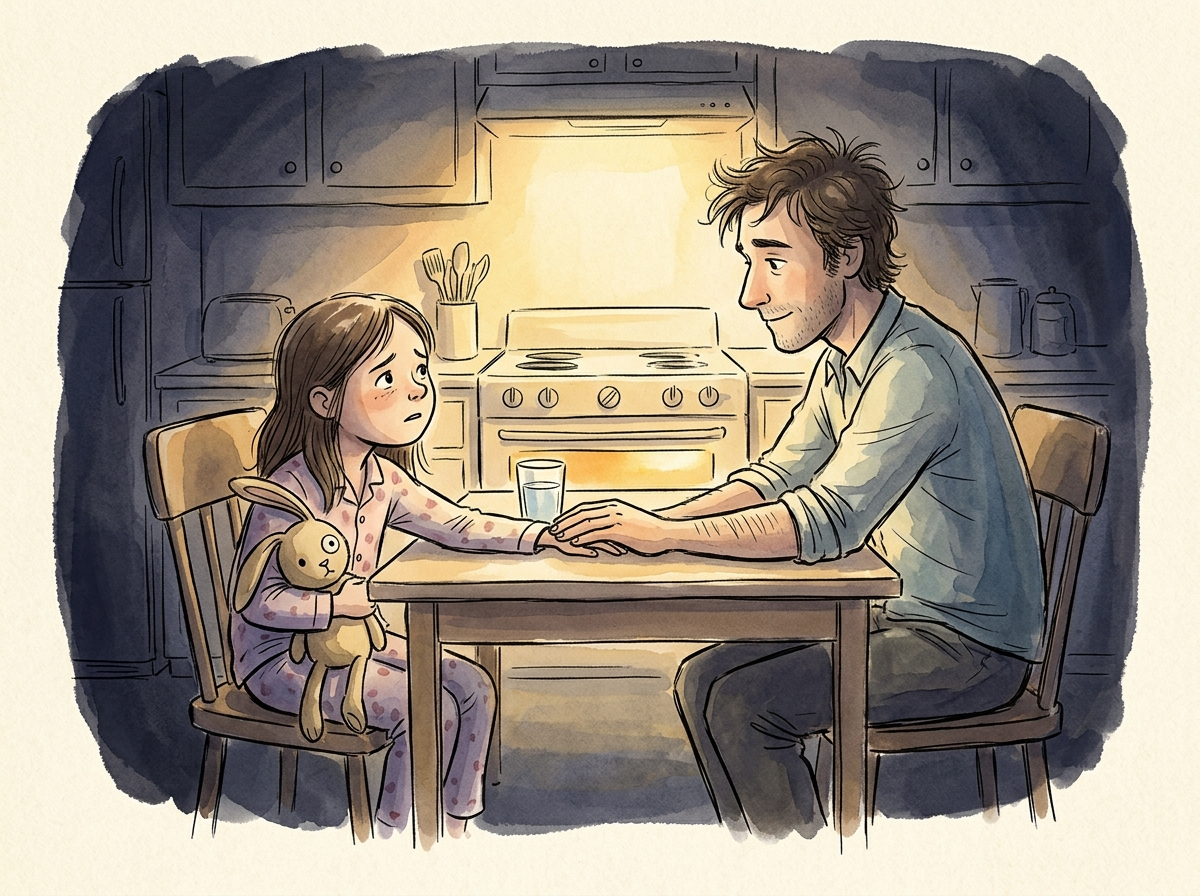
Sid walked to the bed and sat on the edge. Mom pulled her into a hug that was almost too tight, the kind that said I am terrified and proud and I don't know what to do with either of those things.
"Tomorrow," Mom said into Sid's hair. "Tomorrow I'll call the council. We'll schedule the interview."
"Really?"
"Really." Mom pulled back. "But Sid — you are grounded. You snuck out of this house at midnight. Two weeks. No debate."
"Fair," Sid said.
"And next time you have something to say to me — about a letter, about anything — you say it. To my face. In the daytime. Like a person who lives in this house."
"Okay."
"Okay." Mom let out a long breath. "Now go to bed."
Sid got up and walked to the door. She turned back.
"Mom?"
"What."
"The wall is perfect. You should see it. It's going to be so good."
Mom looked at her — this kid in a hoodie and sneakers, standing in the hallway at 12:40 in the morning with chalk dust on her fingertips and stars still in her eyes — and something in her expression softened. Shifted. Opened, just a little, like a door.
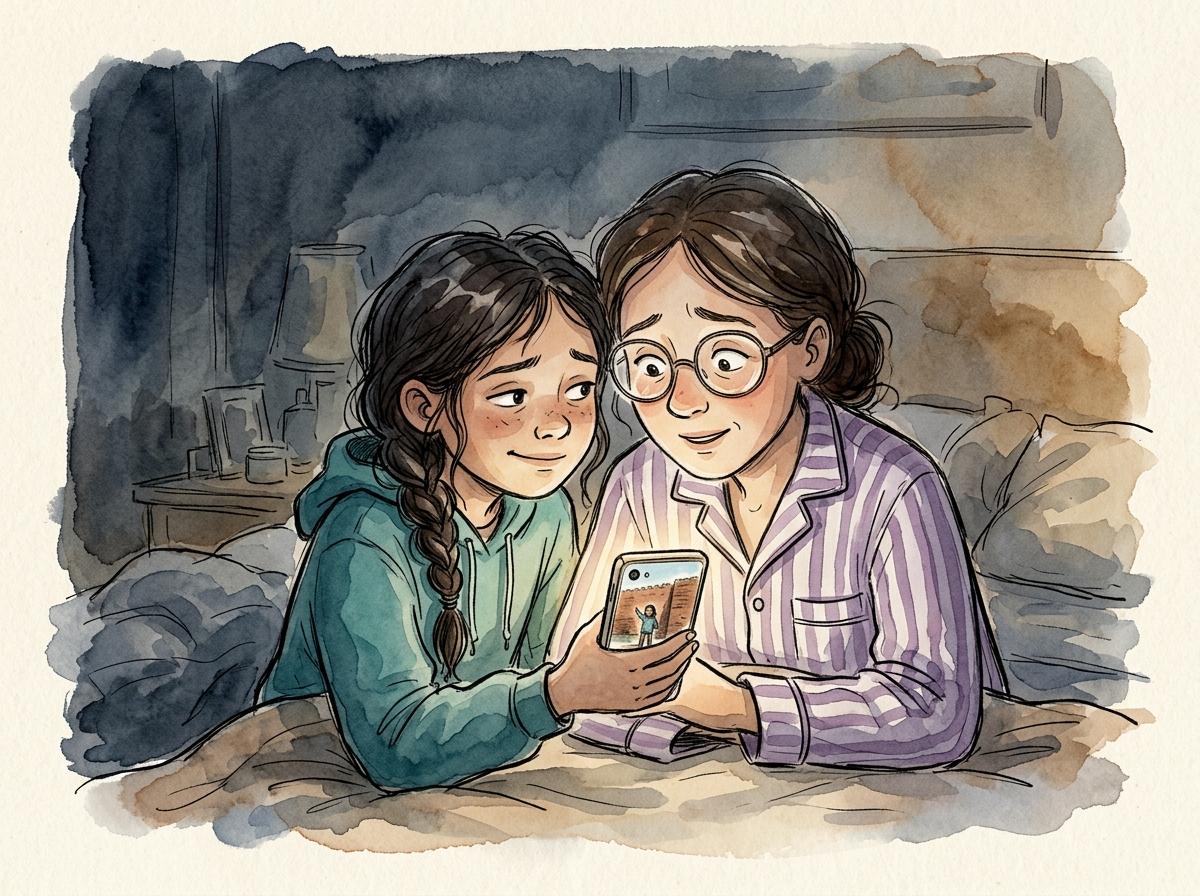
"Show me the picture," Mom said.
Sid pulled out her phone, climbed onto the bed, and showed her.