The Lighthouse Letter
Fable
Ages 9–11 · 11 min
On the shore at Gull Point, Iris finds a glass bottle with a letter inside from a boy who lived in the lighthouse during the war.
The bottle came in with the Tuesday tide.
Iris wasn't even supposed to be on the beach that morning. She was supposed to be at her grandmother's house, helping sort through boxes in the attic — the kind of chore that sounded boring and was, in fact, exactly as boring as it sounded. But Gran had fallen asleep in her reading chair at 9:15 AM, mouth open, glasses crooked, and Iris had taken that as permission to slip out the back door and down the sandy path to the shore.
The bottle came in with the Tuesday tide.
Iris wasn't even supposed to be on the beach that morning. She was supposed to be at her grandmother's house, helping sort through boxes in the attic — the kind of chore that sounded boring and was, in fact, exactly as boring as it sounded. But Gran had fallen asleep in her reading chair at 9:15 AM, mouth open, glasses crooked, and Iris had taken that as permission to slip out the back door and down the sandy path to the shore.
The beach at Gull Point wasn't the kind you saw on postcards. There were no palm trees or white sand or people lying on colorful towels. It was rocky and gray and smelled like salt and old seaweed, and the wind always seemed to be going in three directions at once. The lighthouse stood at the far end, white with a red stripe, its light turned off years ago. Iris loved it with her whole heart.
She was climbing over the tide pools, sneakers squelching, when she saw it. A glass bottle, dark green, wedged between two rocks like it had been placed there carefully by someone with very small, precise hands.
Iris pulled it free. There was something inside.
She held the bottle up to the gray sky and could see paper — yellowed, rolled tight, tied with what looked like a piece of string. Her fingers tingled. Her stomach did a little flip.
She sat down on a flat rock, unscrewed the crusted cap, and tilted the bottle until the rolled paper slid into her palm.
The letter was written in pencil, in careful handwriting that slanted slightly to the right.
3rd September, 1943
To whoever finds this,
My name is Thomas Alcott. I am twelve years old and I live in the lighthouse at Gull Point with my mother. My father is away at the war and we have not had a letter from him in four months.
I am writing this because today is the loneliest I have ever been. Mother says loneliness is just boredom wearing a costume, but I don't think that's true. I think loneliness is real and it is heavy and it sits on your chest like a cat that won't move.
If you find this letter, I would like to know one thing: Does the lighthouse still stand? I worry about it sometimes, the way you worry about a friend who is old and tired.
Your friend across the water, Thomas Alcott
Iris read it three times.
Then she read it a fourth time, slower, whispering the words so the wind carried them.
Loneliness is real and it is heavy and it sits on your chest like a cat that won't move.
She looked up at the lighthouse, its paint peeling, its windows dark. It still stood. Thomas would want to know that.
And then — even though it was impossible, even though she knew it was completely, absolutely, one hundred percent impossible — Iris decided to write back.
She ran back to Gran's house, careful to ease the screen door shut. Gran was still asleep, snoring lightly, a book about perennial gardens rising and falling on her chest. Iris crept to the kitchen table, found a pencil and a sheet of paper from Gran's telephone pad, and sat down to write.
She stared at the blank page for a long time.
What do you say to someone who wrote to you eighty years ago? Someone who was lonely and twelve and worried about a lighthouse and his father?
She started three times, crumpling each attempt.
Too formal. Crumple. Too weird. Crumple. Way too long and kind of sad. Crumple.
Finally, she just wrote what was true.
Dear Thomas,
My name is Iris and I found your letter today, September 9th, in the year 2023. I know that probably sounds fake. I promise it's not.
The lighthouse still stands. It doesn't work anymore, but it's still there, white with a red stripe, and honestly it looks pretty good for something that's over a hundred years old. Better than most things I know.
I think you're right about loneliness. It IS heavy. My parents got divorced last year and I've been staying with my grandmother a lot, and sometimes the feeling sits on me exactly the way you described. Like a cat. A big one. Maybe one of those Maine Coons that weigh twenty pounds.
I hope your father came home from the war. I hope you got his letters eventually. I hope you had a good life.
Your friend across the time, Iris
She rolled the letter tight, tied it with a rubber band — she couldn't find string — and put it in an empty jam jar from Gran's recycling bin. It wasn't as elegant as a green glass bottle, but it would do.
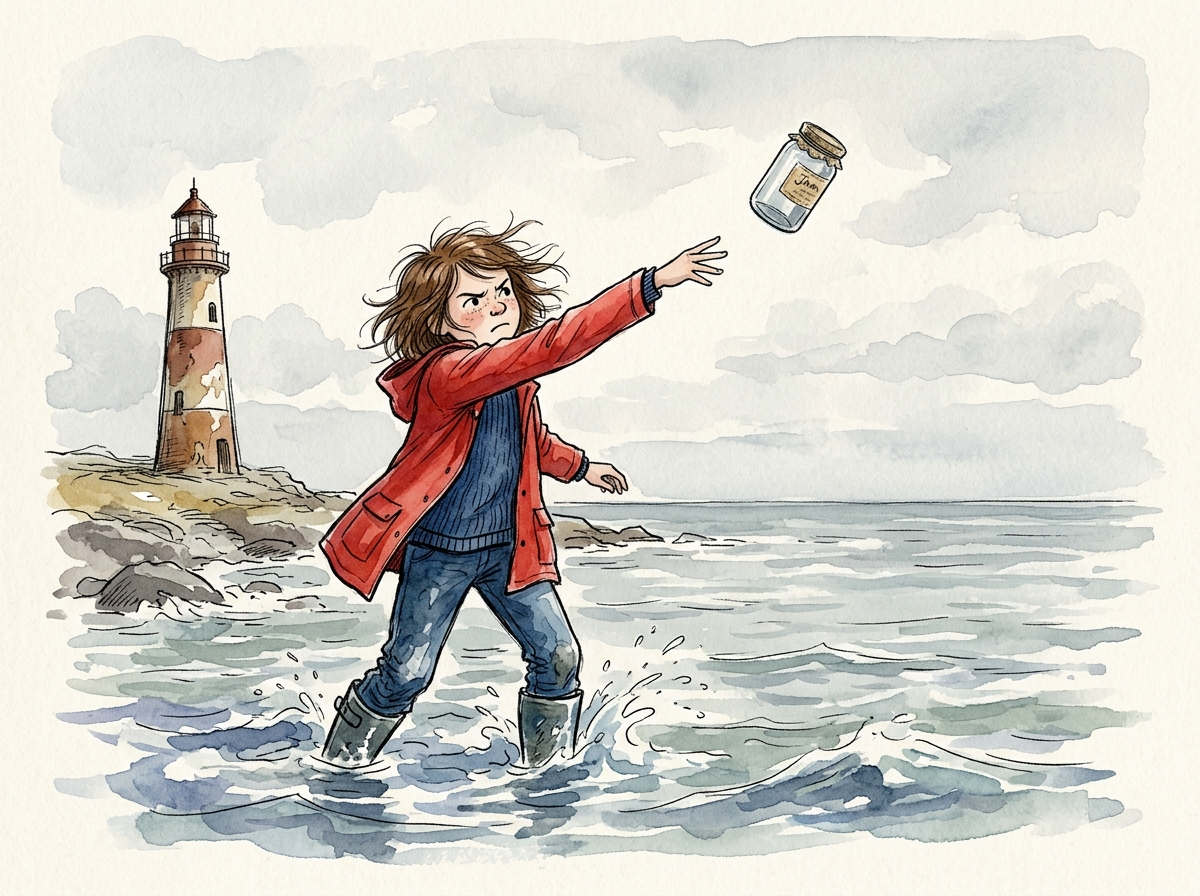
She walked back to the beach and stood at the edge of the water. The waves licked at her sneakers. She pulled her arm back and threw the jar as far as she could. It wasn't very far. It splashed into the shallows and immediately started drifting back toward her.
She threw it again. Same thing.
The third time, she waded in up to her knees — gasping at the cold — and hurled it with everything she had. The jar caught a wave heading outward and tumbled over itself, bobbing, getting smaller, until she couldn't see it anymore.
Iris stood there, jeans soaked, shivering, knowing the letter would never reach Thomas Alcott. Knowing it would probably wash up on this same beach tomorrow, or end up in a landfill, or sit on the ocean floor collecting barnacles.
She didn't care. She had written back. That was the thing. Someone had said, I am lonely, and she had said, me too.
That afternoon, Gran woke up, adjusted her glasses, and said, "Have you been swimming with your clothes on?"
"I was throwing something into the ocean," Iris said, because she was a terrible liar.
"Ah," said Gran, as if this were perfectly normal. "Well, help me with these attic boxes, then. I've put it off long enough."
The attic was hot and dusty and packed with things that hadn't seen daylight in decades. There were boxes of Christmas ornaments, stacks of old National Geographic magazines, a broken rocking horse, and a sewing machine that looked like it belonged in a museum.
"Gran, what do you want me to do with all this?" Iris asked, lifting the lid of a cardboard box labeled MISCELLANEOUS in shaky handwriting.
"Sort it into keep, donate, and rubbish. Use your judgment."
Iris pulled out a tarnished picture frame, a set of brass buttons, a folded flag, a stack of letters tied with — she stopped.
Tied with string.
The letters were old. The paper was yellowed. The handwriting slanted slightly to the right.
Her hands were shaking as she untied the bundle and opened the first envelope.
14th March, 1944
Dear Mother,
I received your package yesterday. The socks are too big but I'm wearing them anyway because my old ones have surrendered entirely...
Iris flipped through the letters quickly, scanning names and dates, her heart hammering.
"Gran," she said, her voice strange and thin. "Who is Thomas Alcott?"
Gran looked up from the sewing machine she was inspecting. Her expression shifted — surprise, then something softer, like a window opening.
"Thomas Alcott," she said slowly, "was my father."
The attic went very quiet.
"He grew up in that lighthouse," Gran continued, settling herself onto an old trunk. "Lived there with his mother during the war while his father — my grandfather — was overseas. He always said those were the loneliest years of his life." She paused, smiling at something Iris couldn't see. "But also that they taught him how to reach out. How to send his feelings out into the world and trust that someone, somewhere, might catch them."
Iris held the letters against her chest. "Did his father come home?"
"He did. Summer of 1944. Walked right up the beach path, and Thomas didn't even recognize him at first because he'd grown a beard." Gran laughed quietly. "My father told that story a hundred times."
"Gran," Iris said. "I found something on the beach this morning."
And she told her. All of it — the bottle, the letter, the jam jar, the soaked jeans, everything. Gran listened without interrupting, which was unusual for her. When Iris finished, Gran was quiet for a long moment.
Then she held out her hand. "May I see his letter?"
Iris pulled the green bottle from her jacket pocket — she'd been carrying it all day without quite realizing it — and handed it over. Gran unrolled the letter with careful fingers and read it silently. Her eyes got bright, and she blinked several times, and she pressed the letter gently to her cheek.
"He'd be glad," Gran whispered. "He'd be so glad someone wrote back."
That evening, Iris sat on Gran's porch, wrapped in a quilt, watching the lighthouse go dark against the sunset. The light didn't work anymore, but the lighthouse still stood. That mattered. Being there mattered, even when you felt like you couldn't do anything, even when the jar floated right back to your feet.
She thought about Thomas, twelve years old, sitting in that lighthouse with his pencil and his loneliness, deciding to roll up his feelings and throw them into the sea. Not knowing if anyone would find them. Not knowing that eighty years later, a girl with soaked jeans and a jam jar would read his words and understand them in her bones.
Gran came out and sat beside her. She didn't say anything. She just handed Iris a cup of hot chocolate and settled into her chair, and they sat together, not lonely, watching the sky turn colors over the water.
The lighthouse held its ground against the wind, the way it always had.