Milo and the Map
Fable
Ages 6–8 · 8 min
After boasting he can map his entire neighborhood from memory, Milo must take his finished drawing and his skeptical sister outside to prove it.
Milo was seven years old, and he knew things.
He knew that cats were better than dogs. He knew that Thursday was the worst day of the week. He knew that his grandmother's house smelled like cinnamon even though his mother said it smelled like lavender, and he knew — he absolutely knew — that he could draw a perfect map of his neighborhood with his eyes closed.
Milo was seven years old, and he knew things.
He knew that cats were better than dogs. He knew that Thursday was the worst day of the week. He knew that his grandmother's house smelled like cinnamon even though his mother said it smelled like lavender, and he knew — he absolutely knew — that he could draw a perfect map of his neighborhood with his eyes closed.
Well, not with his eyes closed. He'd need his eyes open to see the paper. But he wouldn't need to look out the window or walk down the street or check anything at all, because Milo remembered everything.
"Everything?" said his older sister, June, raising one eyebrow the way she'd been practicing in the mirror.
"Everything," said Milo.
So on a rainy Tuesday afternoon, Milo got the biggest piece of paper he could find — the back of an old poster from the recycling bin — and he spread it across the kitchen table and picked up a fat blue marker.
He started with his own house, right in the middle. He drew the front door (red) and the big tree in the yard (enormous) and the mailbox that leaned a little to the left. Then he drew the sidewalk going both directions.
"Mrs. Huang's house is next," he said out loud, drawing it to the right. "It's yellow. And she has a garden with a wooden fence."
He drew Mr. Patterson's house across the street — the one with the green shutters and the porch that wrapped all the way around. He drew the fire hydrant on the corner, and the big oak tree next to it. He drew the bakery two blocks down, and the park with the twisty slide, and the little free library shaped like a barn.
He drew and drew and drew.
When he was finished, he held it up. The map was beautiful. It was detailed. It was, Milo thought, perfect.
"Are you sure about all that?" said June, who was eating an apple and being annoying.
"I'm sure about everything," said Milo.
June shrugged. "Okay. Let's walk it."
The rain had stopped, and the sidewalks were shiny and wet. Milo brought his map, and June brought the apple, and they started right at the front door.
"See?" said Milo, pointing at the map, then at the house. "Red door. Big tree. Mailbox leaning to the left."
He looked at the mailbox.
The mailbox was leaning to the right.
"Huh," said Milo.
"Huh," said June.
"That's just one tiny thing," said Milo. He pulled out a pencil and made a small correction on the map. A very small correction. Barely worth mentioning.
They walked to Mrs. Huang's house. Milo had drawn it yellow with a wooden fence around the garden.
Mrs. Huang's house was yellow. This was very satisfying.
But the fence was not wooden. It was made of wire, with little metal curls at the top, and green beans were climbing all over it like they were trying to escape.
"I was close," said Milo.
"You were in the neighborhood," said June, and then laughed at her own joke.
Milo erased the wooden fence on his map and drew a wire one with little scribbly green beans. The map was getting a tiny bit messy now, but that was fine. That was part of the process.
They crossed the street to Mr. Patterson's house. Milo checked his map confidently. Green shutters. A porch that wrapped all the way around.
The shutters were blue.
"Those are absolutely green," said Milo.
"Those are absolutely blue," said June.
Milo squinted. He tilted his head. He took three steps closer.
They were blue. They were so blue. They were the bluest shutters he had ever seen in his life, and he could not understand how he had ever, for even one second, thought they were green.
And the porch did not wrap all the way around. It went across the front and stopped.
"It feels like it wraps around," Milo said quietly.
He made more corrections on the map. The map was starting to look a little rough.
They kept walking.
The fire hydrant was not on the corner. It was in the middle of the block. Milo fixed it.
The big oak tree next to the fire hydrant was actually a maple. Milo stared up at the leaves for a long time. "Oak, maple — same family," he said.
"They are not the same family," said June.
He fixed it.
The bakery was not two blocks down. It was three blocks down. And it was on the other side of the street. And it was not called "The Bread Place" like he'd written on the map. It was called "Sunrise Bakery," which Milo admitted was a better name anyway.
The park had the twisty slide — he got that right! — but it also had a second slide, a straight one, that Milo had completely forgotten, even though June reminded him he'd gone down it about a thousand times last summer.
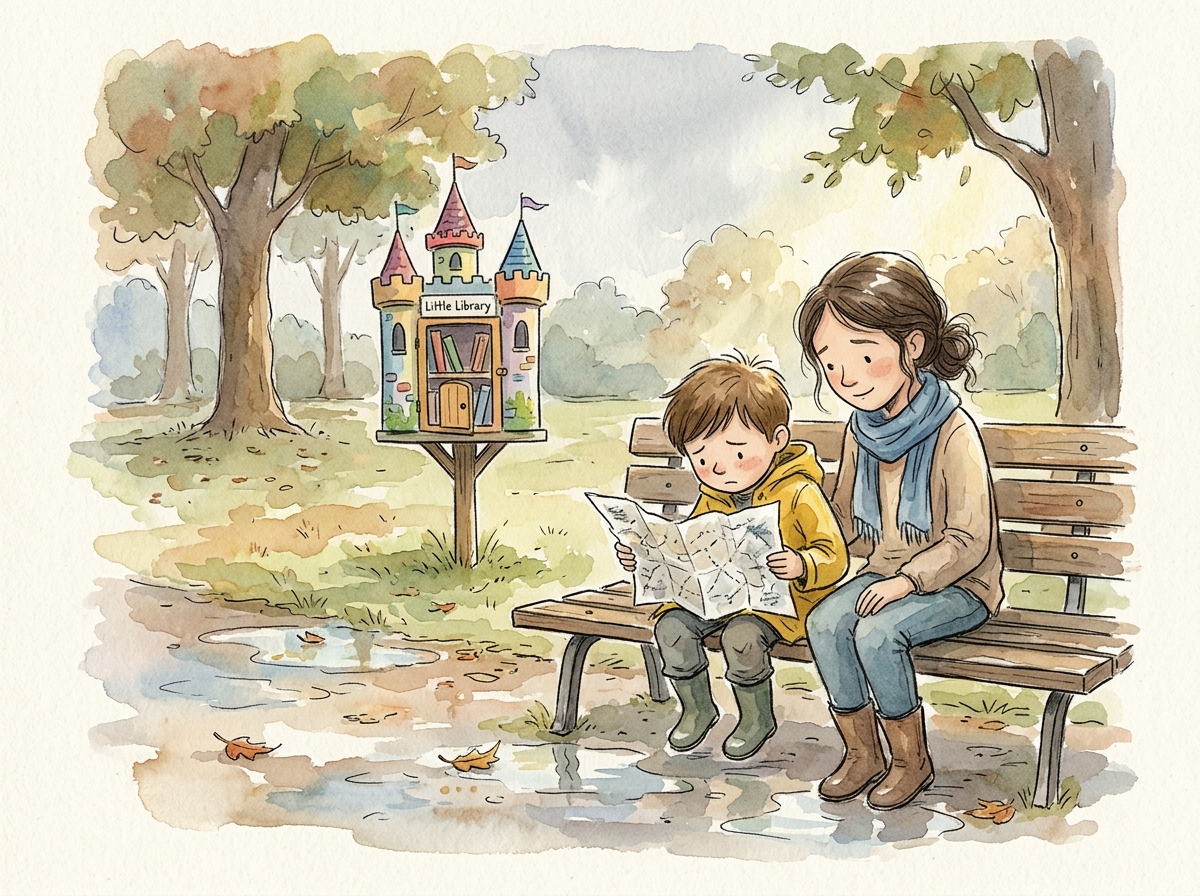
And the little free library was not shaped like a barn.
It was shaped like a castle.
Milo stared at it. He'd walked past this little free library nearly every day for a year. He had taken books from it. He had put books back in it. And somehow, in his memory, the castle had become a barn.
"How did I get a castle wrong?" Milo whispered.
He looked down at his map. It was covered in eraser marks and corrections and crossed-out words and redrawn lines. It looked like it had been through a storm.
Milo sat down on the bench next to the little free library castle and frowned at the paper for a long time.
"It's a bad map," he said.
June sat down next to him. She'd finished her apple a while ago and had been surprisingly quiet for several minutes, which was unlike her.
"Can I see it?" she said.
Milo handed it over.
June studied it — the original lines and the corrections, the wrong colors crossed out and the right colors written in, the arrows moving things to where they actually belonged.
"This is a great map," she said.
Milo looked at her suspiciously. "You just watched me get almost everything wrong."
"Yeah," said June. "And then you fixed almost everything. Now it's right. Before, it was just a drawing of what you thought you remembered. Now it's a map of what's actually here."
She handed it back.
Milo looked at the messy, scribbled, corrected paper. The original drawing had been prettier. But this version — with the wire fence and the blue shutters and the fire hydrant in the right place and the castle — this version could actually help someone find their way.
"I think I need a new piece of paper," Milo said. "To draw it again. The real version."
"Can I help?" said June.
Milo thought about this. Usually he would say no, because he liked doing things himself, and because he was seven, and because he had opinions about how maps should look.
But then again, he had just discovered that his memory had turned a castle into a barn.
"Yeah," said Milo. "You can help."
They walked the whole neighborhood one more time before going home. This time, Milo looked — really looked — at everything. He noticed that Mrs. Huang's house had a wind chime shaped like a dragonfly. He noticed that Mr. Patterson's blue-shuttered house had a welcome mat that said "HELLO" in five languages. He noticed a crack in the sidewalk shaped like a lightning bolt and a fence post where someone had stuck googly eyes.
He'd walked these streets a hundred times and never seen any of it.
That evening, Milo spread a fresh piece of paper on the kitchen table. June sat across from him with her own marker. And together, they drew the neighborhood — not the one Milo had carried around in his head, but the one that was actually, wonderfully, surprisingly there.
It was a very good map.
And this time, the castle was a castle.