The Kid Nobody Talked To
Fable
Ages 9–11 · 13 min
Every day at lunch, Marisol watches a new boy sit by himself at the wobbly table by the wall and wonders if she has the courage to say hello.
Marisol first noticed him on a Monday.
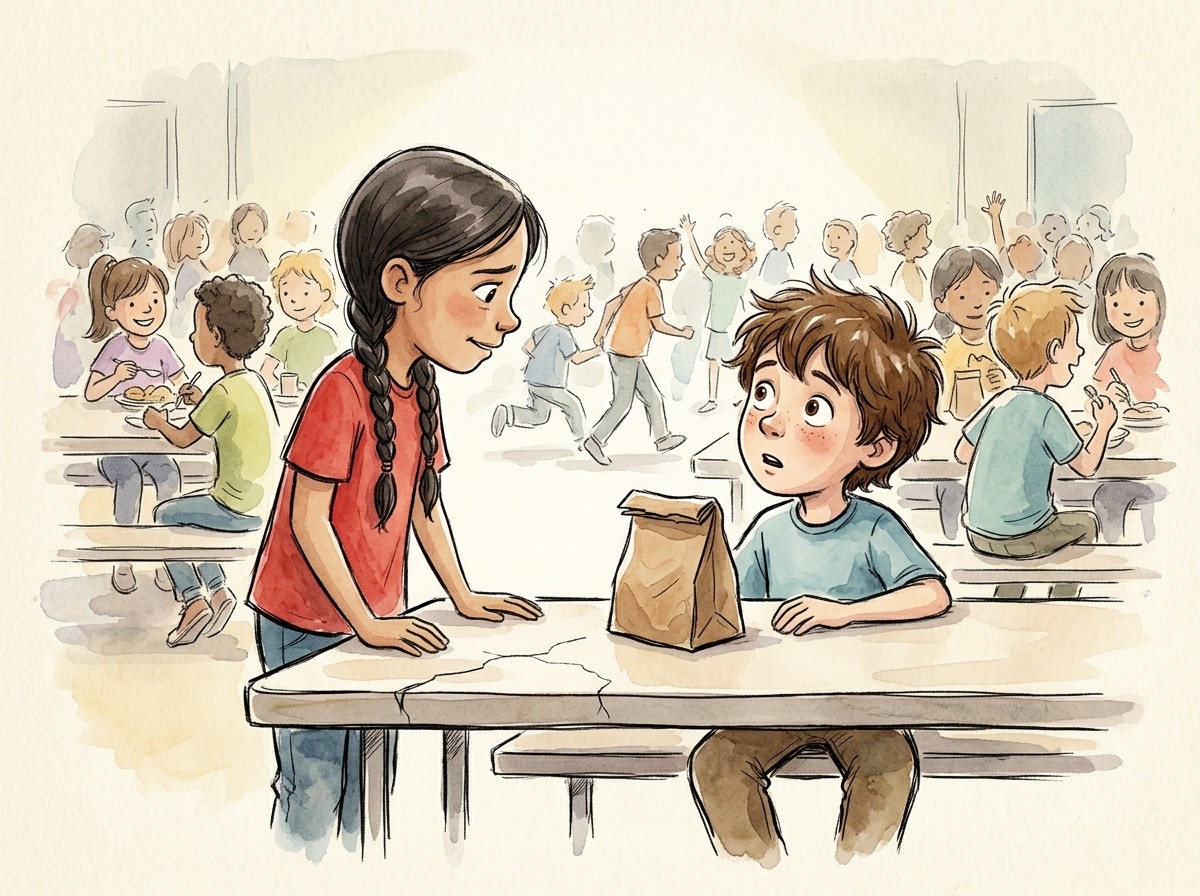
He was sitting at the end of the lunch table closest to the wall, the seat nobody picked on purpose — the one with the wobbly leg and the crack running through the middle like a lightning bolt. He had a brown paper bag and he was eating a sandwich slowly, looking straight ahead at nothing, like he was watching a movie that only he could see.
Marisol first noticed him on a Monday.
He was sitting at the end of the lunch table closest to the wall, the seat nobody picked on purpose — the one with the wobbly leg and the crack running through the middle like a lightning bolt. He had a brown paper bag and he was eating a sandwich slowly, looking straight ahead at nothing, like he was watching a movie that only he could see.
She almost said something. Almost. But Priya was telling her about the raccoon that had gotten into her garage over the weekend, and it was genuinely a great story — the raccoon had knocked over an entire shelf of paint cans — so Marisol laughed and ate her chips and forgot about the kid by the wall.
On Tuesday, he was there again. Same seat. Same brown bag. This time he had an apple, and he was turning it around and around in his hands like he was studying it from every angle before deciding where to bite. Nobody sat within three chairs of him. It wasn't that kids had decided not to sit near him. It was more like he was invisible — like the empty chairs around him were just empty chairs and he was just part of the wall.
Marisol watched him for maybe ten seconds. Then Jackson slid his tray next to hers and said, "Did you do the math homework? Because I have no idea what distributive property even means," and she spent the rest of lunch trying to explain parentheses.
Wednesday. There he was. He had a book this time — a thick one with a dark blue cover and no pictures on the front. He wasn't eating. Just reading. His eyes moved steadily across the pages, and every once in a while, he'd do this thing where he almost smiled — like a smile that got halfway to his mouth and then changed its mind.
Marisol thought: I should go over there.
And then she thought: And say what?
And then: What if he wants to be alone?
And then: What if it's weird?
And then Priya said, "Mars, are you coming to the field? We're doing soccer," and Marisol went to the field and played soccer and was the second-best goalie, which she felt pretty good about.
Thursday was the worst one. Thursday was the day she saw him in the hallway after last period, standing by the water fountain, waiting. A group of kids walked past, and one of them — Tyler Beck, who Marisol had known since first grade — bumped into him. Not hard. Not on purpose, probably. But the kid stumbled a little, and Tyler didn't say sorry or even look back, and the kid just… adjusted his backpack straps and kept standing there. Like bumps were just a thing that happened. Like weather.
That was the image Marisol couldn't shake. Not the bump. The adjusting. The way he fixed his backpack so carefully afterward, like he was putting himself back together piece by piece.
She went home and lay on her bed and stared at the ceiling.
"You're quiet," her mom said at dinner.
"I'm thinking."
"About what?"
"There's this kid at school."
Her mom waited the way she always did — patient, fork paused midair.
"He doesn't talk to anyone. Or — nobody talks to him. I don't know which one it is."
"Hmm," her mom said. "Do you know his name?"
Marisol didn't. And that felt like the worst part of all.
Friday. She told herself she'd do it Friday. She'd walk over to the wobbly table and say hi and ask his name and maybe ask about the book with the blue cover. She had it all planned out. She even practiced in the bathroom mirror that morning, which she would deny under oath in a court of law.
But then Friday came and the cafeteria was loud and buzzing because someone had started a rumor that the sixth graders were getting a field trip to Wildwater Kingdom, and everyone was talking about it, and Marisol got caught up in the noise and the excitement, and when she finally looked over at the wobbly table —
He was there. Same spot. No book today. Just sitting, his hands flat on the table, looking at the space in front of him.
And Marisol felt something twist in her chest like a key turning in a lock, and she thought: A whole week. He's been sitting there a whole week and I've done nothing.
She stood up.
"Where are you going?" Priya asked.
"Be right back."
It was maybe twenty steps from her seat to his table. Twenty steps. She counted them because counting gave her brain something to do besides scream WHAT ARE YOU DOING?
Fifteen steps. The cafeteria noise seemed to get quieter, or maybe louder — she couldn't tell.
Ten steps. He hadn't seen her yet.
Five steps. Her heart was pounding like she was about to give a presentation in front of the entire school, which was ridiculous because she was literally just walking toward a table.
She stopped next to the chair across from him.
"Hi," she said.
He looked up. He had brown eyes, and they were wide, and for a second he looked startled — like he couldn't quite believe someone was standing there on purpose.
"Hi," he said back. His voice was quiet but not shaky. Just… unused. Like a door that hadn't been opened in a while.
"I'm Marisol."
"I know," he said. Then he blinked. "I mean — I've heard people call you that. I'm not — I didn't —"
"It's fine," she said, and she almost laughed because he looked so worried when literally all he'd done was hear her name. "Can I sit?"
He nodded fast. Too fast. Then seemed embarrassed about nodding too fast.
She sat down. The chair wobbled. "This table is the worst," she said.
"The trick is to put your foot on the short leg," he said. "Like a human shim."
She tried it. The wobble stopped. "Oh, that's actually genius."
"I've had a lot of practice." He almost smiled — the real kind this time, the kind that actually reached his mouth.
"What's your name?"
"Elliot."
"When did you start here? I haven't seen you before this week."
"Last Monday. We moved from Reno. My dad got transferred."
Marisol nodded. She tried to imagine it — new city, new school, new cafeteria, nobody knowing your name. No Priya. No Jackson. No one to argue about distributive property with. Just a brown paper bag and a wobbly table and five days of silence.
"That's really hard," she said. She didn't say it in a pitying way. She said it the way you say that's a big hill when you're biking with someone — just acknowledging the truth of the thing.
Elliot shrugged. "It's okay. I've done it before. We moved from Tucson before Reno."
"Has it gotten easier?"
He thought about it honestly. She could tell he was actually thinking and not just saying what sounded right. "The moving part gets easier. The first-week part never does."
"What's the worst thing about the first week?"
"Lunch," he said immediately, and then laughed — a short, surprised laugh, like he hadn't expected it to come out. "That's dumb."
"That's not dumb at all. Lunch is when you can really feel it."
He stared at her. "Yeah. That's exactly it."
They were quiet for a second. Around them, the cafeteria roared and clattered, but their little pocket of wobbly table felt separate, like a tiny island.
"What's the book you were reading?" Marisol asked. "The blue one?"
His face lit up in a way that made him look like a completely different person. "It's called The House in the Cerulean Sea. It's about this guy who has a really boring life and then he gets sent to this island where there are these magical kids and —" He stopped. "Sorry. I can talk about books for, like, ever."
"Don't apologize for that. That's not a thing you apologize for."
He did the almost-smile again, but this time it completed its journey.
"Do you want to come sit with us?" Marisol pointed toward her table, where Priya and Jackson and a few others were deep in debate about whether Wildwater Kingdom had a lazy river or not. "Fair warning — they're kind of loud."
Elliot looked over at the table. Then back at Marisol. Then at his hands.
"You don't have to," she added quickly. "If you like it here, that's cool too. I just —"
"No," he said. "I want to." He picked up his brown paper bag. "I just… are you sure they won't mind?"
"Elliot. Jackson once spent an entire lunch period ranking every type of cheese. They are not picky about company."
He laughed again. A real one this time. And he picked up his bag and followed her back across the cafeteria, and when they got to the table, Marisol said, "Everyone, this is Elliot. He just moved here from Reno, he's reading a really good book, and he knows how to fix wobbly tables."
"From Reno?" Jackson said. "Isn't it super hot there?"
"Unbelievably hot," Elliot said. "Like, melt-your-shoes hot."
"No way. How hot?"
And just like that, Elliot was talking. Not a lot. Not the loudest person at the table. But talking. And Priya asked about the book, and Elliot told her, and she said it sounded amazing, and Jackson asked if there were lazy rivers in Reno, which didn't make sense as a question but somehow kept the conversation going.
Marisol ate her chips and listened and felt the twist in her chest slowly unwind.
It had taken twenty steps. That was all. Twenty steps and five days too many — but twenty steps.
And the next Monday, when Marisol walked into the cafeteria, Elliot was already at their table. Not the wobbly one by the wall. Their table. He'd saved her a seat.
He was reading the blue book, and when he saw her, he smiled — the full kind, no hesitation — and said, "You have to read this when I'm done. Chapter twelve is going to destroy you."
"Can't wait," Marisol said.
She sat down, and the chair didn't wobble at all.