The Invisible Force
Fable
Ages 6–8 · 9 min
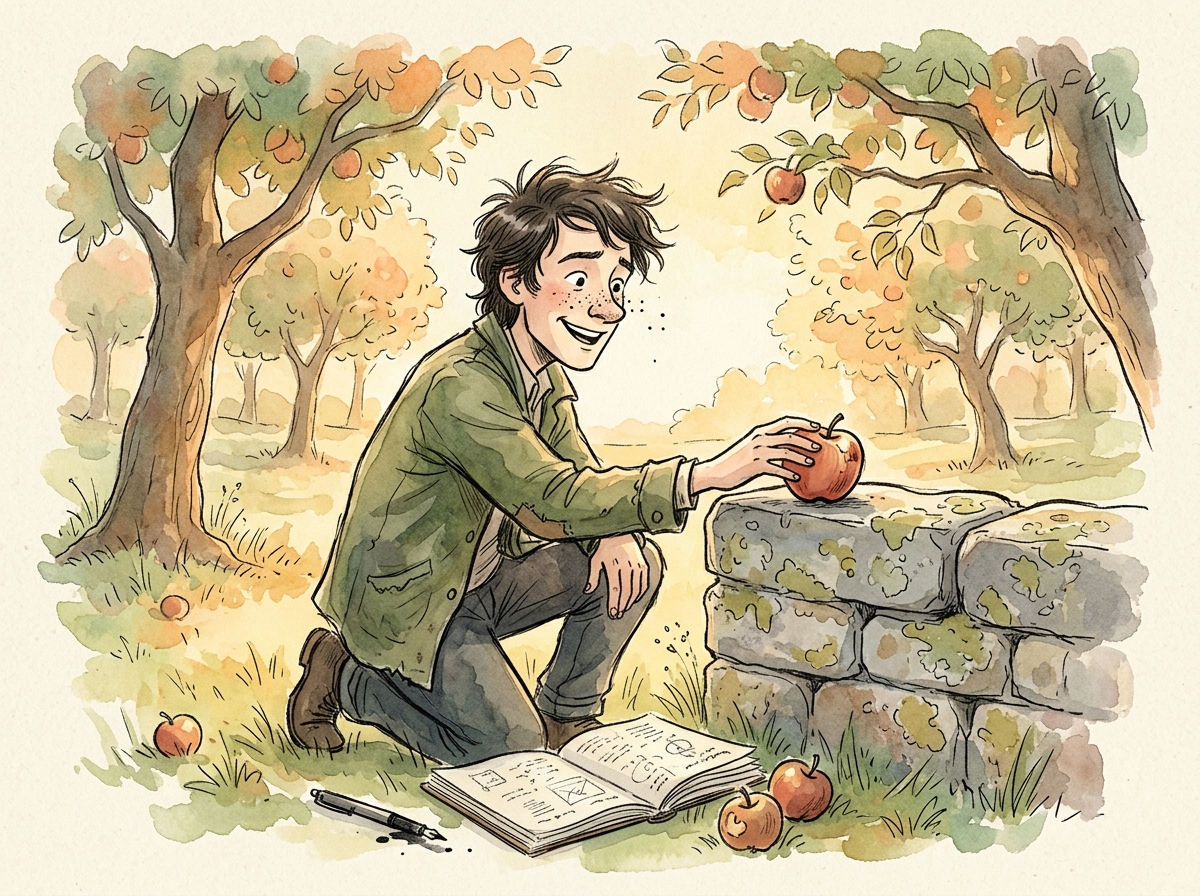
A plump red apple named Bramley dangles from a tired stem, directly over a young man named Newton who sits under the tree staring up at the sky.
My name is Bramley, and I am an apple.
Now, before you say "apples can't talk," let me just tell you — apples have a lot of time to think while hanging on a tree. We hang there for weeks and weeks and weeks, just dangling and thinking and growing rounder by the day. So I've had plenty of time to figure out how to tell you this story.
My name is Bramley, and I am an apple.
Now, before you say "apples can't talk," let me just tell you — apples have a lot of time to think while hanging on a tree. We hang there for weeks and weeks and weeks, just dangling and thinking and growing rounder by the day. So I've had plenty of time to figure out how to tell you this story.
It's about the most extraordinary day of my life.
It's about the day I fell.
It all started on a warm Tuesday in September. I was hanging from my usual branch — third from the top, slightly to the left — on the biggest apple tree in the orchard. I'd been growing there all summer long, and I was getting quite plump and quite red and, if I'm being honest, quite proud of myself.
"Look at me!" I whispered to the other apples. "I'm the roundest one up here!"
"Oh, hush, Bramley," said Granny Smith, the green apple two branches below me. She'd been on the tree much longer than I had and thought she knew everything. "Being round isn't everything."
"It is if you're an apple," I said.
She just grumbled the way old green apples do.
From my branch, I could see the whole world — the stone wall around the garden, the little cottage with its crooked chimney, and the path where a young man came to sit almost every single afternoon.
His name was Newton.
I knew this because the woman from the cottage would lean out the window and shout, "NEWTON! Come inside and eat your dinner!" and he would say, "In a minute!" and then not go inside for another two hours.
Newton was strange. He didn't chase chickens like the farm boys did. He didn't pick apples like the orchard workers. He just sat under our tree with a thick notebook and stared at things.
He stared at the sky.
He stared at the clouds.
He stared at the sunlight coming through our leaves.
"What is he LOOKING at?" I asked Granny Smith.
"He's thinking," she said.
"About what?"
"How should I know? I'm an apple."
On that particular Tuesday, Newton came to sit under the tree right after lunch. He had his notebook and his funny little ink pen, and he leaned his back against our trunk and looked up through the branches.
I looked down at him.
He looked up at me.
For one strange second, I felt like he was actually seeing me.
Then a breeze blew through the orchard. It was a gentle breeze, nothing special — but I had been growing rounder and heavier for weeks, and my stem had been getting thinner and more tired, and when that breeze came through...
Snap.
My stem broke.
And I was falling.
Now, let me tell you something about falling. When you've been hanging in the same spot your entire life, falling is the most shocking, most terrifying, most absolutely THRILLING thing that can happen to you.
The leaves rushed past me — whoosh!
A beetle on a branch looked at me with very surprised eyes.
The wind whistled around my skin.
And the whole time, I was thinking: Down. I'm going DOWN.
Not up. Not sideways. Not in a loop-de-loop.
DOWN.
Straight, straight, straight down.
BONK.
I landed right on Newton's head.
"OW!" he shouted, and his notebook went flying.
I bounced off his head and rolled into the grass beside him. The world was spinning. The sky was where the ground should be. I was dizzy and bruised and absolutely delighted to be alive.
Newton rubbed his head. He looked at me lying there in the grass, round and red and slightly dented.
And then he got very, very quiet.
He picked me up. He held me in his hand. He looked at me like I was the most interesting thing in the entire universe.
"Why..." he whispered, "did you fall down?"
Well, I thought that was a very silly question. Where ELSE would I fall?
But Newton wasn't finished.
He held me up at arm's length and then let go. I dropped — thump — right into his other hand.
"Down," he said. "Always down."
He picked up a pebble and tossed it into the air. It went up for a moment, then came right back down into the dirt.
"Down," he said again, his eyes growing wide.
He grabbed a stick and threw it as high as he could. It spun through the air, rising, rising... and then curving back down to earth.
"Down, down, down," Newton muttered. "Everything comes DOWN."
He looked at me again. Then he looked at the pebble. Then at the stick. Then up at the sky, where the moon was just barely visible in the pale afternoon blue.
"The moon..." he whispered. "Why doesn't the MOON fall down?"
Now THAT was an interesting question. Even I had to admit it.
Newton sat back against the tree and started scribbling in his notebook so fast that ink splattered on his nose. He drew pictures — circles with arrows, the earth with little dotted lines around it, the moon going round and round. He scribbled numbers and crossed them out and scribbled more numbers.
I just lay there in the grass, watching.
"There must be a force," he said out loud, though I don't think he was talking to me. "An invisible force. Something that pulls everything toward the ground. Something that pulls the moon toward the earth. Something that keeps us all from floating away into nothing!"
He jumped to his feet.
"A force that pulls ALL things toward ALL other things!"
He started pacing back and forth, stepping right over me, muttering words I didn't understand — words like mass and distance and proportional. His eyes were bright as stars.
"It's everywhere!" he said. "It's pulling ME to the ground right now! It's pulling the rain from the clouds! It's pulling the river downhill! It's holding the moon in its path around the earth and the earth in its path around the sun! It's EVERYWHERE and NO ONE CAN SEE IT!"
He looked down at me, and his face broke into the biggest smile I had ever seen on a human being.
"Thank you," he said to me. "Thank you, little apple."
And he picked me up and put me gently on the stone wall, propped up like something precious.
Newton ran inside after that, shouting things about invisible forces and the moon and how everything pulls on everything else. The woman from the cottage told him his dinner was cold. He didn't care.
I sat on that wall for a long time.
Granny Smith called down from the tree. "Bramley? BRAMLEY! What happened? We heard the bonk!"
"I fell on his head," I called back.
"Oh dear. Is he angry?"
"No," I said, still a little dazed. "I think... I think I helped him figure something out."
"Figure WHAT out?"
I looked at the ground below me. I looked at the sky above me. I thought about how I had fallen straight down — not up, not sideways — and how Newton's eyes had gone so wide, and how he'd looked at the moon like he was seeing it for the very first time.
"Why things fall," I said.
"Things fall because they FALL," Granny Smith huffed. "That's not a discovery!"
But it was.
It really, really was.
Because sometimes the biggest secrets in the whole universe are hiding right in front of you, in the most ordinary things — in a pebble, in a stick, in the path of the moon across the sky.
In one round, red, slightly dented apple, falling from a tree on a warm Tuesday afternoon.
My name is Bramley.
And I started a revolution.