The Group Project
Fable
Ages 9–11 · 13 min
For a school project to build a water filter, Gabi's group members all pick their jobs, leaving her with the task of doing whatever is left.
Gabi stared at the names on the whiteboard and felt her stomach do a slow somersault.
Group 4: Gabi Reyes, Marcus Chen, Lily Okonkwo, Devon Park.
Gabi stared at the names on the whiteboard and felt her stomach do a slow somersault.
Group 4: Gabi Reyes, Marcus Chen, Lily Okonkwo, Devon Park.
Assignment: Build a working model of a water filtration system. Due Friday.
It was Monday.
Mrs. Alvarez clapped her hands. "Find your groups, start planning. I want to see blueprints before you leave today."
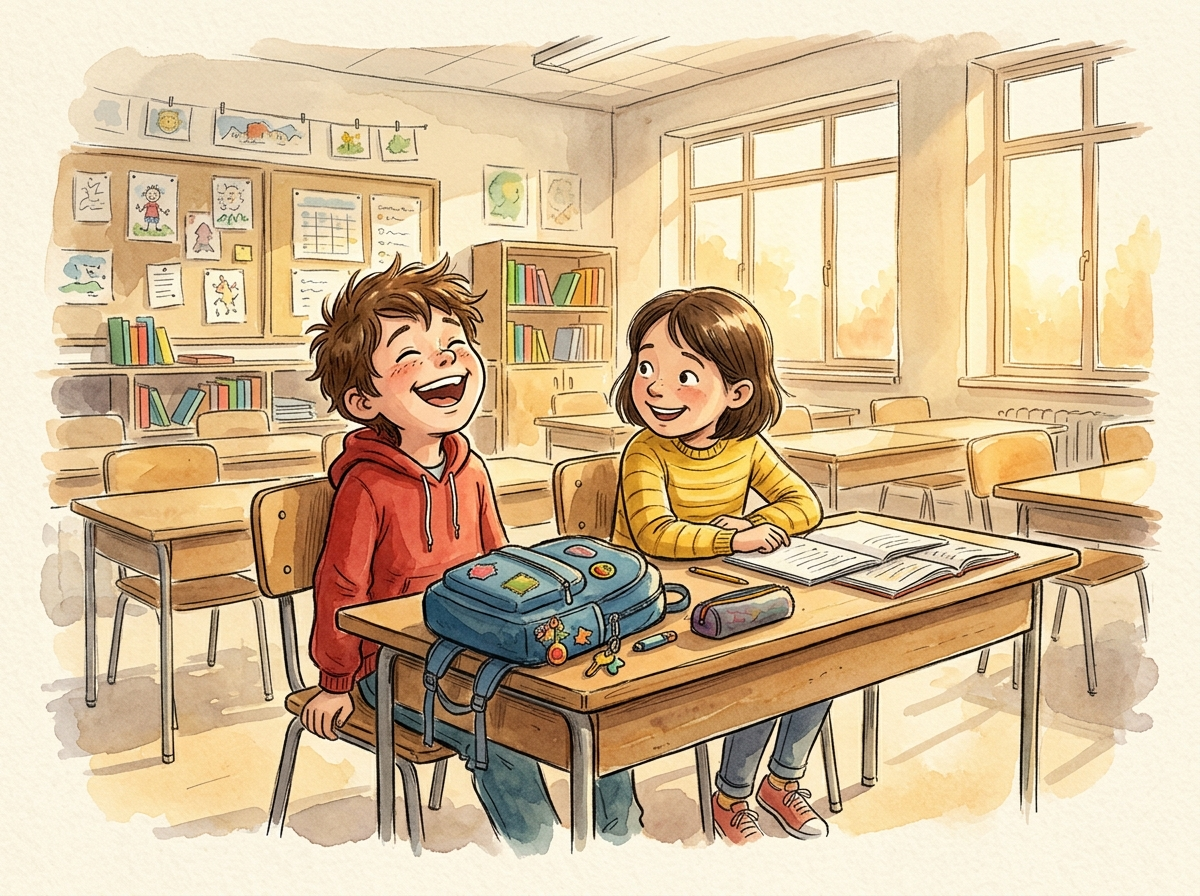
Chairs scraped. The classroom erupted into a shuffling, buzzing mess of kids finding their people. Gabi clutched her notebook and made her way to the back table where Marcus was already sitting, spinning a pencil between his fingers like a tiny helicopter.
"Hey," Gabi said.
"Hey," Marcus said, not looking up from the pencil.
Lily arrived next, sliding into her chair with the quiet confidence of someone who always seemed to know exactly where she was going. She set down a color-coded folder — a color-coded folder — and opened it to a blank page that already had "GROUP 4 — WATER FILTRATION" written across the top in perfect bubble letters.
"I started organizing on the way over," Lily said.
Devon showed up last, walking backward because he was still finishing a conversation with someone three tables away. He dropped into his chair, grinned at everyone, and said, "So. Water filters. Cool, cool, cool. My cousin has one on his fridge."
Gabi opened her notebook. "Okay, so we need to figure out who's doing what."
"I can do the research," Lily said immediately.
"I'll handle the presentation part," Devon offered. "I'm good at talking."
"I can bring supplies," Marcus said. "My mom has a ton of stuff in the garage."
Gabi waited. She looked around the table. "So... what am I doing?"
"You can do whatever's left," Devon said cheerfully.
"What's left?"
Nobody answered.
"Great," Gabi said. She wrote in her notebook: My job: whatever's left. Then she stared at it, because it didn't feel like a job at all. It felt like a hole where a job should be.
By Tuesday, things were already getting wobbly.
Lily came to school with six printed pages of research — single-spaced, with footnotes — about how water filtration systems worked in seventeen different countries. It was incredibly thorough. It was also incredibly confusing.
"Which system are we actually building?" Gabi asked, flipping through the pages.
Lily blinked. "I thought we'd decide that together."
"But we haven't decided anything yet."
"Well, no," Lily admitted. "I was waiting for someone to pick."
Gabi turned to Marcus. "Did you bring supplies?"
Marcus pulled a plastic bag from his backpack and dumped its contents onto the table: two empty soda bottles, a bag of cotton balls, a handful of pebbles, a coffee filter, and something that might have been charcoal but also might have been a very old brownie.
"Is that charcoal or food?" Gabi asked carefully.
Marcus squinted at it. "I'm... sixty percent sure it's charcoal."
"What are we supposed to do with all this?"
Marcus shrugged. "Build a filter?"
"But which kind? With what design?"
"I brought the stuff," Marcus said. "I figured someone else would know how to put it together."
Gabi's stomach did another somersault. She looked at Devon, who was leaning back in his chair practicing his "presentation voice," narrating an imaginary slideshow to no one.
"And as you can see in slide four," Devon murmured to himself, gesturing grandly, "the water goes from dirty to clean using the power of SCIENCE."
"Devon," Gabi said. "We don't have slides. We don't even have a plan."
Devon lowered his hands. "Right. So... someone should probably make a plan."
All three of them looked at Gabi.
She didn't know why. She hadn't volunteered to be the plan person. She'd been the "whatever's left" person. But apparently, "whatever's left" meant "everything that actually holds this whole thing together."
She felt a flicker of frustration — hot and sharp, like touching a pan you didn't know was still warm. She wanted to say, This isn't fair. She wanted to say, Why is this my problem?
Instead, she picked up her pencil.
"Fine," she said. "Give me ten minutes."
That night, Gabi sat at the kitchen table with Lily's research spread out in front of her, a video about sand-and-gravel filtration playing on her mom's tablet, and a diagram she was drawing in her notebook. She labeled each layer of the filter. She wrote a materials list. She figured out which of Marcus's supplies they actually needed — the soda bottles: yes; the mysterious maybe-charcoal: absolutely not — and what else they'd have to get.
She texted the group chat:
Gabi: Here's the plan. Lily — can you write a short summary of how sand/gravel filtration works? Like half a page, not six pages. Marcus — we need sand, gravel, and ACTUAL charcoal. Devon — start making slides, I'll send you what to put on them.
Devon: 👍
Marcus: 👍
Lily: I can do half a page. Should I include footnotes?
Gabi: No footnotes.
Lily: 😢 Okay.
Gabi put down her phone and stared at the ceiling. She'd spent two hours on this. Two hours organizing other people's work. She hadn't even started her math homework.
Wednesday was better. And worse.
Better because Lily's half-page summary was clear and actually made sense. Marcus brought real charcoal and a bag of sand from a hardware store. Devon had three slides done, and they looked surprisingly good — he'd added animations of water droplets with little cartoon faces.
Worse because when they tried to actually build the filter, everything fell apart. The sand kept clogging the bottle. The gravel layer was too thick. Water pooled at the top and just sat there, like it was refusing to cooperate on principle.
"Pour it slower," Lily said.
"I'm pouring it as slow as I can," Marcus said.
"Maybe we need less sand," Devon suggested.
"Maybe we need more sand," Lily countered.
They both looked at Gabi.
And Gabi — who had been watching, and thinking, and biting her lip — said, "We need to poke small holes in the cap. The water has nowhere to drain."
Marcus turned the bottle over. The cap was fully sealed.
"Oh," he said.
Lily grabbed a pushpin from Mrs. Alvarez's board. Marcus poked five tiny holes in the cap. They reassembled the layers, poured the murky brownish water in from the top, and waited.
For three seconds, nothing happened.
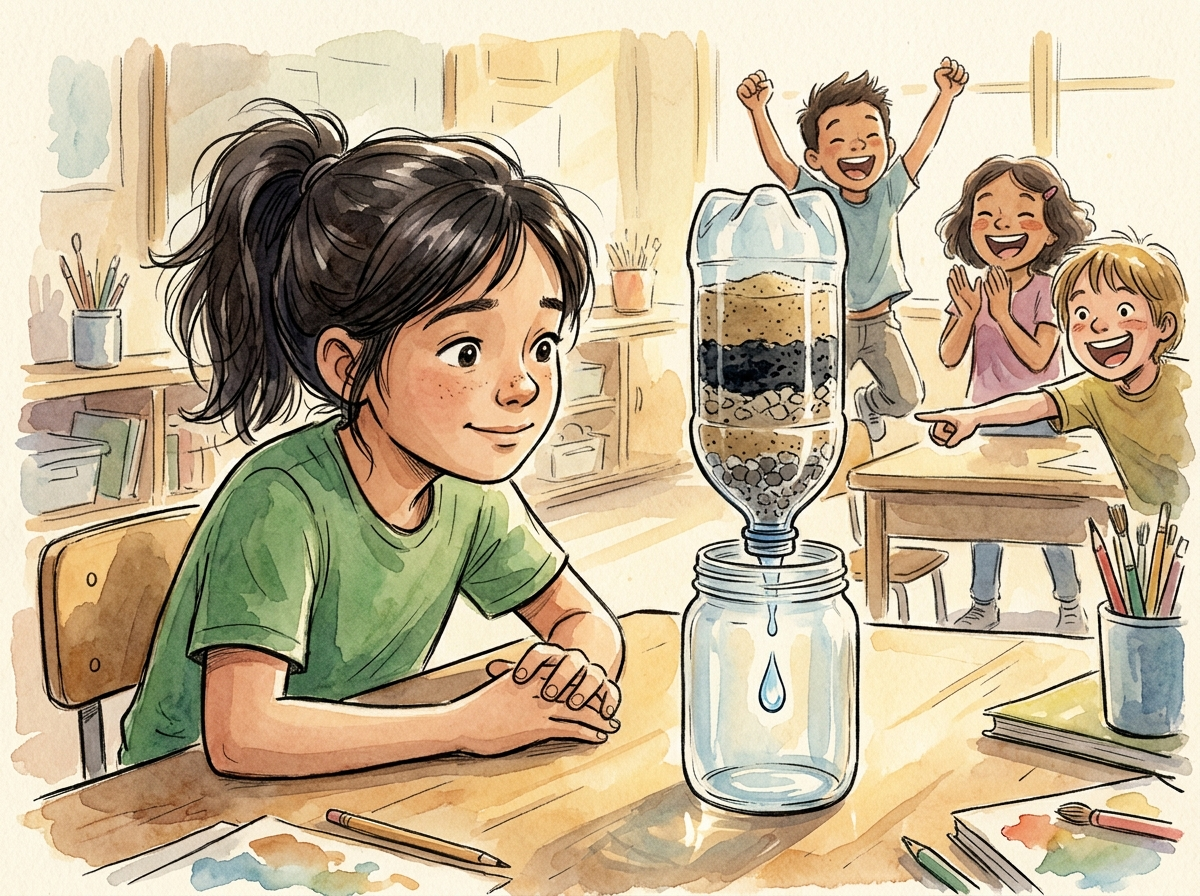
Then — drip. A single drop of water fell from the bottom of the bottle into the jar below. It was clearer. Not perfect. But clearer.
Drip. Drip. Drip.
"IT'S WORKING!" Devon yelled, so loud that Group 2 flinched.
Marcus pumped his fist. Lily actually squealed, which Gabi had never heard her do before. And Gabi — Gabi just sat there, watching the water drip, feeling something warm bloom in her chest like a light turning on.
She hadn't built the filter with her hands. She hadn't done the research or made the slides or bought the charcoal. But somehow, she'd done the thing that made all those pieces connect.
Thursday, they ran the filter three more times to make sure it was consistent. Gabi made a checklist. She timed each run with her phone. She helped Lily trim her summary to fit on Devon's slides. She helped Marcus figure out how to display the filter so it wouldn't tip over during the presentation. She helped Devon practice his talking points without going off on a five-minute tangent about his cousin's fridge.
"Stay focused," she told him. "You've got two minutes. Talk about the problem, the solution, and the results."
"Can I do the water droplet voice?"
"What water droplet voice?"
Devon cleared his throat and said in a high squeaky voice, "Help! I'm dirty! Please filter me!"
Marcus snorted. Lily covered her mouth. Even Gabi laughed — really laughed — for the first time all week.
"Fine," she said. "You can do the voice. Once."
Friday.
Group 4 stood at the front of the classroom. The filter was displayed on a small table. The slides glowed on the projector behind them. The jar of filtered water sat next to the jar of murky water, and the difference was obvious — one was cloudy brown, the other pale and almost clear.
Devon stepped forward. He was nervous — Gabi could see his hands trembling slightly — but when he opened his mouth, his voice was steady and warm and just a little bit funny. He explained the problem. He explained the solution. And yes, he did the water droplet voice, and the whole class laughed.
Lily presented the science, clear and confident. Marcus explained the materials and the build process. And when Mrs. Alvarez asked how the group had organized the project, all three of them turned and looked at Gabi.
"Gabi figured everything out," Marcus said. "Like, the whole plan."
"She kept us on track," Lily added.
"She told me I could only do the voice once," Devon said. "Which was honestly good advice."
Mrs. Alvarez smiled at Gabi. "Sounds like you were the project manager."
Gabi opened her mouth to say she hadn't really done that much. That she hadn't done the research or the building or the presenting. But then she stopped. Because she looked at the filter dripping clean water into the jar, and she looked at her three group members standing there — all of them having done their parts, all of them having done them well — and she realized that what she'd done wasn't "whatever's left."
It was the thing that made everything else work.
"Yeah," Gabi said. "I guess I was."
She didn't say it loudly. She didn't need to. She said it the way you say something when you finally believe it's true.