The Girl Who Fixed Wings
Fable
Ages 9–11 · 11 min
After solving a long equation in her head, ten-year-old Katherine is told her answer is incorrect, and now she must challenge her eighth-grade teacher's official answer key.
Katherine Coleman loved to count everything.
She counted the seventeen steps from her front porch to the road. She counted the forty-three maple trees that lined the street to school. She counted the seconds between lightning and thunder, dividing by five to know how many miles away the storm was, and she'd announce it to anyone who would listen.
Katherine Coleman loved to count everything.
She counted the seventeen steps from her front porch to the road. She counted the forty-three maple trees that lined the street to school. She counted the seconds between lightning and thunder, dividing by five to know how many miles away the storm was, and she'd announce it to anyone who would listen.
"Three and two-fifths miles," she'd say, and her mother would smile and pull her away from the window.
But the thing Katherine loved counting most of all was stars.
On clear nights in White Sulphur Springs, West Virginia, she would lie in the grass behind the house while her father sat on the porch, humming hymns and sharpening his tools. The sky would open up like an enormous black quilt stitched with light, and Katherine would try to count every single star she could see.
She never finished, of course. But she got farther than you'd think.
Katherine was ten years old the day the problem happened.
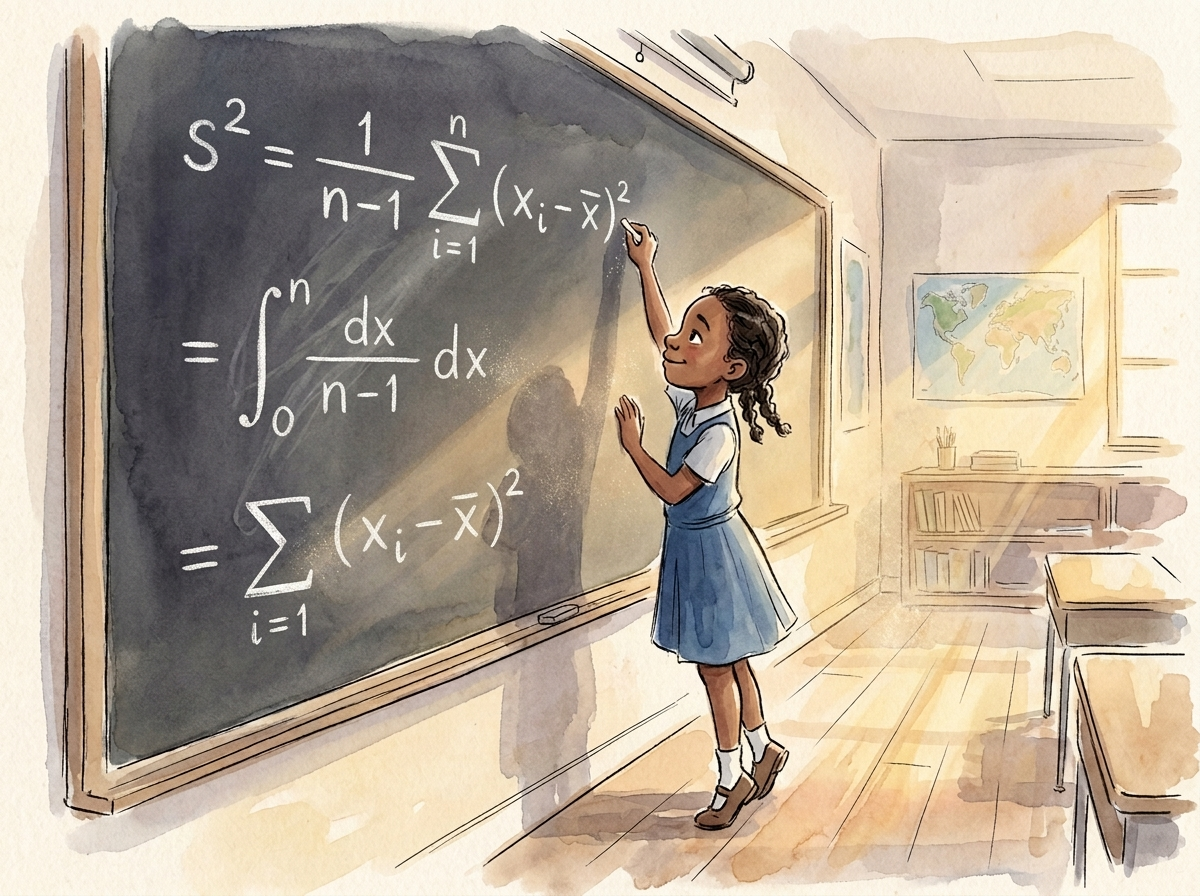
It was a Tuesday in September, and Mr. Sayers had written an equation on the chalkboard so long that it stretched from one side to the other. The chalk dust drifted down like tiny ghosts. This was the eighth-grade classroom — Katherine had been moved up, and then moved up again, because the math in her own grade had run out of things to teach her.
The eighth graders were fourteen. Katherine was ten. She sat in the second row, and her feet didn't quite reach the floor.
"Now," Mr. Sayers said, tapping the chalk against his palm, "this is a tough one. I want you to work it out on paper. Take your time. Show every step."
Twenty-six pencils started scratching. Katherine looked at the equation. She tilted her head, the way a bird tilts its head when it hears a worm moving underground.
The numbers talked to her. They always had. Not with words, exactly, but with a kind of music — the way a chord sounds right when all the notes fit together. She could feel when numbers balanced. She could feel when they didn't.
Twelve seconds passed.
Katherine raised her hand.
Mr. Sayers blinked. "Katherine, I said take your time."
"I have the answer," she said.
A few of the eighth graders looked up. Bobby Patterson, who sat behind her and was nearly twice her size, snorted.
"You don't even have your pencil out," Bobby said.
"I did it in my head," Katherine said. Simply. Not bragging. Just the way you'd say I walked here or I used the door.
Mr. Sayers studied her for a moment. He was a kind man, but even kind people sometimes don't expect extraordinary things from a ten-year-old girl with her feet dangling above the floor.
"All right, Katherine. What did you get?"
"One hundred and thirty-seven and three-quarters," she said.
The room went quiet. Mr. Sayers turned to look at the board, then down at his own solution key, which he kept folded in his shirt pocket. He unfolded it. He stared at it. He folded it back up.
"That's... not correct," he said.
Katherine felt something drop in her stomach, like a stone into a well. Not because she thought she was wrong — the numbers had been clear, and they always were. But because the whole room was looking at her now, and Bobby Patterson was grinning, and the two girls by the window were whispering, and Mr. Sayers was already moving on.
"Close, though!" Mr. Sayers said cheerfully. "The answer is one hundred and thirty-eight. Keep working at it."
Katherine's hands pressed flat against her desk. The stone in her stomach turned hot.
One hundred and thirty-eight was wrong.
She knew this the way she knew the sun would rise. The way she knew that seventeen steps led from her porch to the road. The numbers didn't lie. They never lied. People sometimes wrote them down wrong, read them wrong, added them wrong. But the numbers themselves were always perfect.
She spent the rest of the class not listening. Instead, she worked through the problem again in her head, slowly this time, step by step, building it like a ladder — each rung clicking into place. She arrived at the same answer.
One hundred and thirty-seven and three-quarters.
After class, the other students poured out into the hallway like water from a cup. Katherine stayed.
"Mr. Sayers?"
He was erasing the board, and he turned with chalk dust on his sleeve. "Yes, Katherine?"
"Your answer key is wrong."
Now, there are a lot of ways a person can react when a ten-year-old tells them they're wrong. Some people laugh. Some people get irritated. Some people pat you on the head and say That's nice, dear in a voice that means Please stop talking.
Mr. Sayers did something different. He paused. He really looked at her. And then he pulled out a chair.
"Show me," he said.
Katherine's heart hammered. She picked up a piece of chalk — she had to stretch to reach the board — and she began to write.
She wrote the first step. Then the second. Her handwriting was small and precise, every number sitting neatly on an invisible line. By the fourth step, her hand was moving faster, the chalk tap-tap-tapping like rain on a roof. She got to the place where the problem branched — where you had to multiply before you subtracted, or else the whole thing tilted sideways like a house built on mud.
"Here," she said, circling a spot on the board. "Whoever wrote the answer key multiplied first, but this part" — she tapped a set of parentheses — "has to be resolved before the multiplication, because it's nested. If you multiply first, you get one hundred thirty-eight. But that's like putting on your shoes before your socks. You get a number, but it's not the right number."
She wrote the correction. Step by step. Each line flowing into the next like water finding its way downhill. The final answer sat at the bottom of the board, circled twice:
137 ¾
Mr. Sayers stood very still.
He pulled out his answer key again. He worked through the problem on a scrap of paper, following Katherine's steps. His pencil stopped. He tapped it against the desk. He worked through it again.
Then he did something that Katherine would remember for the rest of her life.
He took his answer key, crossed out 138, and wrote 137 ¾ in its place.
"You're right," he said. "I'll notify the publisher."
Katherine let out a breath she didn't know she'd been holding.
"Katherine," Mr. Sayers said, leaning back in his chair, "can I ask you something?"
She nodded.
"When you look at numbers — at a big equation like that — what do you see?"
Katherine thought about it. No one had ever asked her this before.
"I see how they fit together," she said slowly. "Like... do you ever look at a bird flying, and you can just tell that one of its wings is longer than the other? And you think, if I could fix that wing, it would fly perfectly? That's what numbers are like for me. I can see when something is off. And I can see how to fix it."
Mr. Sayers nodded slowly, like he was hearing music from very far away.
"Then you keep fixing wings, Katherine," he said. "Don't let anybody tell you the bird is flying fine when you can see that it isn't."
The next day, Katherine walked into class, and Bobby Patterson leaned forward.
"Hey, Calculator Girl. What's the answer to today's problem?"
Mr. Sayers hadn't even written it on the board yet.
"I'll let you know," Katherine said.
A couple of students laughed. But it wasn't mean laughter. It was the surprised kind — the kind that sneaks out when someone says something so confident and calm that it catches you off guard.
Mr. Sayers wrote a new problem on the board. Longer than yesterday's. More parentheses. More branches. The chalk dust drifted.
Twenty-six pencils started scratching.
Katherine looked at the equation. She tilted her head.
The numbers began to sing.
Years later, Katherine Coleman Johnson would sit at a desk at NASA, checking the mathematics that sent astronauts into space. John Glenn himself — the first American to orbit the Earth — would refuse to fly until Katherine personally verified the numbers that the electronic computers had calculated.
"Get the girl to check the numbers," he said. "If she says the numbers are good, I'm ready to go."
And Katherine checked them. Every single one.
She found a wing that was slightly off. She fixed it.
And the rocket flew perfectly.
But that is a bigger story for another day. This story is about a ten-year-old girl in a second-row seat, chalk dust on her fingers, feet dangling above the floor, who looked at a problem that everyone else said was already solved and knew — knew — that she was right.
And didn't stop until she'd proved it.