The Ferry at Night
Fable
Ages 6–8 · 10 min
On the midnight ferry crossing that other captains call too dark and lonely, Captain Mac steers his boat away from the dock and into the bay.
Mac had been driving the ferry across Heron Bay for twenty-three years, and he knew the water the way most people know their own backyard. He knew where the current pushed left near Gull Rock. He knew where the fog liked to settle on cool mornings. He knew the exact spot where the sunset touched the waves and turned them orange every evening in July.
But his favorite crossing was the last one — the midnight run.
Mac had been driving the ferry across Heron Bay for twenty-three years, and he knew the water the way most people know their own backyard. He knew where the current pushed left near Gull Rock. He knew where the fog liked to settle on cool mornings. He knew the exact spot where the sunset touched the waves and turned them orange every evening in July.
But his favorite crossing was the last one — the midnight run.
Most captains didn't want it. "Too dark," they said. "Too quiet. Too lonely."
Mac just smiled when they said that. He thought the midnight crossing was the most interesting one of all.
Tonight, the dock was nearly empty. A single van waited to roll aboard, carrying a woman and her sleeping daughter home from a birthday party. The little girl's face was painted like a butterfly, and she was clutching a half-eaten cupcake even in her sleep.
"Last ferry," Mac called out from the wheelhouse window. "Hop aboard."
The van drove on. The ramp clanked shut. And Mac eased the big boat away from the dock, out into the dark, dark water.
The engine hummed low and steady — mmmmmmm — like a giant cat purring. The lights of the town behind them got smaller and smaller until they were just tiny golden dots, like a handful of fireflies someone had scattered along the shore.
Mac turned on the spotlight and swept it across the water ahead.
And that's when the night got interesting.
First, he saw the log.
Well, it looked like a log. A long, bumpy shape floating just at the surface. But Mac had been doing this long enough to wait one extra second before looking away. And sure enough — the log blinked.
Two shining eyes caught the spotlight, and then a broad, flat tail rose up and slapped the water. SMACK!
"Evening, beaver," Mac said, tipping his captain's hat.
The beaver dove under with a splash, probably heading home to its own family, carrying some branch or bit of bark for a midnight snack. Mac steered the ferry gently to the left to give it room.
A few minutes later, the water got glassy and still, and Mac saw something he'd only seen a handful of times in all his years. Just off the starboard side — that's the right side of the boat — the water began to glow.
Not from his lights. Not from the moon.
The water itself was glowing.
Tiny, tiny creatures, smaller than grains of sand, were lighting up blue-green beneath the surface. They were called bioluminescent plankton — which is a very long name for very small things. But you didn't need to know the name to feel the magic. Every ripple the ferry made sent swirls of blue-green light spinning away into the darkness, like someone was painting with light on the water.
Mac cut the engine to a low idle. The ferry slowed, drifting gently.
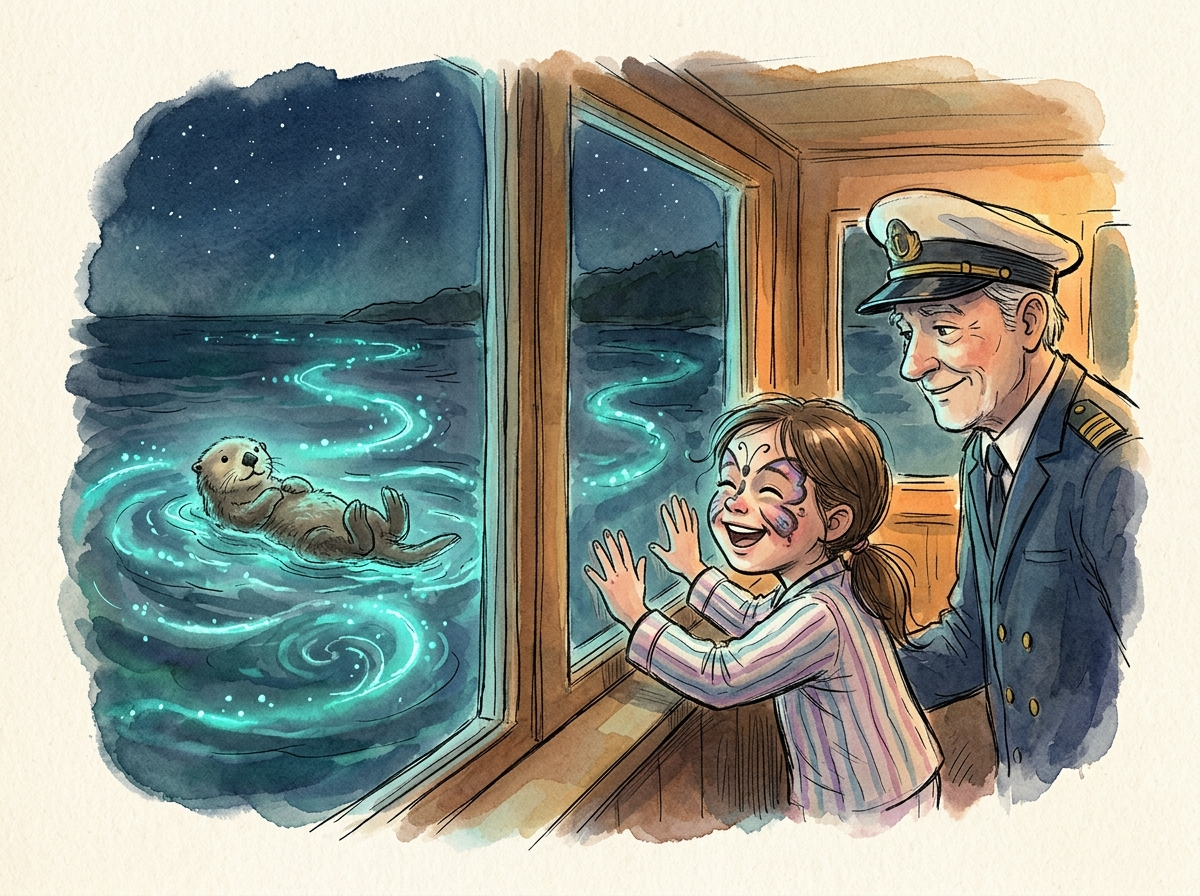
He heard a sound behind him — small footsteps on the metal stairs. He turned to see the little girl from the van, butterfly paint smudged on one cheek, cupcake still in hand, eyes wide as dinner plates.
"My mama said I could come see," she whispered.
Mac looked past her and saw the woman standing at the bottom of the stairs, nodding and smiling.
"Well then," Mac said, "you came at just the right time. Look out there."
The girl pressed her nose against the wheelhouse window. When she saw the glowing water, she made a sound that wasn't quite a word — more like the sound your heart makes when it sees something it didn't know was possible.
"Are those... stars?" she asked. "In the water?"
"Something like that," Mac said. "Tiny living things that make their own light."
"Why?"
"Nobody's completely sure. Maybe to scare off bigger things that want to eat them. Maybe to find each other in the dark." Mac paused. "Maybe just because glowing is what they do."
The girl watched the swirls of light curl and drift. "I didn't know the water did this at night."
"Most people don't," Mac said. "Most people are home sleeping — which is a perfectly fine thing to do. But the ones who stay up? Sometimes they get to see what the world does when it thinks nobody's watching."
The girl looked up at him. "What else do you see?"
Mac thought about it. "Lots of things. I've seen an owl fly right across the bay, wingtip to wingtip, not making a single sound. I've seen a family of otters sliding off a rock at two in the morning like they were at a water park. One time, I saw a whale — a real, actual whale — come up to breathe not fifty feet from the ferry. Just this enormous, gentle thing, rising up and sinking back down, like the ocean itself was breathing."
The girl's eyes were getting wider with every sentence.
"But here's the thing," Mac said. "I only see those things because I'm out here. Every night. Paying attention. Some nights, I don't see anything special at all. Just water and dark. And those nights are fine too — because the water and the dark are something worth looking at all on their own."
Just then, something thumped lightly against the side of the ferry. Mac shone his handheld flashlight over the railing, and there, bobbing in the glowing water, was a sea otter, floating on its back with its paws folded on its belly. It looked up at them with round black eyes, completely unbothered — like they were the strange ones.
The girl laughed — a bright, bubbling laugh that rang out across the bay.
The otter flipped over and dove, and a trail of blue-green light followed it down like a comet's tail.
Mac eased the engine back up. They were halfway across now, and he could see the far dock's lights beginning to appear — faint at first, then brighter, like someone slowly turning up a lamp.
"Can I ride the midnight ferry again sometime?" the girl asked.
"Anytime you like," Mac said. "It runs every night, rain or shine. Most people just don't think to come."
"I'll come," she said firmly. "I want to see the owl."
"Then you'll have to be patient. The owl doesn't come every night. That's what makes it special when it does."
The girl nodded seriously, as if this was very important information — which it was.
The ferry bumped gently against the dock. The ramp lowered with its familiar clank and groan. The girl's mother appeared at the top of the stairs.
"Thank you, Captain," the woman said.
"Thank her," Mac said, nodding at the girl. "She was good company."
The girl turned to go, then stopped. "Captain Mac? Do you ever get lonely? Out here at night by yourself?"
Mac leaned back in his chair and looked out at the bay — the dark water, the distant trees like shadows, the fading blue-green glow, the stars scattered overhead like someone had flung a whole jar of glitter across the sky.
"You know," he said, "I used to think I might. But there's the beaver building things in the dark, and the otter having a float, and the plankton putting on a light show for nobody in particular. The bay is pretty full, once you start noticing." He smiled. "I think lonely is just what it looks like before you start paying attention."
The girl smiled back — a sleepy, cupcake-smudged, butterfly-painted smile — and followed her mother down the stairs.
Mac watched the van drive off the ramp and up the road, its taillights disappearing into the trees.
Then he pulled the ramp up, turned the ferry around, and headed back across the bay. The water was dark. The engine hummed. And somewhere out there, an owl was flying — silent, steady, and sure — across the wide, wonderful night.
Mac tipped his hat to it, just in case.