The Diwali Power Cut
Fable
Ages 6–8 · 9 min
When a power cut hits on Diwali night, the three hundred electric lights on Priya's balcony go dark, threatening to ruin the festival she waited for all year.
Priya had been counting the days since October began, crossing them off one by one on the calendar in the kitchen with a fat red marker. And now, finally, the day was here.
Diwali.
Priya had been counting the days since October began, crossing them off one by one on the calendar in the kitchen with a fat red marker. And now, finally, the day was here.
Diwali.
The whole house smelled like heaven. Mummy had been frying gulab jamuns since morning, and the sweet, syrupy smell had crept into every single room — even the bathroom. Papa had spent the afternoon untangling strings of electric lights, muttering things under his breath that Priya pretended not to hear. Her little brother Rohan had "helped" by tangling them back up again.
But now — oh, now everything was perfect.
The electric lights blazed along the balcony railing in every color Priya could name and a few she couldn't. The living room glowed bright and golden. The TV played festive songs, and the whole apartment building hummed with excitement. Priya could hear the Sharma family upstairs laughing, and the Patels next door had their music turned up loud.
Priya stood back and admired the rangoli she had made by the front door. She had spent forty-five whole minutes on it — a big flower with petals of pink, orange, yellow, and white powder. It was, she decided, the most beautiful rangoli in the entire building. Possibly the entire city. Possibly the entire world.
"Priya, come help me with the diyas," Nani called from the kitchen.
Priya skipped inside to find her grandmother lining up little clay oil lamps on the counter. There were dozens of them — small and brown and simple, with tiny cotton wicks poking out.
"These little things?" Priya wrinkled her nose. "But Nani, we have the electric lights. Papa put up three hundred bulbs. He counted."
"Hmm," said Nani, pouring mustard oil carefully into each little cup. "Help me carry them outside anyway."
Priya sighed the way only a seven-year-old who has been given an unnecessary task can sigh. But she picked up the tray and followed Nani to the balcony, to the front door, to the windowsills. One by one, Nani lit each diya with a long matchstick. The tiny flames flickered and danced, but honestly? You could barely even see them next to Papa's three hundred dazzling electric bulbs.
"There," Nani said, smiling at the little clay lamps like they were old friends.
"Nani, no one's even going to notice those," Priya said. "They're so small."
Nani just tucked a strand of hair behind Priya's ear and said, "Small things have a way of surprising you."
At seven-thirty, the whole family gathered in the living room for the puja. Mummy arranged the silver thali with kumkum, rice, flowers, and sweets. Papa lit the incense. Even Rohan sat still for almost two entire minutes, which was basically a world record for him.
Then came Priya's favorite part — the sparklers.
They all went out to the balcony. Papa handed Priya a sparkler and lit it, and it burst into a fizzing, crackling fountain of white-gold light. Priya waved it through the air, writing her name in glowing letters against the dark sky. P-R-I-Y-A. Rohan waved his in wild circles, laughing so hard he got the hiccups.
The whole city was alive. Firecrackers popped and boomed in the distance. Every balcony in every building glittered with lights. The sky flashed with color.
And then —
Click.
Everything went dark.
Not just their apartment. The whole building. The building across the street. The one behind it. Every electric light, every TV, every music speaker — gone. Just like that. Like someone had thrown a giant switch over the whole neighborhood.
For one long second, there was silence.
Then Rohan started to cry.
"The lights!" Priya gasped. She ran inside. The living room was pitch black. She couldn't see the rangoli, she couldn't see the decorations, she couldn't see anything. Papa's three hundred bulbs were just dark little shapes on a wire.
"Power cut," Papa said, pulling out his phone for the flashlight. "Must be the whole grid. Too many people using electricity tonight."
"But — but it's Diwali!" Priya's voice came out all wobbly. Her eyes stung, and not from the incense. This was supposed to be the festival of lights, and now there were no lights at all. She had waited so many days for this. She had crossed them off, one by one, with her fat red marker. And now it was ruined.
Mummy picked up Rohan and bounced him on her hip. "Shh, shh. It's okay."
"It's NOT okay," Priya said, and she meant it with her whole chest.
"Priya," Nani said quietly from the balcony. "Come here."
Priya didn't want to come there. She wanted to stay right where she was and be upset. But something in Nani's voice pulled at her, the way Nani's voice always did. She shuffled over to the balcony door.
And stopped.
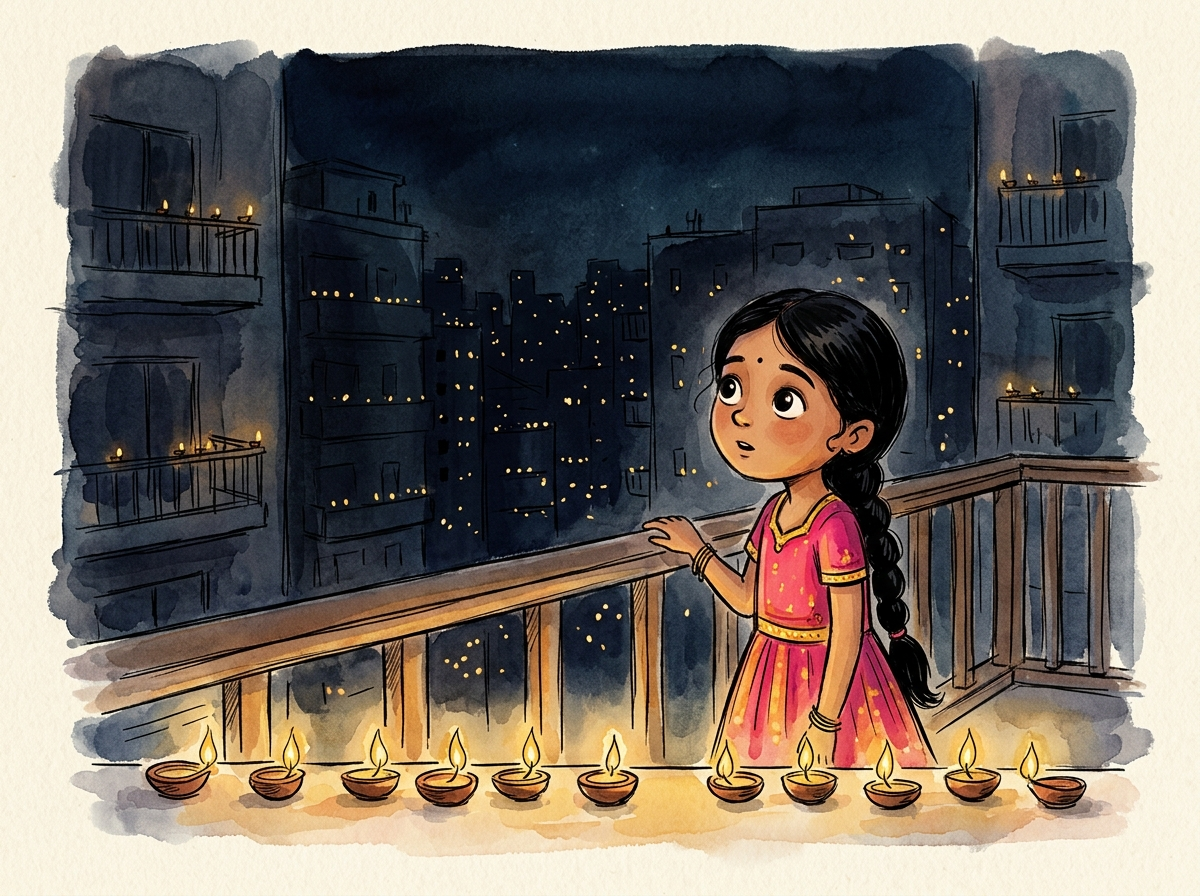
The diyas were still burning.
Every single one. On the balcony railing, on the windowsills, by the front door — each little clay lamp held its tiny flame, steady and warm, glowing soft orange against the darkness. And not just theirs. Across the street, where the Mehtas lived, Priya could see diyas flickering on their balcony too. And below them, more little flames. And on the rooftop of the next building, a whole row of golden lights that no power cut could touch.
Without all the electric lights, the diyas looked completely different. They weren't small anymore. They were everything. Each little flame stood out like a star, and together, all across the dark neighborhood, they turned the night into something that made Priya hold her breath.
"Oh," she whispered.
The Sharma family upstairs came out onto their balcony with a whole tray of fresh diyas. "Power's out everywhere!" Uncle Sharma called down cheerfully, as if this were wonderful news. "Good thing we have these, huh?"
The Patels' door opened, and Mrs. Patel poked her head out, holding a diya in each hand. "Priya! Your rangoli — come and see it in the diya light!"
Priya ran to the front door and looked down. Mrs. Patel was right. The rangoli, which had been washed out under the harsh electric lights, now glowed soft and magical in the warm flicker of the clay lamps. The colors seemed deeper. The flower seemed almost real.
Something loosened in Priya's chest.
"Mummy," she said, running back inside. "Mummy, do we have more diyas?"
"Nani made extras," Mummy said. "A whole box in the kitchen."
Priya found the box and carried it into the hallway of their building, where it was darkest of all. She knocked on every door on their floor. "Do you need diyas? We have extras!"
Old Mr. Krishnan on the corner took four and placed them along his doorstep. The new family who had just moved in — Priya didn't even know their names yet — took six, and the mother smiled at Priya like she had handed her something precious.
"I'm Aisha," said the girl behind the mother. She looked about Priya's age.
"I'm Priya. Happy Diwali."
"Happy Diwali," Aisha said, and they grinned at each other in the flickering golden light.
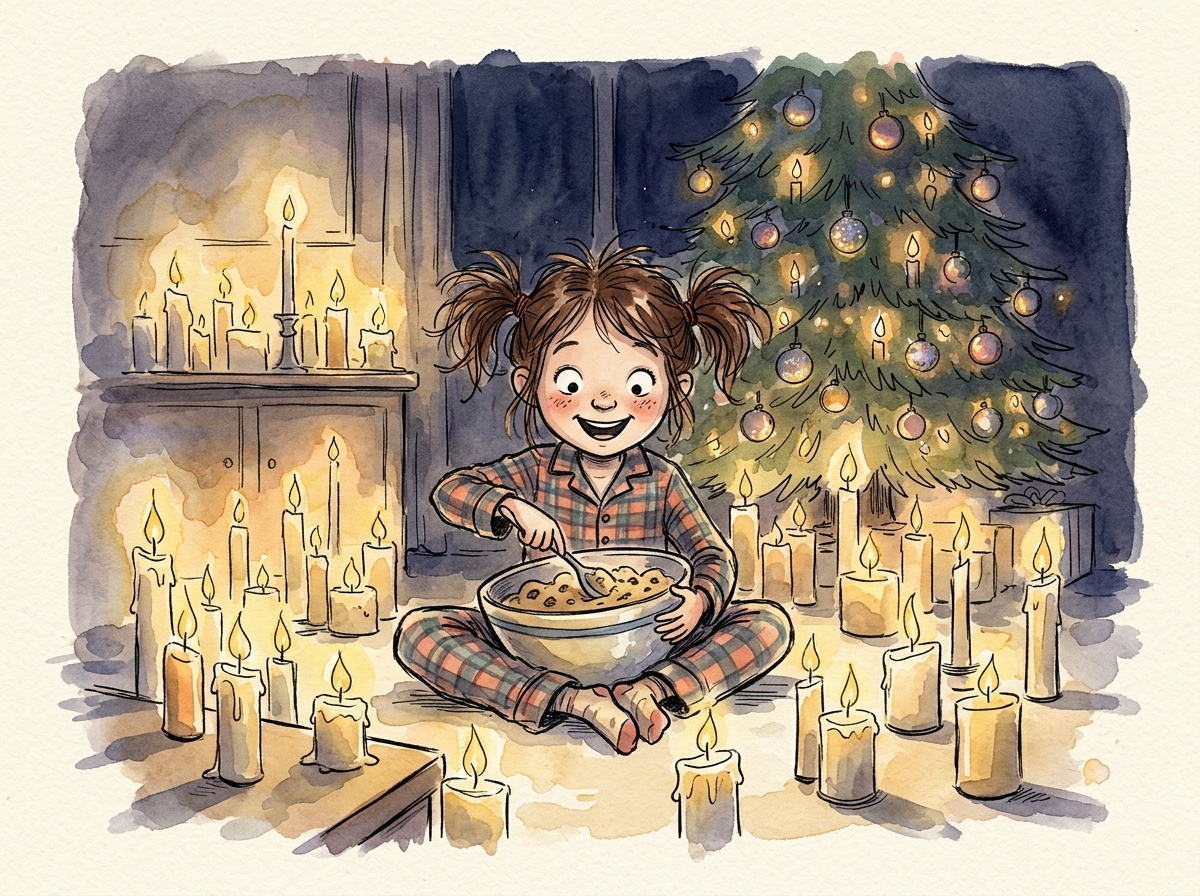
When Priya came back to the apartment, Nani had set out the gulab jamuns and snacks on the living room floor, with diyas all around like a little picnic of light. Papa was telling Rohan a funny story about a monkey, and Rohan had completely forgotten he'd been crying. The room felt warm and close, and everyone's face glowed soft and amber.
Priya sat down next to Nani and leaned against her arm.
"Nani?"
"Hmm?"
"I think the diyas are better."
Nani kissed the top of her head.
At nine forty-five, the power came back on. The electric lights blazed to life, the TV blared, and Papa's three hundred bulbs lit up the balcony like a carnival.
But Priya noticed something.
Nobody on their floor turned off their diyas.
Not the Sharmas. Not the Patels. Not Mr. Krishnan. Not Aisha's family. And definitely not Priya.
She sat on the balcony with a gulab jamun in one hand, watching her little clay lamps burn steadily beside the bright electric lights — small, and warm, and completely, completely enough.