The Bridge That Holds
Fable
Ages 6–8 · 10 min
As his bus rolls onto the Greendale Bridge, Alec holds on tight because he is sure it will fall, until a woman with a deli sandwich sits down beside him.
Every Tuesday, Alec rode the number seven bus across the Greendale Bridge.
And every Tuesday, right when the bus rolled onto that bridge, Alec grabbed the bottom of his seat with both hands and held on tight.
Every Tuesday, Alec rode the number seven bus across the Greendale Bridge.
And every Tuesday, right when the bus rolled onto that bridge, Alec grabbed the bottom of his seat with both hands and held on tight.
He didn't scream. He didn't cry. He just held on, squeezed his eyes shut, and waited for the bus to reach the other side.
Because Alec had a question that nobody had answered well enough yet.
How does a bridge not fall?
He'd asked his mom. She said, "Engineers build them strong, sweetie." That was okay, but it wasn't enough. Strong how?
He'd asked his teacher, Ms. Huang. She said, "There's a lot of math involved." That was even worse. Math didn't seem like something you'd want to trust your life to. Especially the kind of math Alec knew, which mostly involved times tables he hadn't finished memorizing.
He'd asked his older cousin Derek, who said, "Dude, just don't think about it." Which was the worst answer of all.
So every Tuesday, Alec held on.
On this particular Tuesday, the bus was more crowded than usual. Alec sat in his regular seat by the window, backpack on his lap, watching the bridge get closer and closer. His fingers were already creeping toward the seat bottom.
A woman sat down next to him. She had short silver hair, round glasses, and a big canvas bag that clinked when she set it on the floor. She was unwrapping a sandwich — the kind from the deli on Park Street, thick with layers.
The bus turned onto the bridge.
Alec grabbed the seat.
The woman glanced at him. She didn't say "are you okay?" the way most adults did. She just looked at his white knuckles, then looked out the window at the bridge cables zipping past, then looked back at him.
"You wondering how it stays up?" she asked.
Alec opened one eye. "Yes."
"Want me to show you?"
Alec opened the other eye. "You know?"
The woman smiled. "I should hope so. I'm a bridge engineer. I help design them." She held out her hand. "I'm June."
Alec shook it, though he kept one hand on the seat. Just in case.
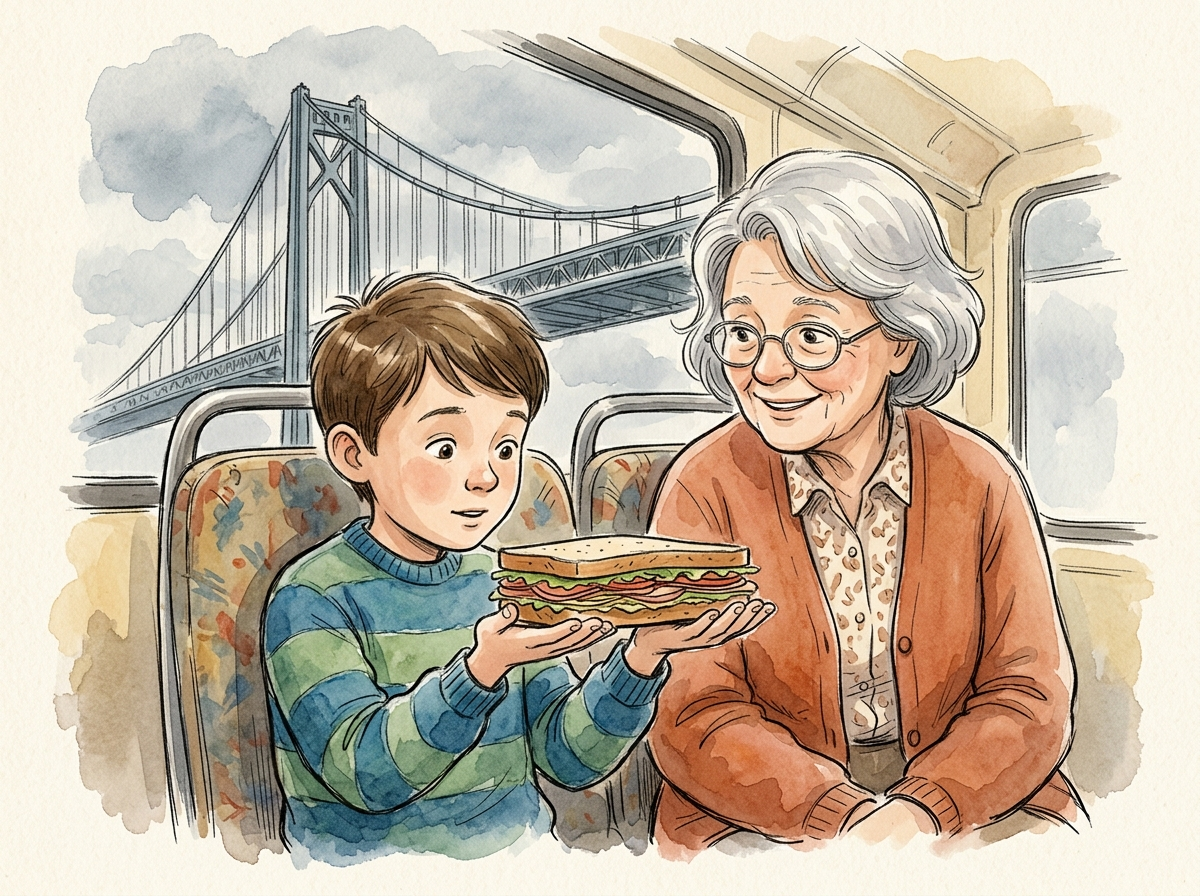
"Here," June said. She held up her sandwich. It was tall — two thick slices of bread with turkey, cheese, lettuce, tomato, and some kind of bright red pepper, all stacked up. "See this sandwich?"
"Yeah?"
"Hold out your hands flat, side by side."
Alec slowly let go of the seat. He held out both hands, palms up, about a foot apart.
June set the sandwich across his hands like a little bridge. The bread rested on his palms, and the middle hung in the air between them.
"This is a beam bridge," June said. "The simplest kind. Your hands are the supports — we call them piers. The sandwich is the deck. That's the part cars drive on. See how it works?"
Alec looked at the sandwich sitting on his hands. "But what holds up the middle? Nothing's under it."
"The bread," June said. "The bread is stiff enough to hold its own weight across that little gap. But watch what happens if I make the gap bigger."
She gently moved his hands farther apart.
The sandwich started to sag. The middle drooped down. A tomato slice began to slide.
"See that?" June said. "The longer the span, the more it wants to bend in the middle. So for short distances, a beam works fine. But for something longer, you need a trick."
"What kind of trick?"
June pulled a paper napkin from her bag. She twisted it into a long, thin rope, then curved it into a U-shape beneath the sandwich, pressing each end against the bread near Alec's palms.
"Push up a little with the napkin," she said.
Alec pinched the napkin ends against the sandwich and watched the middle lift back up. The sag disappeared.
"That's an arch," June said. "The curve pushes the weight outward and down into the supports. Arches are ancient — the Romans used them thousands of years ago. Stone bridges, aqueducts. Some of them are still standing."
"Still standing after thousands of years?"
"Some of them. Stone is stubborn like that."
Alec liked that. Stubborn stone.
"But what about this bridge?" he asked, nodding toward the window. The cables of the Greendale Bridge fanned out like a giant harp against the gray sky.
"Ah," June said. She took the napkin rope back and this time held it above the sandwich, pinching it high in the middle so it made a big triangle shape. The napkin went from one of Alec's hands, up to a peak above the sandwich, and back down to his other hand.
"This is closer to what's out there," she said. "A cable-stayed bridge. Instead of pushing up from below like an arch, the cables pull from above. They're connected to those tall towers — see them?"
Alec looked out the window. Two enormous concrete towers rose up on either side of the bridge, and from each tower, thick cables stretched down to the road like the strings of some giant instrument.
"The cables are pulling the road up?" Alec said.
"Holding it up. Like puppet strings. The deck hangs from the cables, the cables pull on the towers, and the towers push all that weight straight down into the foundations, which go deep into the earth. Everything has a job. The cables pull. The towers push. The foundations hold."
"What if a cable breaks?"
June didn't brush the question away. She nodded, like it was a good one.
"Bridges are designed with extra strength — much more than they need on any ordinary day. Engineers think about the worst day the bridge could ever have. The heaviest trucks. The strongest winds. Ice. Even earthquakes. And then they make it stronger than that. Every cable, every bolt, every beam has more strength in it than it should ever need to use."
She tapped the sandwich. "It's like if you needed to carry one grocery bag, but you brought ten bags just in case. You'd feel pretty confident walking home, right?"
Alec laughed. "That's a lot of bags."
"That's a lot of bridge."
The bus was past the middle now, rolling toward the far side. Alec realized something strange. His hands were still out, holding the sandwich. Neither hand was on the seat.
He was riding across the Greendale Bridge, and he wasn't holding on.
June noticed too. She raised an eyebrow but didn't say anything about it.
"Can I ask one more thing?" Alec said.
"Of course."
"How do you know the foundations won't move? The stuff underground?"
June leaned back, looking impressed. "You ask better questions than some of my college students. Before anyone builds a bridge, engineers drill down into the ground to test the rock and soil underneath. They figure out exactly how deep they need to go to reach something solid — something that isn't going anywhere. Bedrock, usually. Stone that's been there for millions of years." She paused. "The bridge stands on the bones of the earth."
The bones of the earth. Alec repeated it silently. He liked that even more than stubborn stone.
The bus rolled off the bridge and onto the regular road. Alec felt the familiar bump where the bridge met the land — and for the first time, he understood that bump too. It was the bridge making room to stretch and shrink as the temperature changed. Even bridges needed a little space to breathe.
"Here," Alec said, handing the sandwich back. "I think I squished it a little."
"Sandwiches are resilient," June said, and took a big bite.
Alec pulled the stop cord. His street was coming up.
"Thank you," he said, standing and pulling on his backpack.
"Anytime, Alec."
He paused. "I never told you my name."
June pointed to his backpack, where his mom had written ALEC in big black marker on the tag.
"Engineers notice things," she said, and winked.
The next Tuesday, Alec rode the number seven bus across the Greendale Bridge. The seat next to him was empty. June wasn't there.
But when the bus rolled onto the bridge, Alec put his hands in his lap. He looked out the window at the cables pulling, the towers standing, the foundations buried deep in stubborn, ancient stone.
He felt the hum of the road beneath him and the gentle sway that meant the bridge was doing exactly what it was supposed to do.
And for the first time on a Tuesday, Alec watched the whole way across.