The Boy Who Drew Maps
Fable
Ages 9–11 · 10 min
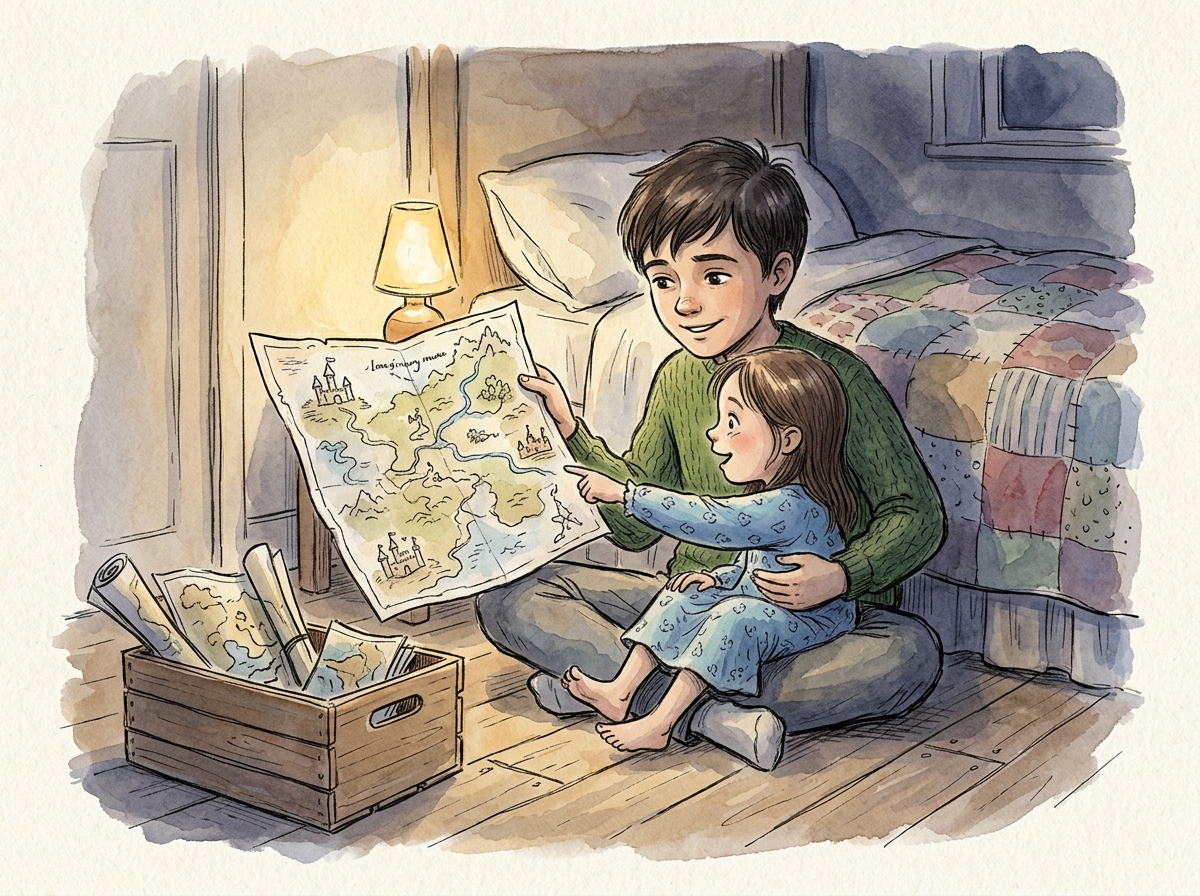
The wooden box under Charles's bed holds his maps of the Understairs Empire and other imaginary places, but his father believes such drawings have no purpose.
Charles Lutwidge Dodgson was the sort of boy who carried a pencil everywhere, even to dinner.
His father, the Reverend Dodgson, would look down the long table at his enormous family — there were eleven children in all — and spot Charles with his nose practically touching his plate, sketching something in the margins of a hymn sheet.
Charles Lutwidge Dodgson was the sort of boy who carried a pencil everywhere, even to dinner.
His father, the Reverend Dodgson, would look down the long table at his enormous family — there were eleven children in all — and spot Charles with his nose practically touching his plate, sketching something in the margins of a hymn sheet.
"Charles," his father would say. "We are eating."
"I know," Charles would say, without looking up. "But I've just realized that the River Tumble has to bend left past the Whispering Cliffs, or the waterfall won't work."
His brothers and sisters would exchange looks. The older ones would roll their eyes. The younger ones would try to peek.
"What's the River Tumble?" his little sister Louisa would ask.
"It's a river," Charles would say, as if this explained everything.
"But where?"
Charles would finally look up, blinking, as though he'd forgotten there were other people in the room. "Nowhere yet," he'd say. "I'm still drawing it."
This was the thing about Charles. He didn't draw pictures of horses or ships or battles like other boys. He drew maps. Maps of places that didn't exist. Extraordinarily detailed, carefully labeled maps of entirely imaginary countries.
He had a map of the Kingdom of Sideways, where all the roads ran north-south and anyone who wanted to go east had to ask a crow for directions. He had a map of Lake Forget-Me-Not, which was shaped like a hand with six fingers. He had a map of the Understairs Empire, inspired by the cupboard beneath the staircase in the rectory where his family lived. That map included a tiny mountain range called the Dust Peaks and a civilization of beetles he'd named the Crawlington Republic.
Each map was drawn on whatever paper he could find — the backs of letters, the blank pages torn (carefully, guiltily) from old books, brown wrapping paper smoothed flat after packages arrived. He kept them in a wooden box under his bed, stacked in order, each one more detailed than the last.
The trouble was, nobody seemed to understand why.
"But what are they for?" his brother Wilfred asked one afternoon, finding Charles on his stomach in the garden, drawing a coastline in the dirt with a stick before copying it onto paper.
"They're maps," Charles said.
"Maps of what, though?"
"Of places."
"What places?"
"The places on the maps."
Wilfred stared at him for a long moment, then walked away to play cricket.
Charles didn't mind, mostly. He was used to being the odd one. He stammered when he spoke — his words came out in little trips and stumbles that made some people impatient and others finish his sentences for him, which was worse. But when he was drawing a map, the stammer didn't matter. Maps didn't require talking. Maps were a language made of lines.
His favorite time to draw was early morning, before the rest of the house woke up. He would sit by the window in the room he shared with three brothers, and in the gray-blue light before dawn, he would add tiny details to whatever country he was building. A forest called the Thicket of Second Thoughts. A desert labeled "Here Be Reasonable Dragons." A dotted path marked "Shortcut (but actually longer)."
He liked the way a blank page could become a world. He liked deciding where the rivers went and what the mountains were called. He liked that in his maps, everything had a place, even the things that didn't make sense — especially the things that didn't make sense. In Charles's maps, nonsense had geography. It had borders and bridges and proper roads leading to it.
Then one day, his father called him into the study.
The Reverend Dodgson was a serious man with kind eyes who believed firmly that every child should grow up to do something Useful. He gestured for Charles to sit.
"Your schoolmaster tells me you're clever with mathematics," his father said.
Charles nodded.
"And Latin."
Another nod.
"He says you could do well at Oxford, in time."
Charles felt something warm bloom in his chest. Oxford. That sounded grand.
His father leaned forward. "But he also says you spend a great deal of time on... drawings."
The warm feeling cooled.
"They're m-maps," Charles said.
"Maps of what?"
It was the same question everyone asked, and Charles still didn't have a good answer. "Of p-places I think about," he tried.
His father studied him. "Charles, I want to understand. Show me."
So Charles went upstairs and brought down the wooden box. He hadn't shown the full collection to anyone before. His hands trembled slightly as he opened the lid.
His father pulled out the first map — the Kingdom of Sideways — and examined it. He turned it. He held it closer to the lamp. He pulled out another, and another. He spent a long time looking at the Understairs Empire, tracing the Dust Peaks with his finger.
Charles watched his father's face, trying to read it the way he read coastlines.
Finally, his father said, "These are very carefully done."
"Thank you," Charles whispered.
"But I'm not sure what purpose they serve." His father set the maps down gently, which was something, at least. "The world has enough real places that need mapping, Charles. Perhaps you might turn this skill toward something... actual?"
Charles took the box back to his room and sat on his bed in the fading light. He looked at the maps — dozens of them, maybe a hundred — and for the first time, they seemed foolish. Lines on paper. Places no one could visit. Countries with no people, no history, no point.
He closed the box and pushed it under the bed.
For three weeks, Charles did not draw a single map.
He did his Latin. He did his mathematics, which he was genuinely good at. He read serious books. He tried to be the kind of boy who did Useful things.
But the world felt flat without his maps. Not flat like paper — flat like a puddle, thin and gray and reflecting nothing interesting. He'd see a crack in a wall and think, That looks like a canyon, and then force himself to stop thinking it. He'd notice the way tree roots tangled together and think, That could be a road system for very small people, and then push the thought away.
It was like trying not to breathe.
One evening, his youngest sister, Henrietta — who was five and afraid of absolutely nothing — climbed onto his lap and demanded a story.
"I d-don't tell stories," Charles said. "I draw maps."
"Then give me a map," Henrietta said, because five-year-olds don't see problems, only solutions.
So Charles — almost without meaning to — pulled the box from under the bed and opened it. He took out the map of the Understairs Empire and held it up for Henrietta.
Her eyes went wide. "What's THAT?" She jabbed a finger at the Dust Peaks.
"M-mountains. Very small ones. Made of dust."
"Who lives there?"
"Beetles. The Crawlington Republic. They have a parliament and everything."
"What do they argue about?"
Charles blinked. No one had ever asked him that before. The question cracked something open inside him, like a door he hadn't known was there.
"They argue about... crumbs," he said slowly. "Whether cake crumbs are better than bread crumbs. It's been going on for years. There was almost a war, but then someone discovered biscuit crumbs, and now there's a whole new political party."
Henrietta shrieked with laughter.
And something happened in Charles's chest — something unfolded. He pointed to another spot on the map, a river he'd labeled the Trickle. "And here," he said, his stammer softening the way it always did when he forgot to worry about it, "there's a fish who swims backward because he likes to see where he's been more than where he's going."
"Why?" Henrietta asked.
"Because where he's been keeps changing."
"That doesn't make sense!"
"No," Charles agreed, grinning. "It doesn't."
She demanded more. So he told her about the Whispering Cliffs, where the rocks repeated everything you said but slightly wrong, so if you shouted "HELLO!" they'd shout back "JELLY!" He told her about the shortcut that was actually longer, which people kept taking because the scenery was better. He told her about the Reasonable Dragons, who only ate vegetables and were very apologetic about the fire-breathing.
Henrietta listened with her whole body, leaning in, grabbing his arm, gasping and laughing. By the time she fell asleep against his shoulder, Charles had told more stories in one evening than he'd told in his entire life.
He looked down at the map of the Understairs Empire, and it didn't look foolish at all. It looked like a beginning.
Charles put Henrietta to bed, then came back and opened his box of maps. He spread them across the floor, all of them, and knelt looking down at the countries and coastlines and impossible places he'd spent years creating.
Then he picked up his pencil and began to write — small notes at first, scribbled in the margins of the maps. Here lives a girl who fell down a hole. Here is a cat that disappears. Here is a tea party that never ends.
The maps weren't useless. They had never been useless. They were the ground floor of something — the soil that stories could grow from.
He didn't know yet that one day he'd call himself Lewis Carroll. He didn't know about Alice, or Wonderland, or the millions of children who would wander through the nonsense worlds he built. He didn't know any of that.
He just knew that the pencil was in his hand, the page was in front of him, and somewhere between the Dust Peaks and the River Tumble, there were more stories than he could tell in a lifetime.
He picked up a fresh sheet of paper, smoothed it flat, and started a new map.
This one, he decided, would go down.