Sunday Market, Lagos
Fable
Ages 6–8 · 9 min
Armed with a small purse of naira and her mother's list, Adaeze enters the noisy Lagos market alone for the first time to bargain for tomatoes, peppers, and onions.
Adaeze had been practicing all week.
In the bathroom mirror on Monday, she crossed her arms and said, "Madam, that price is too much oh!" She made her voice firm, the way Mama did, with one eyebrow lifted just so.
Adaeze had been practicing all week.
In the bathroom mirror on Monday, she crossed her arms and said, "Madam, that price is too much oh!" She made her voice firm, the way Mama did, with one eyebrow lifted just so.
On Tuesday, she practiced on her older brother, Chidi. "I will give you twenty naira for that pencil," she said.
Chidi laughed so hard he fell off his chair. "That pencil cost me fifty naira!"
"Twenty-five," said Adaeze, not even blinking.
Chidi stopped laughing. "Fine. Twenty-five." Then he blinked. "Wait — I didn't even want to sell my pencil!"
By Wednesday, Adaeze had practiced her serious face, her walking-away trick, and her "final offer" voice — which was quieter than her regular voice, because Mama always said the person who speaks softest holds the power.
And now, finally, it was Sunday.
Market day.
Mama handed her a small cloth purse with five hundred naira inside. The coins and notes made a satisfying little chunk sound when Adaeze shook it. She had a list written on a folded piece of paper:
Tomatoes — one big pile Scotch bonnet peppers — small bag Onions — three fat ones
"You know the prices?" Mama asked.
"Yes, Mama."
"You know what is too high?"
"Yes, Mama."
"You know what to do if they try to sweet-talk you?"
Adaeze lifted one eyebrow — the exact eyebrow she had been practicing all week.
Mama's face broke into a grin. "Ehn-ehn! Look at this one. Okay, go. I will be at Mama Nkechi's fabric stall. Come find me when you are done."
And just like that, Adaeze was alone in the biggest, loudest, most colorful place in all of Lagos.
Well — one of them, anyway.
The Sunday market was a universe of noise. Somewhere to her left, a woman was singing out the price of yams like it was a song on the radio. To her right, two men argued about the proper way to stack oranges — "Pyramid!" "No, flat!" — while a small boy sat between them eating an orange and ignoring both of them completely.
Adaeze squeezed her purse and walked toward the vegetable section, where the tomato sellers sat like queens behind mountains of red.
She chose the second stall, not the first. Mama always said the first stall caught the lazy buyers. The second stall had to work harder, which meant better prices.
"Good afternoon, Aunty," Adaeze said politely.
The tomato seller was a large woman in a green headwrap, with arms that looked like they could carry the whole market home. She peered down at Adaeze and smiled wide.
"Ah-ah! See this fine small madam! Where is your mama?"
"She sent me," Adaeze said. She stood as tall as her legs would allow, which was not very tall, but she made up for it with her eyebrow. "I need one big pile of tomatoes. How much?"
The woman — her name was Mama Bola, it said so on the wooden sign — leaned forward. "For you, my dear? Three hundred naira."
Adaeze did not gasp. She did not frown. She had practiced this.
Three hundred was too high. Mama had told her the tomatoes should be about one-fifty to two hundred, depending on the size. Adaeze looked at the pile. The tomatoes were fine — red and firm, no soft spots. But three hundred? No.
"Aunty," Adaeze said, shaking her head slowly, "I will give you one-fifty."
Mama Bola clasped her hands to her chest like she had been wounded. "One-fifty! You want to wound me! You want me to close my stall and go home crying?"
"Two hundred," said Adaeze.
"Two-seventy-five," said Mama Bola.
"Two hundred," said Adaeze, in her quiet voice.
Mama Bola narrowed her eyes. Then she leaned in close. "You have done this before?"
"No," said Adaeze honestly. "This is my first time."
Mama Bola stared at her for three full seconds. Then she threw back her head and laughed — a big, booming laugh that made the oranges in the next stall tremble.
"First time! And already you are giving me wahala! Okay, okay — two hundred. But I am adding two extra tomatoes because you made me laugh. Deal?"
"Deal," said Adaeze, and she carefully counted out two hundred naira.
Mama Bola dropped the tomatoes into Adaeze's bag and winked. "Tell your mama she is training a lioness."
Adaeze tried not to smile too wide as she walked away, but her feet felt bouncy, like the ground had turned to something soft. She had done it. She had actually done it!
One down. Two to go.
The peppers were next.
The pepper seller was a thin, quiet man with glasses and neat rows of scotch bonnets arranged by color — green, yellow, and the dangerous-looking red ones.
"Good afternoon, Uncle. Small bag of scotch bonnet, please. How much?"
"One hundred," he said, not even looking up from the newspaper he was reading.
Adaeze paused. One hundred was actually fair. Mama had said peppers would be eighty to one hundred.
Here was the thing nobody had told her about: what to do when the price was already good. Should she negotiate anyway? Would she seem foolish if she didn't? Would she seem rude if she did?
She thought about it for exactly four seconds.
"That is a fair price, Uncle. Thank you."
The man looked up from his newspaper, surprised. A small smile appeared on his face. "Sensible girl," he said, and he added three extra peppers to her bag without saying a word.
Two down. One to go.
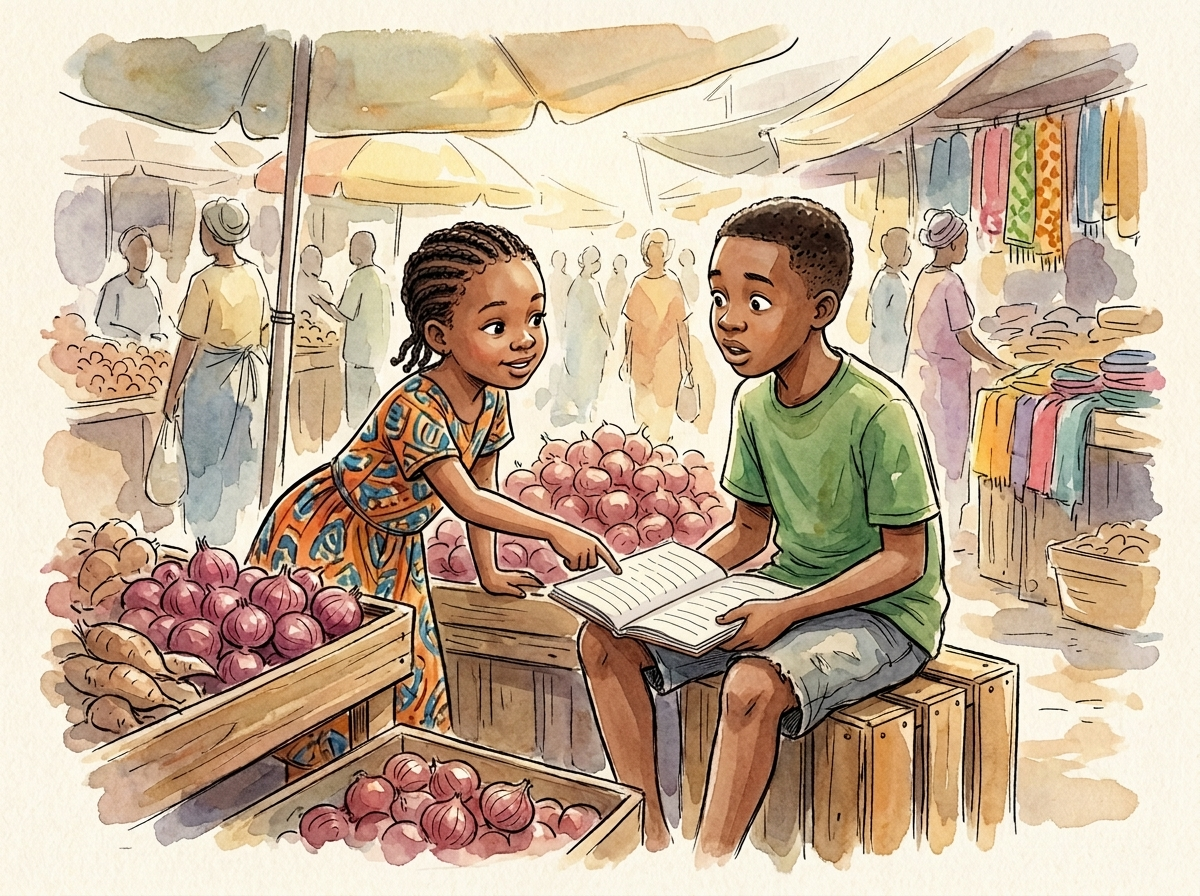
The onion seller was a boy. Not a man — a boy. He looked about twelve, maybe thirteen, sitting on a wooden crate behind a table of onions, doing homework in a notebook balanced on his knee.
"Good afternoon," Adaeze said. "Three fat onions, please. How much?"
The boy looked up. "One-fifty."
Now, Adaeze knew — she knew — that three onions should cost no more than one hundred. She had this information locked in her brain.
"Eighty," she said.
"One-twenty," said the boy.
"Ninety," said Adaeze.
"One hundred," said the boy. "Final price." He crossed his arms.
Adaeze crossed her arms right back.
They stared at each other. The market buzzed and honked and sang around them, but in this small space between the onions, it was a showdown.
Adaeze looked at his notebook. It was open to a mathematics page. Long division. She could see eraser marks everywhere — he had been trying the same problem over and over.
"One hundred," she said, "if you let me show you how to do that problem."
The boy blinked. He looked down at his notebook. He looked back at her.
"You know long division?"
"I am very good at long division," said Adaeze. This was true. It was possibly the truest thing she had ever said.
Five minutes later, Adaeze had three fat onions in her bag, the boy had the correct answer in his notebook — and understood why it was correct, which was the important part — and they had agreed that the onions cost one hundred naira, which was fair for both of them.
"What is your name?" the boy asked.
"Adaeze."
"I'm Emeka. You'll be here next Sunday?"
"Maybe," she said. "If there is long division."
Emeka grinned. "There is always long division."
Adaeze found Mama at Mama Nkechi's fabric stall, examining a blue cloth with golden patterns. She held up her bag, heavy with tomatoes and peppers and three fat onions.
"How did it go?" Mama asked.
Adaeze placed the change into Mama's hand — every single naira accounted for. Mama counted it. Looked at the vegetables. Counted again.
"Adaeze," Mama said slowly, "you have extra tomatoes here."
"Mama Bola added them. She said to tell you something."
"What?"
Adaeze lifted her eyebrow.
Mama laughed — a big, warm laugh that wrapped around Adaeze like a hug. Then she put her arm around her daughter's shoulders, and together they walked through the Sunday market, two queens among the noise and color, heading home with a bag full of everything they needed and a purse that still jingled with change.