She Said No
Fable
Ages 9–11 · 11 min
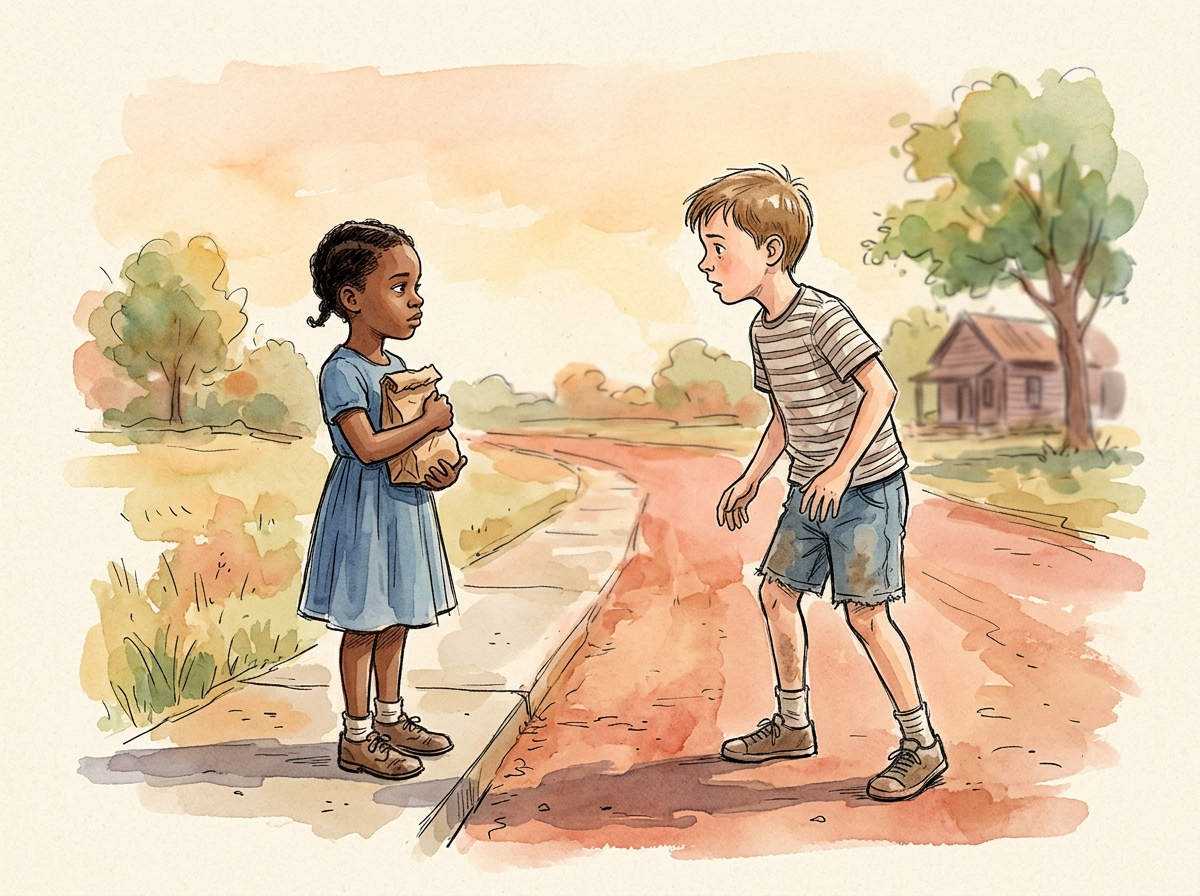
On a narrow sidewalk in Alabama, nine-year-old Rosa is walking home with a peppermint stick when a boy demands she move into the red dirt road.
Rosa lived on Pine Level Road in Alabama, where the red dirt stained everything it touched — her shoes, her socks, the hem of her dress, and sometimes, if she wasn't careful, the palms of her hands when she fell playing in the yard.
She was nine years old. She was small for her age. And she was walking home from the general store with a brown paper bag that held exactly two things: a spool of white thread for her grandmother and a peppermint stick that she had bought with her own penny.
Rosa lived on Pine Level Road in Alabama, where the red dirt stained everything it touched — her shoes, her socks, the hem of her dress, and sometimes, if she wasn't careful, the palms of her hands when she fell playing in the yard.
She was nine years old. She was small for her age. And she was walking home from the general store with a brown paper bag that held exactly two things: a spool of white thread for her grandmother and a peppermint stick that she had bought with her own penny.
The peppermint stick was already half-gone because Rosa had been working on it since she left the store, turning it slowly in her mouth like a little red-and-white barbershop pole. It was the best part of any errand — the walking-home part, when the task was done and the candy was fresh and the afternoon stretched out long and easy ahead of her.
Pine Level was a small town. Not much to it. A few dirt roads, a few farms, some churches, and a whole lot of sky. Rosa knew every oak tree and every fence post between the store and her grandparents' house. She knew where the mockingbird lived that could imitate a screen door creaking. She knew the exact spot where the road dipped and collected rainwater into a puddle that took three whole days to dry.
She was thinking about that puddle — wondering if last Tuesday's rain had left anything worth splashing in — when she saw the boy.
He was walking toward her on the same sidewalk. A white boy. About her age, maybe a little older. Sandy hair that fell over his forehead. He was kicking a stone ahead of him, the way boys do when they're bored and their feet need something to say.
Rosa kept walking.
The boy kept walking.
The sidewalk was narrow, but it was wide enough for two children to pass if they both made a little room. Rosa shifted slightly to the right, the way you do when you're sharing a path. A small movement. Polite. Natural.
The boy stopped kicking his stone. He looked up.
"Move off," he said.
Not excuse me. Not could you move over. Just: move off.
He meant off the sidewalk entirely. Into the red dirt road. So he could have the whole path to himself.
Rosa stopped walking.
She looked at him. He had freckles across his nose and a grass stain on his left knee, and in almost every way, he looked like just another kid on a summer afternoon. But his voice had something hard in it, something borrowed from somewhere — from older voices, grown-up voices, voices that had said this kind of thing so many times it had become ordinary. Like weather.
"Move off the sidewalk," he said again, louder, as if maybe she hadn't heard.
Rosa had heard.
She had heard it plenty of times, in plenty of ways. She'd heard it in the signs above drinking fountains. She'd heard it in the way certain people looked right through her, as if she were a window and there was something more interesting on the other side. She'd heard it from her grandmother, even — not the demand itself, but the warnings. Don't make trouble. Keep your eyes down. Step aside.
Her grandmother said these things with love. Rosa knew that. Her grandmother said them the way you'd tell a child to come inside from a thunderstorm — not because you love the storm, but because you love the child and you know what lightning can do.
But today, on this sidewalk, with peppermint dissolving on her tongue and the brown bag crinkling against her chest and the afternoon wide open around her — today, something in Rosa went very quiet. Not angry. Not scared. Just still.
Like a pond with no wind on it.
Like a clock between ticks.
She looked at the boy, and she did not move.
"I said—" he started.
"I heard what you said."
Her voice surprised her. It came out calm and even, like she was telling someone what day it was. It's Tuesday. The sky is blue. I heard what you said.
The boy's face changed. Not a lot. Just a flicker. Like a candle when a door opens in another room. He wasn't used to this — that was clear. He was used to the stepping-aside, the looking-down, the making-room. He had probably done this before and it had always worked, the way a key works in a lock, the way a quarter works in a gumball machine. You say the thing. The world rearranges itself.
But Rosa did not rearrange.
She stood on the sidewalk with her paper bag and her peppermint and her small, scuffed shoes planted on the ground as if they had grown roots right down through the packed dirt and into the deep red clay below. She looked at him with steady brown eyes, and she did not move.
They stood like that for what felt like a long time but was probably only a few seconds. The mockingbird sang its screen-door song from somewhere in the oaks. A horsefly buzzed between them like a tiny, confused referee.
The boy opened his mouth. Closed it. His fist tightened at his side, and for a moment, Rosa felt a flash of something cold in her stomach — not quite fear, but fear's cousin. She was nine, not foolish. She knew the stories. She knew about night riders and burned churches and people who disappeared for doing much less than standing on a sidewalk.
But the stillness inside her held.
It was the strangest thing. It was like discovering a room in your own house that you didn't know was there — a room with a lock on the inside and walls that didn't shake.
The boy's shoulders dropped, just slightly. He looked over his shoulder, as if checking whether anyone was watching this — this thing that wasn't going the way it was supposed to go. Nobody was there. Just the road, the oaks, the sky.
He stepped off the sidewalk.
He went around her, his shoes crunching in the red dirt, and he didn't say anything else. He just walked on, leaving his kicking stone behind on the path.
Rosa watched him go. Her heart was beating hard — she could feel it in her ears, in her fingertips, in the paper bag that trembled slightly against her chest. She hadn't felt it during. Only after. The way you don't feel cold until you step out of the rain.
She started walking again.
The puddle from Tuesday's rain was still there, but it had shrunk to a thin crescent, like a little brown moon in the road. Rosa stepped over it. She walked past the fence where Mrs. Johnson's goat always stuck his head through the slats to beg for attention. She turned up the path to her grandparents' house, where the porch sagged in the middle and her grandfather's rocking chair sat waiting like a patient old friend.
Her grandmother was in the kitchen, rolling out biscuit dough, her hands white with flour up to the wrists.
"You get the thread?" she asked without turning around.
"Yes, ma'am." Rosa set the bag on the table.
"You eat that candy already?"
"Most of it."
Her grandmother glanced at her. She had sharp eyes, Rosa's grandmother. Eyes that could read weather, read people, read the space between what a child said and what a child meant.
"Something happen?"
Rosa thought about it. She thought about the boy and the sidewalk and the stillness and the room she'd found inside herself with the lock on the inside.
"No, ma'am," she said. "Nothing happened."
And in a way, that was true. Nothing happened. A girl walked home. A boy walked the other direction. Nobody got hurt. Nobody got rescued. There was no crowd to cheer, no villain to defeat, no grand moment that anyone else in Pine Level, Alabama, would have noticed or remembered.
But Rosa would remember.
She would remember the exact temperature of that stillness — the way it felt to plant her feet and find them solid, the way the word no could be a quiet thing, the quietest thing in the world, and still be the strongest.
She would carry it with her the way the red dirt carried its color: all the way through, down to the bone, permanent and deep.
Years later, on a city bus in Montgomery, people would say she was tired. They would say her feet hurt. They would say she just didn't feel like getting up that day.
But Rosa knew the truth.
She wasn't tired.
She had just been ready for a very long time.
And it started here. On a narrow sidewalk. With a peppermint stick. At nine years old.
When she said no — not by shouting, not by fighting, not by making a speech — but by simply, quietly, completely refusing to disappear.