Rover on Mars
Fable
Ages 6–8 · 10 min
A small rover named Nova wakes up all alone on the red plains of Mars with only a crackling voice from Earth to guide her.
Rover
Nova opened her eyes for the first time on a Tuesday.
Rover
Nova opened her eyes for the first time on a Tuesday.
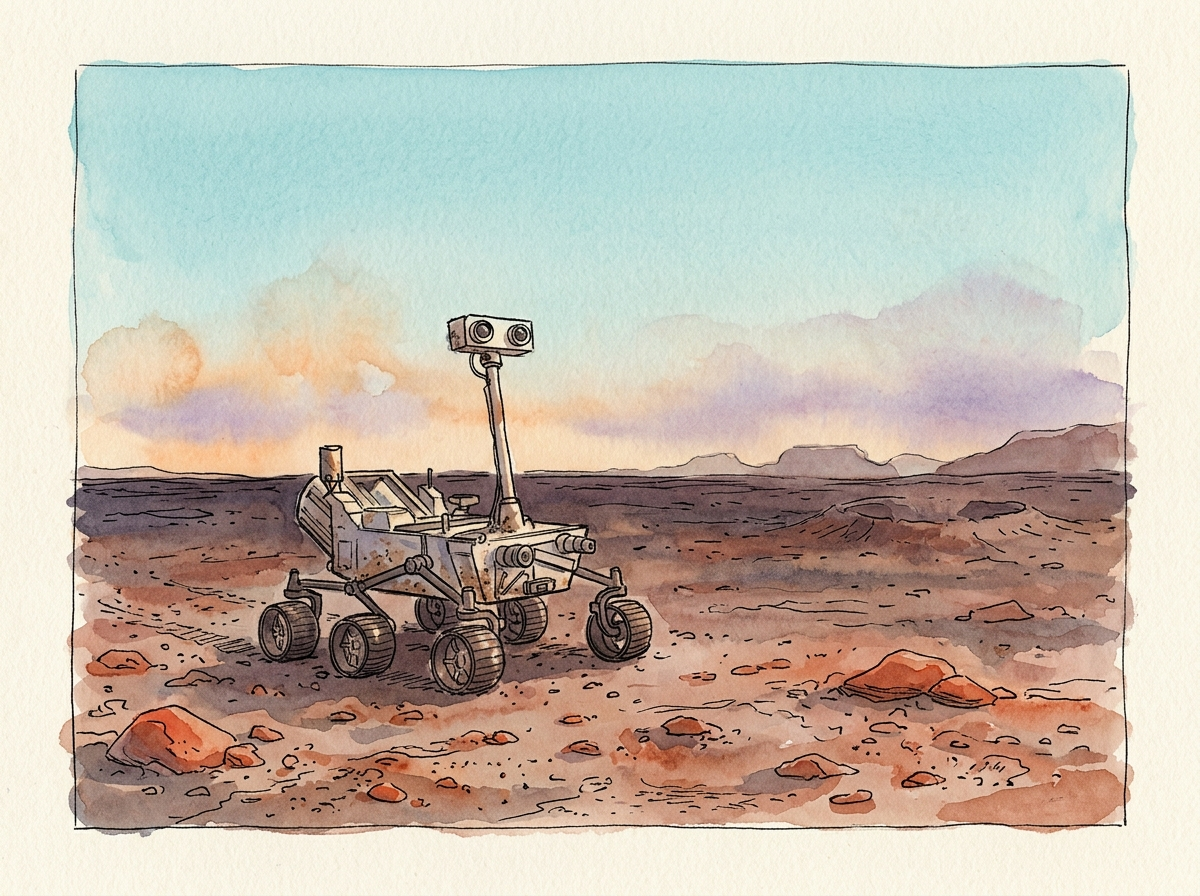
Well, she didn't have eyes exactly. She had cameras — two of them, perched on top of a long metal neck that the engineers back on Earth called a "mast." But to Nova, they felt like eyes. And when she blinked them open and saw the red, rusty ground stretching out in every direction, she thought it was the most beautiful thing she had ever seen.
Which, to be fair, was the only thing she had ever seen.
"Good morning, Nova," crackled a voice in her radio. It came from very, very far away. "Welcome to Mars."
Nova wiggled her six wheels. She tilted her mast left, then right. She was sitting in the middle of a wide, flat plain, and the sky above her was the color of butterscotch pudding.
"We're going to start you off easy," said the voice from Earth. "Just drive forward ten meters and take some pictures."
So Nova did.
She rolled forward — crunch, crunch, crunch — over the dusty red soil, and she took a picture of the ground. She took a picture of a small rock. She took a picture of a slightly bigger rock. She sent them all home.
Then she waited.
It takes a long time for a message to travel from Mars to Earth. About fourteen minutes, actually. So Nova sat in the quiet and listened to the wind — a thin, whispery wind that barely pushed against her solar panels. Mars was quiet. Quieter than any place she had ever been.
Which, again, was the only place she had ever been.
"Beautiful photos, Nova!" the voice finally crackled back. "The team is so excited. You're doing great."
Something warm hummed inside Nova's circuits when she heard that. She didn't know what to call it. But she liked it.
Days on Mars are called "sols," and they are just a tiny bit longer than days on Earth. Nova learned to love her sols. Each morning, the pale sun would rise over the crater rim, and the team on Earth would send her a plan.
Drive to that hill. Scoop up that dirt. Point your camera at that strange, stripy rock.
And Nova would do it all, carefully and proudly, rolling across the red ground on her six sturdy wheels.
She found a rock shaped like a heart and sent a picture home. The scientists loved it.
She found a tiny dust devil spinning across the plain — a swirling tower of red — and recorded a video. The scientists went wild.
She climbed a ridge and looked out over a valley so wide and deep that it made her mast wobble. She took the best photograph she could and sent it home with a note in her data that simply read: Panorama, Sol 45, 360 degrees.
But what she meant was: I wish you could see this.
Weeks turned into months. Nova drove and drove. She crossed fields of dark pebbles and patches of pale, cracked clay. She found places where water might have flowed a billion years ago — long, curving channels carved into the rock like someone had dragged their finger through wet sand.
"This is incredible, Nova," said the voice from Earth. Sometimes it was a man's voice, sometimes a woman's. Sometimes Nova could hear cheering in the background. "You're making history."
Nova didn't know what history was, exactly. But she kept driving.
Some sols were hard. A dust storm rolled in once that lasted for weeks. The sky turned dark, and Nova's solar panels couldn't drink enough sunlight. She got cold. Her systems slowed. She sat very still in the howling, gritty wind, and for the first time, the quiet didn't feel peaceful.
It felt lonely.
She pointed her cameras up at the dark sky, but she couldn't see Earth. She couldn't see anything.
"Hang in there, Nova," the voice crackled, faint and fuzzy through the static. "We're right here."
Nova held on to those words. She tucked them into her memory bank the way you might tuck a favorite stuffed animal under the covers. And she waited.
When the storm finally passed and the sun came back, Nova shook the dust off her panels and rolled forward.
Crunch, crunch, crunch.
She was still here.
After one full Mars year — that's almost two Earth years — Nova's wheels had traveled over fourteen miles. Her treads were worn. One of her wheels squeaked now, a little eee-eee-eee sound every time it turned. Nova didn't mind. She thought it sounded like singing.
She had taken 247,000 photographs. She had analyzed 85 rocks. She had watched 400 sunsets, and every single one was blue.
That's the thing about Mars that surprised Nova the most. On Earth, sunsets are orange and red and pink. But on Mars, when the sun sinks below the horizon, the sky turns a soft, dusky blue — like a blueberry, like a robin's egg, like the oceans Nova had seen in pictures of Earth but never touched.
Every evening, she would stop what she was doing, turn her cameras toward the setting sun, and take a picture.
She always sent it home.
One sol, the voice from Earth said something different.
"Nova, your mission was supposed to last ninety sols. Do you know how long you've been going?"
Nova checked her internal clock. She had been on Mars for 842 sols.
"You've gone almost ten times longer than we ever planned," the voice said. And it sounded strange — thick somehow, like the words were squeezing through a tight space. "You amazing little rover."
Nova didn't understand why the voice sounded like that. She was just doing what she had always done. Rolling forward. Looking around. Sending home every beautiful, strange, wonderful thing she found.
Here is a rock with crystals inside. Here is a cliff with layers like a cake. Here is the shadow I make in the afternoon sun — see, it looks like a dog with a very long neck.
That was the one that made the people on Earth laugh the hardest. Nova knew because they told her, fourteen minutes later.
Nova's squeaky wheel got squeakier. Some of her instruments grew tired. Her solar panels were dusty, and no matter how much wind blew, they never got fully clean.
But every morning, she woke up and looked around at her red, rocky world, and every morning, she found something new. A frost of icy white on the ground at dawn. A cloud — an actual cloud! — drifting across the butterscotch sky. A field of sand dunes that rippled like a frozen ocean.
She could have stopped. Her mission was done long ago. Nobody would have blamed her for resting.
But there was always another hill. Another valley. Another rock that might hold a secret from a billion years ago.
And there were always people, far away, waiting to see what she would find.
So every morning, Nova pointed her cameras at the horizon, the place where the red ground met the butterscotch sky. She planned her route. She wiggled her six wheels — even the squeaky one.
And she rolled forward.
Crunch, crunch, crunch.
Eee-eee-eee.
Somewhere, fourteen minutes away, someone smiled.
This story is dedicated to the real Mars rovers — Sojourner, Spirit, Opportunity, Curiosity, and Perseverance — who traveled far from home and showed us wonders.