Jollof Rice Saturday
Fable
Ages 6–8 · 11 min
With her secret notebook, Amara enters the annual family jollof rice competition for the first time, ready to challenge her uncle, the Jollof King.
Every year on the first Saturday of June, the Okafor family took over Grandma Nne's backyard. They strung up lights between the mango trees. They dragged out the long wooden tables. They set up four cooking stations with four big pots. And then — oh, then — they made jollof rice.
Not just any jollof rice.
Every year on the first Saturday of June, the Okafor family took over Grandma Nne's backyard. They strung up lights between the mango trees. They dragged out the long wooden tables. They set up four cooking stations with four big pots. And then — oh, then — they made jollof rice.
Not just any jollof rice.
Competition jollof rice.
For twenty years, the Okafor family had battled pot against pot to see who could make the best jollof rice in the family. Uncle Chidi had won seven times. Auntie Bola had won five. Grandma Nne had won the rest — except for one mysterious year when Cousin Tunde won and nobody liked to talk about it because his rice had been suspiciously perfect.
And for every single one of those twenty years, Amara had watched.
She'd watched from her little plastic chair, kicking her legs, smelling the onions sizzling, the tomatoes bubbling, the rice steaming. She'd tasted every entry with her eyes closed, the way the judges were supposed to. She'd kept a secret notebook — a tiny purple one — where she wrote things like: Uncle Chidi's rice: smoky but too peppery. Auntie Bola's rice: sweet sweet sweet but mushy.
Amara was eight years old now, and this year, finally, Grandma Nne had looked at her across the breakfast table and said, "Amara. I think it's time."
Amara had almost choked on her toast.
"You mean—"
"I mean you're entering the competition."
Amara had screamed so loud the dog next door started barking.
Now it was Saturday morning, and Amara stood in Grandma Nne's kitchen with her purple notebook open, staring at her ingredients. She had planned her recipe for weeks. She'd picked the ripest tomatoes from the market with her own hands, squeezing them gently the way Grandma Nne had taught her. She'd measured out her rice the night before, washing it three times until the water ran clear. And she had her secret weapon ready: a tiny jar of smoked paprika mixed with ground crayfish, which she'd labeled "AMARA'S MAGIC DUST" in wobbly handwriting.
"You ready, small chef?" Uncle Chidi called from his station, already chopping onions so fast his knife sounded like a drumroll. He wore his apron that said JOLLOF KING in big gold letters.
"I'm ready," Amara said, tying on her own apron — a plain blue one that Grandma Nne had sewn for her, with her name stitched in orange thread.
"Don't worry," Auntie Bola said sweetly. "Nobody expects you to win your first year."
Amara just smiled. She opened her notebook to the page where she'd written her recipe and set a tomato on her cutting board.
The first hour went beautifully.
Amara's tomato sauce was bubbling thick and red, just like the picture in her head. The onions had gone golden and soft. She added her spices one by one — the way Grandma Nne always said, "Don't rush the spices. Let each one introduce itself" — and the smell coming from her pot was so good that two of her little cousins wandered over and just stood there, breathing.
"Smells like heaven," whispered her cousin Emeka, who was five and very honest.
Amara grinned. She poured in her washed rice, stirred it gently into the sauce, added her water, and covered the pot. Now came the hard part — the waiting. Jollof rice needed low heat and patience. You couldn't peek too much. You couldn't stir too much. You had to trust the pot.
Amara set her timer for twenty minutes and sat on her stool, swinging her legs.
That's when things went wrong.
At twelve minutes, she smelled something. Not the sweet, rich, wonderful smell of jollof rice doing its thing. Something sharper. Something darker.
Burning.
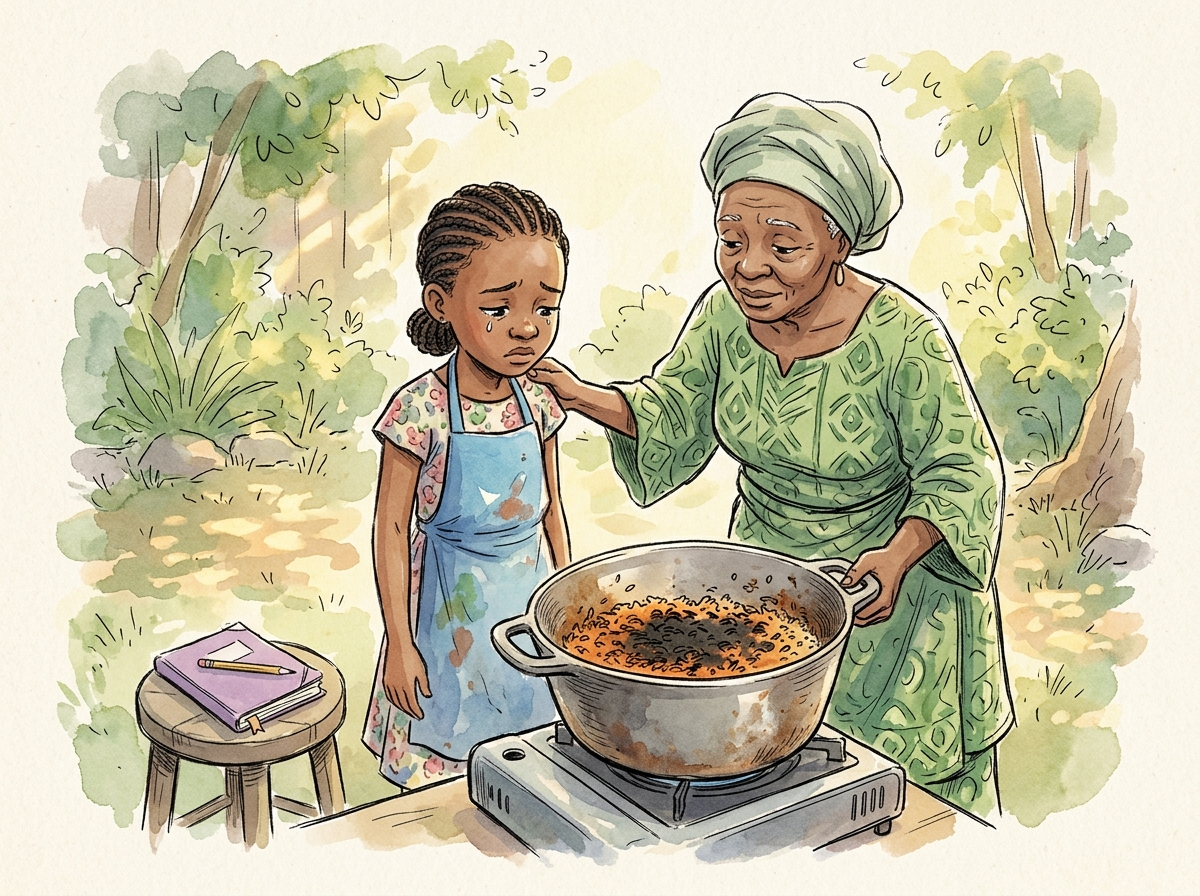
Amara jumped off her stool and lifted the lid. A cloud of steam hit her face, and when it cleared, she saw it: the bottom of her pot had gone dark. The rice on top was still wet and pale, but underneath — where it mattered most — the rice had stuck and scorched.
Her stomach dropped.
"Oh no," she whispered. "Oh no, oh no, oh no."
She turned down the heat, but her hands were shaking. She grabbed her wooden spoon and tried to stir, but the burned bits from the bottom mixed up into the good rice, leaving brown flecks everywhere.
Her eyes stung, and not from the steam.
Uncle Chidi glanced over. Auntie Bola glanced over. Amara could feel everyone trying not to look, which was somehow worse than if they'd all just stared.
She blinked hard and stared into her pot.
Grandma Nne appeared beside her like she'd been carried by the breeze. She didn't say anything at first. She just stood there, close enough that Amara could smell her shea butter lotion and the faint sweetness of the chin chin she'd been frying for dessert.
"Grandma," Amara whispered, "I ruined it."
Grandma Nne looked into the pot. She picked up a spoon, took a tiny taste from the top layer, and chewed slowly.
"Hmm," she said. "The flavor is beautiful, Amara."
"But it's burned on the bottom. And the brown bits are all mixed in now."
Grandma Nne was quiet for a moment. Then she said, "Do you know what we call the burned part at the bottom of the jollof pot?"
Amara shook her head.
"We call it the kanzo. And your Uncle Chidi — the Jollof King himself — do you know what happened the very first year he won?"
Amara sniffed. "What?"
"He burned his pot so badly that your grandfather said it smelled like a tire fire." Grandma Nne's eyes crinkled. "But Chidi didn't quit. He scraped off what he could, added a little more tomato paste, adjusted his seasoning, and served what he had. And the flavor in that pot was the best any of us had ever tasted."
Amara looked down at her rice again. The brown flecks stared back at her.
"You still have time," Grandma Nne said softly. "And you still have good rice in that pot. The question is — what are you going to do with it?"
Then she walked away, because Grandma Nne always knew exactly when to walk away.
Amara wiped her eyes with the back of her hand. She took a breath. She opened her purple notebook.
Then she got to work.
She carefully spooned out the worst of the scorched rice and set it aside. She tasted what was left. Grandma Nne was right — the flavor was really, truly good. Rich and tomatoey and warm. But it needed something to cover the slight smokiness from the burn.
Amara looked at her little jar. AMARA'S MAGIC DUST.
She'd been planning to add just a pinch. Instead, she added two pinches, stirred gently, and covered the pot again. The smoky paprika wrapped right around the burned taste like a hug, turning the mistake into something deeper — something that smelled like a campfire in the best possible way.
When her timer finally went off, Amara lifted the lid. The rice was fluffy on top, stained a deep orange-red, each grain standing on its own. She scooped a little onto a spoon and tasted it.
Her eyes went wide.
The judging happened at sunset, when the lights in the mango trees switched on and everything glowed gold. Grandma Nne's neighbor, Mrs. Adeyemi, was the judge, because she was the only person in the neighborhood brave enough to tell an Okafor that their rice wasn't good enough.
Mrs. Adeyemi tasted Uncle Chidi's rice and nodded. She tasted Auntie Bola's rice and smiled. She tasted Cousin Tunde's rice and raised one eyebrow.
Then she tasted Amara's.
She stopped chewing. She looked at Amara. She took another bite.
"This child," Mrs. Adeyemi said slowly, "has something."
Amara held her breath.
When the scores were tallied, Uncle Chidi won. Of course he did — he was the Jollof King, and he'd had twenty years of practice. But Amara came in second. Second. Above Auntie Bola, above Cousin Tunde, above everyone else.
The whole family erupted. Her little cousins cheered. Auntie Bola pretended to faint. Uncle Chidi walked over, took off his JOLLOF KING apron, and draped it over Amara's shoulders.
"You keep that," he said. "I have a feeling I'm going to need a new title soon."
Amara pulled the apron around herself. It was way too big. It hung past her knees and pooled on the ground.
She had never felt taller.
That night, she sat under the mango trees eating jollof rice from all four pots while the fireflies came out. She opened her purple notebook to a fresh page and wrote:
My rice: smoky (on purpose and a little by accident). Second place. First year.
Then, underneath, she added one more line:
Next year — first place.
She closed the notebook, licked her spoon clean, and smiled.