How Far Is the Moon?
Fable
Ages 6–8 · 9 min
On his back porch one night, a boy named Ren asks how far away the moon is and gets an answer so big his counting brain feels blank.
Ren loved big numbers.
He loved them the way some kids loved dinosaurs or race cars or collecting shiny rocks. He kept a notebook — a bright blue one with a rubber band around it — and he filled it with numbers he found throughout the day.
Ren loved big numbers.
He loved them the way some kids loved dinosaurs or race cars or collecting shiny rocks. He kept a notebook — a bright blue one with a rubber band around it — and he filled it with numbers he found throughout the day.
The number of steps from his bed to the kitchen: forty-seven.
The number of cheerios in his bowl one morning: two hundred and six. He counted twice.
The number of bricks on the front of his school: one thousand, three hundred, and twelve. That one took him three recesses.
Ren's dad said he had "a counting brain," and Ren liked that. He pictured his brain covered in tiny numbers, like sprinkles on a cupcake.
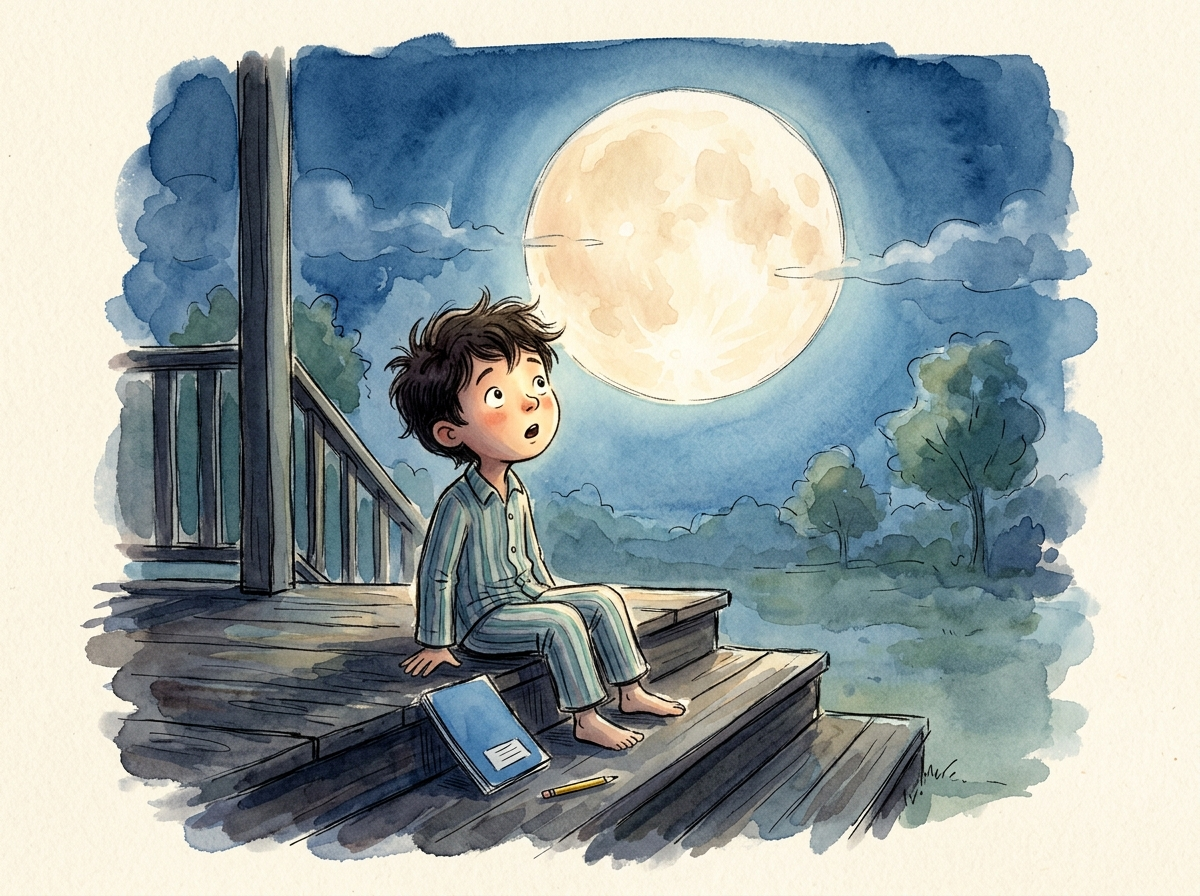
One night, Ren and his dad sat on the back porch. The moon was up — big and white and round as a dinner plate. Ren stared at it for a long time. Then he asked the question.
"Dad, how far away is the moon?"
His dad leaned back in his chair and said, "About two hundred and thirty-nine thousand miles."
Ren opened his mouth. Then he closed it. Then he opened it again.
"Two hundred and thirty-nine thousand?"
"Give or take," said his dad.
Ren pulled out his blue notebook and wrote the number down. Two hundred and thirty-nine thousand miles. He stared at it. He stared at it some more. He had never met a number he couldn't get his arms around, but this one just sat on the page like a rock he couldn't lift.
He tried to picture it. Two hundred and thirty-nine thousand miles. But what did that even look like? His brain, usually so full of sprinkles, felt blank.
"I don't understand that number," Ren whispered. And for Ren, that was a very uncomfortable thing to say.
The next day at school, Ren couldn't stop thinking about it. During reading time, he stared out the window at the pale daytime moon. During lunch, he barely touched his sandwich.
His friend Maisie sat across from him and said, "You look like you're doing math in your head."
"I'm trying to," said Ren. "But the math is too big."
"How big?" asked Maisie.
"Moon big."
Maisie nodded slowly, as if this made perfect sense.
After school, Ren sat on his bed and opened his notebook. He looked at the number again. Two hundred and thirty-nine thousand miles. He needed to make it smaller. Not wrong — just smaller. Small enough to hold.
He tapped his pencil on the page.
"Okay," he said. "I know how far one mile is. It's from our house to the grocery store."
He wrote that down. One mile equals the distance from our house to the grocery store.
So the moon was like walking to the grocery store... two hundred and thirty-nine thousand times?
Ren flopped backward on his bed. That didn't help at all.
He tried again.
"How far is it to Grandma's house?"
He ran downstairs. "Dad! How far is Grandma's house?"
"About two hundred miles," said his dad, chopping onions.
Ren ran back upstairs. He did the math carefully, his tongue poking out the side of his mouth.
Two hundred and thirty-nine thousand divided by two hundred. That made one thousand, one hundred and ninety-five.
So the moon was like driving to Grandma's house... one thousand, one hundred and ninety-five times.
Ren groaned. He loved going to Grandma's house — she had a dog named Butterscotch and a jar of lemon drops that never seemed to empty — but even he didn't want to go there a thousand times in a row.
The number was still too big.
That night on the porch, the moon was back. Ren sat with his notebook in his lap and a grumpy look on his face.
"Still working on the moon?" asked his dad.
"It won't get small enough," said Ren.
His dad sat quietly for a moment. Then he said, "What if you didn't use miles?"
Ren looked up. "What do you mean?"
"Well, you keep trying to measure it with things you already know — grocery stores and Grandma's house. But maybe you need a different kind of measuring."
Ren chewed on his pencil. "Like what?"
His dad pointed at the sky. "How long does it take light to get from the moon to us?"
"I don't know."
"About one and a quarter seconds."
Ren sat straight up. "One second?"
"And a quarter. A beam of light leaves the moon, and before you can even say the word 'moon,' it's already here."
Ren whispered the word "moon." It took less than a second. He felt a shiver go up his back.
"So... the moonlight I'm seeing right now left the moon... just now?"
"Just about," said his dad.
Ren looked up at the moon. He blinked. In that blink, light had traveled from there to here. From that big glowing circle all the way down to his eyes, to his face, to this porch.
One second and a quarter.
He wrote it in his notebook, in big letters. Moonlight travel time: one and a quarter seconds.
And for the first time in two days, the number felt like something he could hold in his hands.
But Ren wasn't done. That was the thing about Ren — once his counting brain got going, it didn't like to stop.
The next day, he tried something new. He asked his teacher, Ms. Reeves, "How fast does a car go on the highway?"
"About sixty miles per hour," she said.
Ren did the math at his desk. If you could drive a car straight up to the moon at sixty miles per hour, never stopping for gas or snacks or bathroom breaks...
It would take about one hundred and sixty-six days.
That was more than five months.
"Five months!" he told Maisie at lunch. "You could leave on your birthday and get to the moon by winter break!"
"Would there be snacks?" asked Maisie.
"No snacks. You can't stop."
"Then I'm not going," said Maisie.
Ren laughed — a real laugh, the kind that had been hiding for two days.
That afternoon, Ren filled an entire page with new ways to measure the distance to the moon.
If you stacked elephants end to end: about sixty-four million elephants. Too big. But funny.
If you laid spaghetti noodles in a line: he wasn't sure, but he wrote "a LOT of spaghetti" and circled it.
If you counted one number per second up to two hundred and thirty-nine thousand: it would take about two days and eighteen hours. "I could do that," Ren said to himself. He probably couldn't. But he liked thinking he could.
And then his favorite one:
If his dad picked him up and put him on his shoulders, they'd be about seven feet tall. To reach the moon, you'd need to stack about one hundred and eighty million dads.
Ren drew a picture of this. A tower of dads, all the way to the moon, each one holding the next one's ankles. It was the best drawing he'd ever made.
That night, one last time, Ren sat on the porch with his dad. The moon hung right where it always did — patient, round, waiting.
"Dad," said Ren. "Two hundred and thirty-nine thousand miles is really, really far."
"It is," said his dad.
"But moonlight gets here in one second."
"And a quarter."
"And you could drive there in five months."
"If you didn't stop for snacks."
Ren smiled. He closed his blue notebook and held it against his chest.
The moon was far away. So far that the number had made his brain go blank. But now he had filled his notebook with bridges — little ways of walking from what he knew to what he didn't. And the distance didn't feel so impossible anymore.
Not small, exactly.
But the right kind of big.
The kind of big that made him want to keep counting.