Her Own Drum
Fable
Ages 6–8 · 8 min
Because a rhythm is always beating inside him, August hits the kitchen table, the soup pot, and the porch railing until his parents tell him to stop.
The Drum
August liked to hit things.
The Drum
August liked to hit things.
He hit the kitchen table with his spoons at breakfast — bam-bam-bam-ba-da-bam. He hit the porch railing with a stick on the way to school — ticka-ticka-ticka-TOCK. He hit his knees in the back seat of the car — dum-da-dum-da-dum-dum-DUM. He hit the couch cushions, the recycling bin, the big metal pot his mom used for making soup, and once, unfortunately, his sister's dollhouse, which did not make a very good sound and also got him sent to his room.
"August," his dad said at least three times a day, "please stop hitting things."
"August," his mom said at least four times a day, "you are going to break something."
And sometimes he did break something. He broke the handle off a wooden spoon. He cracked the lid of the recycling bin. He put a dent in the big metal soup pot that made his mom close her eyes and breathe very slowly through her nose, which was never a good sign.
"I wasn't trying to break it," August explained. "I was playing it."
"Playing it," his mom repeated.
"It sounds like an ocean if you hit it right here," August said, pointing to the side of the pot. "And like thunder if you hit it right HERE." He demonstrated.
His mom took the pot away.
At school, August's teacher, Ms. Latham, had a container of colored pencils on her desk. While the other kids were reading quietly during free time, August reached over and started tapping two pencils on the edge of the table. Softly at first. Then a little louder. Then a LOT louder. He couldn't help it. There was a rhythm trapped inside his hands and it had to come out.
Tap-tap — tappa-tap-tap — tap-tap — tappa-tap-tap —
"August," said Ms. Latham.
He stopped. "Sorry."
But thirty seconds later, his fingers were at it again, drumming on his legs under the desk. His feet joined in, tapping the floor. His whole body wanted to keep the beat.
Ms. Latham watched him from across the room. She didn't say anything this time. She just tilted her head a little, like she was listening.
That Friday, a letter came home in August's backpack.
"What's this?" his dad asked, pulling out the folded paper.
August shrugged. He was busy tapping on the kitchen counter with a pair of chopsticks.
His dad read the letter. Then he read it again. Then he looked at August's mom.
"Ms. Latham says the school is starting a beginner percussion group," he said. "She thinks August should join."
August stopped tapping. "What's percussion?"
"Drums," said his dad. "And other things you hit."
August's eyes went wide. "There's a GROUP for that?"
His parents looked at each other. His mom had the expression she got when she wasn't sure about something, like when August asked if he could have a snake for a pet.
"It's after school on Tuesdays," his dad said. "We could try it."
"Just — TRY it," his mom said carefully.
The first Tuesday, August walked into the music room and saw them.
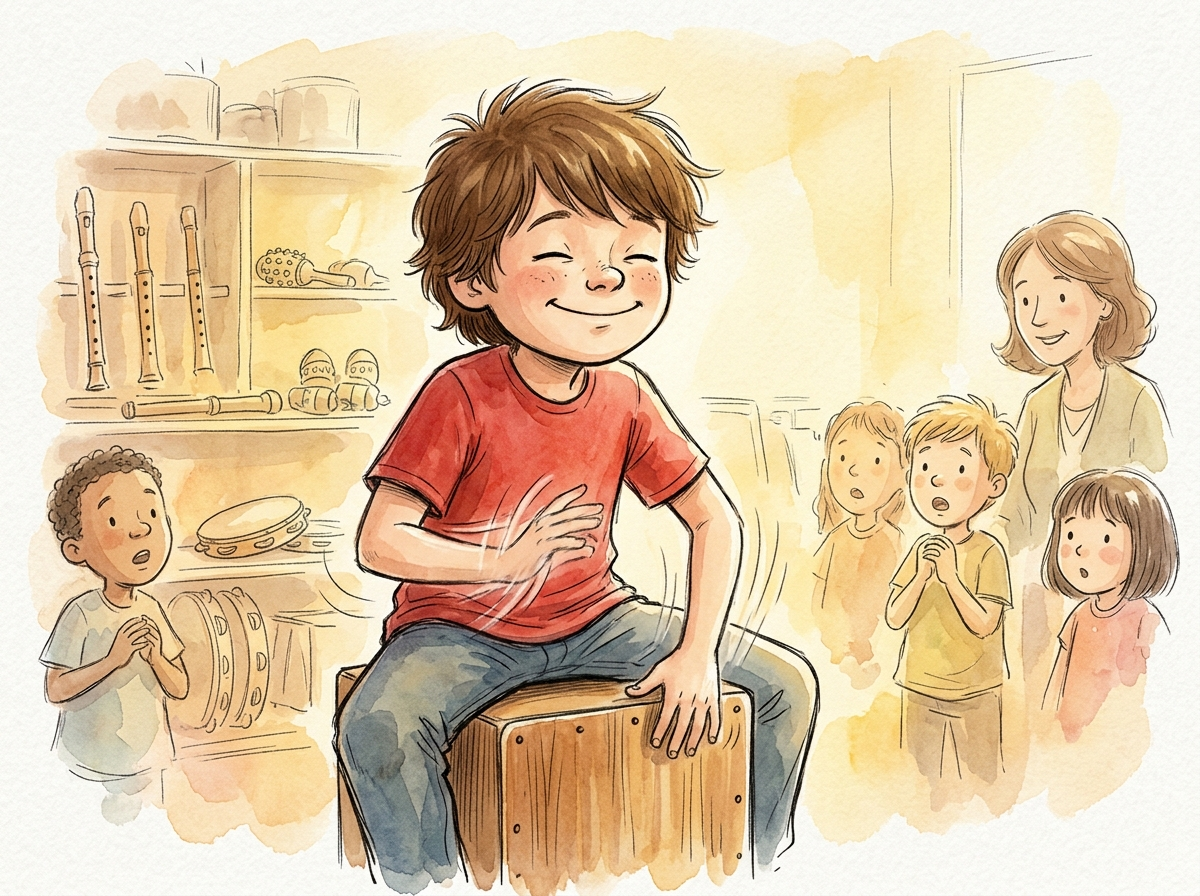
Drums. Real drums. Big ones and small ones. Tall ones that stood on the floor like tree stumps. Tiny ones you could hold in your hand. There were also shiny circles on stands — cymbals, the teacher called them — and a xylophone, and wooden blocks, and something called a cajón, which was basically a box you sat on and hit. August thought that was the greatest invention in the history of the world.
The teacher's name was Mr. Domingo. He was a short man with a big smile and hands that moved so fast they blurred.
"First rule," Mr. Domingo said to the group of six kids. "You don't hit the drums until I say."
August nearly fell off his chair. That was the WORST rule.
"Second rule," Mr. Domingo continued. "When you DO hit the drums, you listen. Listening is more important than hitting."
August frowned. That didn't make any sense.
But then Mr. Domingo sat down at the cajón, and he played.
His hands were soft, then loud, then soft again. He made sounds August didn't know a box could make — deep booms and sharp snaps and quick little flutters like rain on a roof. There was a pattern to it, a heartbeat underneath, and the pattern kept changing but it always, always made sense.
August felt his own heart speed up. His fingers tingled.
"Now," said Mr. Domingo. "I play a pattern. You clap it back."
He clapped: boom — boom — ba-da-boom.
The kids clapped back. Most of them were a little off. A couple were way off.
August was exactly right.
Mr. Domingo looked at him. "Again," he said, and played a harder one: boom-chicka-boom-chicka-boom-boom-CLAP.
August clapped it back perfectly, and his feet added a little extra kick on the floor — tap-tap — that fit right into the spaces between the beats.
Mr. Domingo raised his eyebrows. "What's your name?"
"August."
"August, have you played drums before?"
"No. But I've played a soup pot."
Mr. Domingo laughed — a big, round laugh. "Come sit here," he said, and he pointed to the cajón.
August sat on the box. He could feel it humming under him, waiting. He put his hands on the surface, and Mr. Domingo showed him where to hit for the low sound and where to hit for the high sound, and then he said, "Play what you feel."
August played.
He started slow — BOM... BOM... bom-bom-BOM — feeling out the sounds, finding where they lived. Then faster. His hands found a rhythm, and the rhythm found more rhythm, and the beats stacked up like blocks building a tower, and the tower didn't fall — it just kept GROWING.
The other kids stopped what they were doing. They stared.
Mr. Domingo stood very still, his arms crossed, nodding slowly.
When August finished, the room was quiet for one second. Then everyone clapped.
August's face went hot. He'd never made people clap before. Usually he just made people sigh.
That night at dinner, August couldn't stop talking about it.
"And there's this thing called a PARADIDDLE, and it goes left-right-left-left, right-left-right-right, and Mr. Domingo says I have natural time, which means I can feel where the beat goes, and next week we're going to play an ACTUAL song together —"
His parents were quiet. Not the bad quiet, like when he dented the soup pot. A different quiet.
"What?" August said.
His dad shook his head. "Nothing. Keep going."
His mom reached over and squeezed his hand. "I'm glad you found your thing, baby."
"Can I practice after dinner? Mr. Domingo said I could use a pillow if I don't have a drum. You put it on your lap and practice the patterns."
"You want to hit a pillow," his dad said.
"Rhythmically," August said.
His dad laughed. "Yeah, okay. Rhythmically."
After dinner, August sat on his bed with a pillow on his lap and practiced paradiddles until his mom said it was time to sleep. His hands were sore in a good way. A worked-hard way.
He lay back and listened to the house settling in for the night — the hum of the heater, the ticking of the hallway clock, the soft thump of his dad's footsteps downstairs. Everything had a beat if you paid attention.
His fingers tapped lightly on the blanket.
Bom... bom... bom-bom-bom.
He smiled in the dark.
Tomorrow there would be a kitchen table and a porch railing and a car ride with his knees just sitting there, waiting. And on Tuesday — Tuesday there would be real drums, and Mr. Domingo, and six kids making sound together, and the cajón humming under him like it was alive.
August closed his eyes.
His hands were finally still.
But the rhythm kept going — steady and warm, beating away inside his chest like it had been there all along, just waiting for someone to hear it.