Yom Kippur Morning
Fable
Ages 9–11 · 13 min
On the morning of his first Yom Kippur fast, Ezra's stomach is growling and the bananas on the kitchen counter are mocking him.
Ezra's stomach growled at exactly 7:42 in the morning.
He knew the exact time because he was staring at the clock on his nightstand, watching each minute click forward like it was personally trying to annoy him. 7:42. That meant he'd been awake for twelve whole minutes without eating, which wasn't normally a big deal, except that today was Yom Kippur, and he wouldn't be eating until the stars came out tonight.
Ezra's stomach growled at exactly 7:42 in the morning.
He knew the exact time because he was staring at the clock on his nightstand, watching each minute click forward like it was personally trying to annoy him. 7:42. That meant he'd been awake for twelve whole minutes without eating, which wasn't normally a big deal, except that today was Yom Kippur, and he wouldn't be eating until the stars came out tonight.
He'd chosen this. That was the really annoying part.
Last year, and every year before that, his parents had said he was too young to fast. He'd eaten his cereal and his sandwiches and his snacks while the grown-ups walked around looking slightly tired and slightly holy. But this year, Ezra had marched into the kitchen two weeks ago, stood up very straight, and announced: "I'm fasting this year. I'm ready."
His mom had looked at his dad. His dad had looked at his mom. They did that thing where they had an entire conversation using only their eyebrows.
"Okay," Dad had said. "If that's what you want."
"It is," Ezra had declared, feeling extremely mature and noble and brave.
That was two weeks ago. Two weeks ago, Ezra was an idiot.
Now he dragged himself out of bed and shuffled to the bathroom. He brushed his teeth carefully—which he normally rushed through—because today brushing his teeth was the most exciting thing that would happen in his mouth all day. He put on the white button-down shirt his mom had laid out and his good khakis, and he looked at himself in the mirror.
"You look like someone going to a funeral," he told his reflection. "Your own funeral. The funeral of Ezra Solomon, who died of starvation at age ten."
"Talking to yourself?" His older sister Noa appeared in the hallway, already dressed, already looking annoyingly calm. Noa was fourteen and had been fasting since she was twelve. She acted like it was nothing, like not eating for twenty-five hours was just a casual Tuesday.
"I'm fine," Ezra said.
"You look pale."
"I always look pale. I'm a redhead."
Noa shrugged and headed downstairs. Ezra's stomach growled again, louder this time, like it was trying to file a formal complaint.
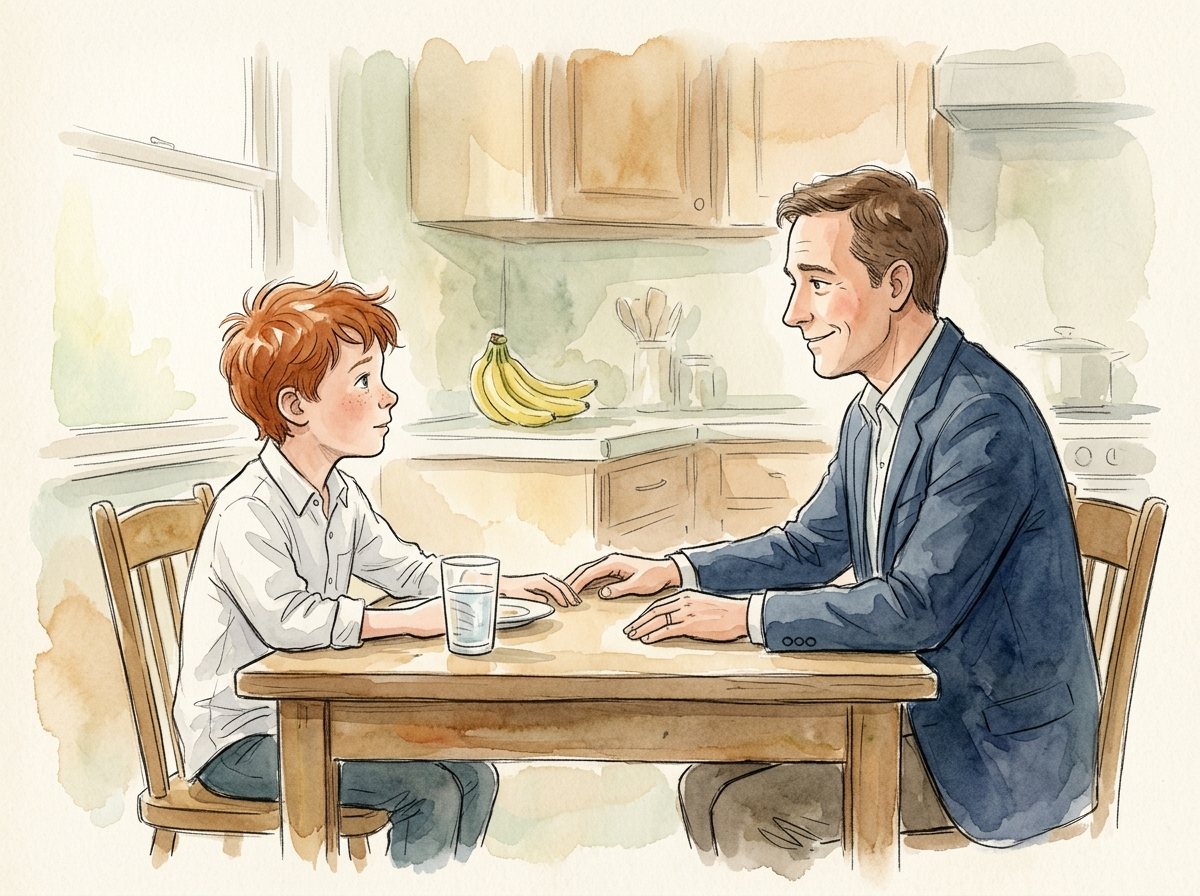
Downstairs, the house had that strange Yom Kippur quiet. No sizzle of eggs in a pan. No toaster popping. No smell of coffee. The kitchen sat there, full of food behind cabinet doors and inside the refrigerator, all of it perfectly available and perfectly off-limits. Ezra could see the bananas on the counter. They were just sitting there. Being bananas. Mocking him.
Dad was at the table in his suit, reading something on his phone. He looked up when Ezra came in.
"Morning. How are you feeling?"
"Great," Ezra lied.
"Hungry?"
"No," Ezra lied again.
Dad smiled. Not a teasing smile—a real one, warm and a little bit sideways, the kind of smile Dad gave when he understood something he wasn't going to say out loud. "Come sit."
Ezra sat. The chair felt harder than usual. Everything felt more noticeable than usual—the tag on his shirt collar, the light coming through the window, the sound of the neighbor's sprinkler two houses down.
"First few hours are the hardest," Dad said, putting his phone down. "Your body's confused. It's expecting what it always gets, and it's not getting it."
"Yep," Ezra said. He picked at a scratch on the table.
"You know what I was thinking about this morning?" Dad said, in that voice he used when he was going somewhere with a story. "I was thinking about the summer I was eleven. Your Grandpa Joe had this truck—you've seen pictures of it, that ugly brown one—and he used to drive it to volunteer at the food pantry on Sundays."
Ezra had heard about the truck before. He had not heard about the food pantry.
"One Sunday he brought me along. I didn't want to go. There was a baseball game on, Royals versus somebody, and I was furious about missing it. I sat in the truck with my arms crossed for the whole drive."
"Sounds like you," Ezra said.
"Oh, worse. I was a champion sulker. Anyway, we got there, and my job was to hand out bags of groceries. Just pick them up, walk them to people, hand them over. Simple. And there was this kid in line—maybe my age, maybe a little younger—and when I handed him the bag, he opened it right there and pulled out a box of cereal and just... held it. Didn't open it. Just held it against his chest like it was something precious."
Dad paused. He wasn't looking at Ezra anymore. He was looking at the bananas on the counter, but Ezra could tell he wasn't really seeing them.
"And I remember thinking—I'd had cereal that morning. I'd poured myself a giant bowl of whatever, probably left half of it, and I didn't think about it for one second. It was just there. It was always just there."
Ezra's stomach growled again, but quieter this time, almost like it was listening too.
"That's the thing about hunger, Ez. Real hunger, not our one-day kind. For a lot of people, it's not a choice. It's not something they get to feel noble about." Dad leaned back in his chair. "So when I fast, and my stomach starts complaining, and my head starts hurting, I try to sit with it for a minute. Not to fix it. Just to notice it. Just to think about the fact that I have a refrigerator full of food that I'm choosing not to open, and how different that is from someone who opens their refrigerator and there's nothing there."
The kitchen was quiet. The sprinkler next door had stopped. Somewhere upstairs, Noa was opening and closing a drawer.
"The kid with the cereal," Ezra said. "Did he say anything?"
"He said thank you. And then his mom said thank you. And then Grandpa Joe talked to them for about twenty minutes because Grandpa Joe never met a stranger in his life."
Ezra smiled. That sounded exactly right. Grandpa Joe, who'd died three years ago, had been the kind of person who talked to everyone in the grocery store like they were old friends. Ezra remembered standing next to him in the checkout line, tugging on his sleeve, whispering Grandpa, we don't know that lady, and Grandpa Joe winking down at him and saying, We do now.
"I miss him," Ezra said. It came out unexpectedly, like a bubble rising to the surface of a pond.
"Me too," Dad said. "Every day. Especially today." He reached over and squeezed Ezra's shoulder. "He would've been really proud of you for fasting this year. He would've made a whole speech about it."
"An embarrassing one."
"Incredibly embarrassing. With hand gestures."
They sat there for a moment, in the kitchen that smelled like nothing, and it felt okay. It felt like the emptiness was making room for something else—for the memory of Grandpa Joe, for the kid holding the cereal box, for the strange quiet of a morning with no breakfast, where you could hear every sound and feel every feeling a little more clearly than usual.
"We should head to synagogue," Dad said, standing up.
Ezra stood too. His stomach was still empty, still grumbling, but it had shifted from an angry growl to something more like a hum. A reminder. He looked at the bananas on the counter one more time.
I'll see you tonight, he thought.
The service was long. It was always long on Yom Kippur, but today it felt longer because Ezra was aware of every single minute. The prayers washed over him—some in Hebrew he recognized, some he didn't. The rabbi talked about forgiveness and starting over and the year ahead. Normally Ezra would've zoned out, maybe counted the ceiling tiles—there were 847; he'd counted twice to be sure—but today he kept thinking.
He thought about Grandpa Joe in the ugly brown truck. He thought about the kid with the cereal box. He thought about his own kitchen, with the bananas and the full refrigerator and the cabinets stocked with everything he could ever want, all of it waiting for him like it always was, like it always had been.
Around noon, his head started to ache, dull and slow. He pressed his fingers against his temples. Noa, sitting next to him, leaned over and whispered, "Drink water when we get home. You're allowed water if you need it."
"I'm fine," he whispered back.
"You're stubborn."
"Runs in the family."
She almost laughed, caught herself because they were in synagogue, and turned it into a cough. Dad, on his other side, pretended not to notice.
By late afternoon, the ache had gotten worse, then better, then worse again. Ezra felt floaty and light, like the edges of things had gone slightly soft. But there was something else too—a kind of clearness in the center of it all, like a window somebody had wiped clean. He noticed things. The way the afternoon light turned the synagogue walls gold. The way his dad's voice sounded during the prayers—rough and low and certain. The way Noa closed her eyes during the silent parts and her lips moved just slightly, like she was having a conversation with someone only she could see.
He noticed the people around him too. Old Mrs. Kaplan, who always slipped him butterscotch candies, sitting very still with her hands in her lap. The Feldman family, all six of them in a row like a set of nesting dolls. People he saw every week but had never really looked at—not like this, not with this kind of attention.
This is what hunger does, Ezra thought. It wakes you up.
The stars came out at 7:58 PM.
Ezra was in the backyard, lying on the grass in his good khakis—his mom was going to have words about that later—and he watched the first star appear. Faint, barely there, a tiny pinprick of light in the deep blue.
"I see one," he called.
Dad came out, carrying a plate. On it: a piece of challah, a slice of apple, a cup of grape juice.
"Tradition says you break the fast gently," Dad said, handing him the plate.
Ezra sat up. He held the challah in his hands. It was soft and golden and it smelled like everything good in the world. He didn't shove it in his mouth the way he'd imagined doing all day. Instead, he sat with it for a moment. He felt the weight of it. He noticed it.
Then he took a bite, and it was the best thing he had ever tasted.
Not because it was fancy. Not because it was special challah. Just because he was paying attention.
"So?" Dad asked, sitting down next to him on the grass. "How was your first fast?"
Ezra chewed slowly. He thought about it—really thought about it—the long day, the aching head, the growling stomach, the window wiped clean.
"I think I'll do it again next year," he said.
Dad smiled that sideways smile.
Above them, a second star appeared. Then a third.