Where You Go
Fable
Ages 9–11 · 11 min
On the road to Bethlehem, a widow named Naomi tries to send her daughter-in-law Ruth back to Moab, the only home Ruth has ever known.
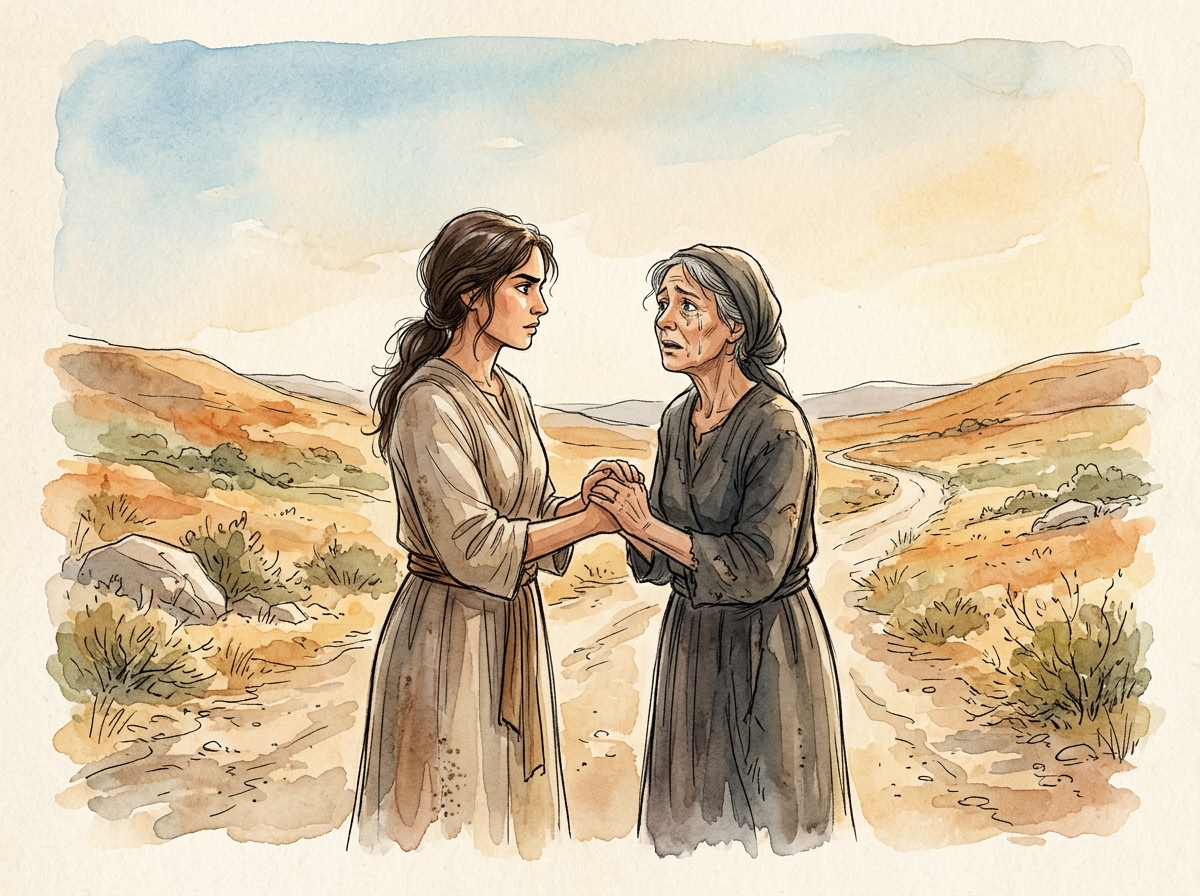
The road stretched out behind them like a long brown ribbon, disappearing into the hills they had already crossed. Naomi's sandals were worn nearly through. She could feel every pebble now, every sharp edge of every stone.
She stopped walking.
The road stretched out behind them like a long brown ribbon, disappearing into the hills they had already crossed. Naomi's sandals were worn nearly through. She could feel every pebble now, every sharp edge of every stone.
She stopped walking.
Ruth nearly bumped into her. "Mother Naomi? Are you alright?"
Naomi didn't answer right away. She stood there in the middle of the road, looking back the way they had come — back toward Moab, the land where Ruth had been born, the land where Naomi had buried her husband and both her sons. The land where everything had gone wrong.
"Ruth," Naomi said quietly. "We need to talk."
Ruth waited. She was good at waiting. She had been good at it ever since she was a girl, sitting cross-legged in her father's doorway, watching the traders come through town, patient as a cat in sunlight. She folded her hands now and waited for whatever Naomi was going to say, even though some part of her already knew.
"You should go home," Naomi said.
The words hung in the dusty air between them.
"Home," Ruth repeated.
"Back to your mother's house. Back to Moab." Naomi turned to face her, and Ruth could see how tired she looked — not just tired from walking, but tired from somewhere deep inside, the kind of tired that sleep can't fix. "You're young, Ruth. You're strong. You'll find another husband. You'll have children and a full life and people around you who—"
"I have people around me," Ruth said. "I have you."
Naomi shook her head slowly, the way people do when they're trying to be patient about something that hurts. "I have nothing to offer you. Don't you understand? I'm an old woman going back to a country I left ten years ago. I don't know if anyone there even remembers me. I don't have money. I don't have land. I don't have sons for you to marry." Her voice cracked on that last word, and she pressed her lips together hard.
Ruth said nothing.
"Orpah understood," Naomi continued, and there was no bitterness in it, just fact. Orpah was Ruth's sister-in-law. She had been walking with them too, just yesterday. She had cried — great heaving sobs that shook her whole body — and she had kissed Naomi on both cheeks, and then she had turned around and walked back toward Moab. Back toward everything familiar.
Ruth had watched her go. She had watched until Orpah was just a small dark shape against the hills, and then not even that.
"Orpah was wise," Naomi said gently. "She made the sensible choice. You should do the same."
A hot wind blew across the road, carrying the smell of dry grass and faraway rain. Ruth's hair whipped across her face. She pushed it back.
"No," she said.
"Ruth—"
"No."
Naomi sighed. She had a way of sighing that could fill a whole room, even out here under the open sky. "Child, listen to me. You don't know what it's like in Bethlehem. You don't know the people, you don't speak the way they speak, you don't worship the way they worship. You'll be a foreigner. Do you know what that means? It means people will look at you sideways. It means you'll have to work twice as hard for half as much. It means—"
"I know what it means."
"Then why?" Naomi's voice broke open like a clay pot dropped on stone. "Why would you choose this? For me? I'm not worth it, Ruth. I left Bethlehem with a husband and two sons and I'm coming back with nothing. Nothing. The Almighty has turned His hand against me." She was crying now, though she was trying very hard not to. The tears cut clean lines through the dust on her face. "Go home. Please. I am asking you to go home."
Ruth looked at Naomi — really looked at her. She saw the gray hair that had once been black. She saw the hands that had taught her how to grind grain and mend cloth and make bread rise. She saw the woman who had welcomed a foreign girl into her family without hesitation, who had taught her songs in a language she didn't know, who had sat beside her through the worst night of her life and held her hand and said I'm here, I'm here, I'm here.
Ruth took a breath.
And then she said the truest thing she had ever said in her life.
"Don't ask me to leave you," she said. Her voice was steady and quiet and absolutely certain, the way a river is certain about which way it flows. "Don't ask me to turn back from following you."
Naomi opened her mouth. Ruth kept going.
"Where you go, I will go. Where you stay, I will stay."
The wind died down. Even the birds seemed to pause.
"Your people will be my people," Ruth said. "And your God will be my God."
Naomi stared at her. A tear slid off her chin and disappeared into the dust.
"Where you die, I will die, and there I will be buried." Ruth stepped closer. She took Naomi's weathered hands in her own and held them tight. "May the Lord deal with me, be it ever so severely, if even death separates you and me."
Silence.
Not the empty kind of silence, but the full kind — the kind that happens when something has been said that is so big and so true that the whole world needs a moment to make room for it.
Naomi looked into Ruth's eyes for a long time. She searched them the way you search for something you've lost, something precious, something you were afraid you'd never find again. And what she found there was not pity. It was not obligation or guilt or the politeness of a daughter-in-law who didn't know how to say goodbye.
It was love. Plain and unshakable and stubborn as bedrock.
Naomi's shoulders, which had been pulled up tight around her ears like she was bracing for a blow, slowly came down. Her grip on Ruth's hands tightened.
She didn't say thank you. She didn't say "are you sure?" She didn't argue anymore. Because she could see — anyone could have seen it — that Ruth meant what she said more than she had ever meant anything. Arguing with it would have been like arguing with the sunrise.
So Naomi nodded. Just once. A small, quiet nod.
And they turned together and kept walking.
The road to Bethlehem was long. They walked through the heat of the day and rested in the shade of scraggly trees when the sun was too fierce. They shared the last of their bread and refilled their waterskins at streams that crossed the path. Ruth's feet blistered. Naomi's back ached. Neither of them complained.
They talked sometimes. Naomi told Ruth about Bethlehem — about the barley fields that turned gold in spring, about the well in the center of town where all the women gathered in the morning, about the way the light looked coming over the eastern hills at dawn. She talked about it the way people talk about someone they used to love, with tenderness and fear all tangled together.
"What if no one remembers me?" she whispered one evening as they watched the stars come out.
"Then we'll make them remember," Ruth said.
And sometimes they didn't talk at all. They just walked side by side, their shadows stretching out long and thin on the road ahead of them, two women with nothing but each other and whatever came next.
They reached Bethlehem in the late afternoon, when the light was turning gold and soft. The town sat on a hill, small and dust-colored, with flat-roofed houses clustered together like sheep in a fold. Ruth could see the barley fields below, just starting to ripen, exactly the way Naomi had described.
People noticed them coming up the road. A woman carrying a water jar stopped and squinted. Then her eyes went wide.
"Naomi?" she called out. "Is that — Naomi?"
Other heads turned. A man in a doorway stood up. Two children stopped their game and stared. More people came out of their houses, and the word spread like ripples in a pond: Naomi's back. Naomi's come home.
They crowded around her, asking questions, reaching for her hands, looking her over the way people do when they can't quite believe what they're seeing. And in the middle of all of it, one woman asked the question that hung in the air like smoke: "But Naomi — who is this with you?"
Everyone turned to look at Ruth.
Ruth stood very still. She could feel their eyes on her — curious, cautious, uncertain. She was a stranger here. A foreigner. Everything Naomi had warned her about.
But before anyone could say another word, Naomi reached back and took Ruth's hand. She pulled her forward, gently, into the circle of people, into the golden light.
"This," Naomi said, and her voice was clear and strong in a way it hadn't been for a long time, "is Ruth."
And Ruth, standing in a town she'd never seen, surrounded by people she'd never met, holding the hand of the woman she'd refused to leave — Ruth looked out at the barley fields glowing in the last light of the day, and she felt something she hadn't felt in a very long time.
She felt like she was home.