What the Tide Leaves Behind
Fable
Ages 6–8 · 9 min
Before the beach fills with towels and umbrellas, Cora takes her yellow bucket down to the water to see what the tide has left behind.
Every morning, before the sun climbed too high and the beach filled up with towels and umbrellas, Cora went looking.
She had a bucket — a yellow one with a wobbly handle — and she had her rain boots, the green ones with frogs on them, even though it wasn't raining. Rain boots were the best for tide pools. Everyone knew that.
Every morning, before the sun climbed too high and the beach filled up with towels and umbrellas, Cora went looking.
She had a bucket — a yellow one with a wobbly handle — and she had her rain boots, the green ones with frogs on them, even though it wasn't raining. Rain boots were the best for tide pools. Everyone knew that.
Cora lived with her grandmother in the little blue house at the top of the dune path. Every morning, Grandma Allie would pour her tea and say the same thing: "What do you think the tide left you today?"
And every morning, Cora would say the same thing back: "I won't know till I go see."
Then she'd push through the screen door — bang — and run down the sandy path with her yellow bucket swinging.
The beach in the early morning was a whole different world. The sand was smooth and dark and cool. The waves whispered instead of roared. And everywhere — everywhere — the tide had left things behind.
Cora found the first treasure near the big rock shaped like a whale's nose.
It was a piece of sea glass. Green, soft at the edges, cloudy in the middle, like a little frozen piece of ocean. She held it up to the sky and the light came through all blurry and beautiful.
"I wonder what you used to be," Cora said.
She said this to almost everything she found. It was her favorite question.
Because the sea glass hadn't always been sea glass. Once, maybe, it had been a bottle. A green glass bottle sitting on somebody's table a long, long time ago. Maybe it held lemonade. Maybe it held something fizzy that tickled someone's nose and made them laugh. Then one day it broke, or someone threw it away, and it tumbled into the ocean.
And the ocean didn't throw it back. The ocean worked on it. Rolled it over and over in the sand and the salt and the waves, night after night, year after year, until all the sharp edges were gone and it became something new. Something soft and glowing and worth putting in a yellow bucket.
Cora dropped it in. Clunk.
"One," she counted.
She walked along the tide line — that long, curving stripe of shells and seaweed that showed how far the water had reached in the night.
The second treasure was half-buried near a clump of kelp.
A shell. But not just any shell. It was a spiraling one, twisted like a tiny staircase, cream and brown with a perfect little hole at the top.
"I wonder what you used to be," Cora said.
Well — she knew what it used to be. It used to be someone's house. A little sea snail had built this shell around itself, one thin layer at a time, the way you might add blankets on a cold night. The snail had carried it everywhere, across rocks and through seaweed forests, under docks where barnacles grew thick as popcorn.
Then one day the snail didn't need it anymore. Maybe it outgrew it. Maybe it was simply done. And the empty shell drifted and tumbled until the tide carried it here, right to this exact spot, right where Cora's boot was standing.
She held it to her ear. People said you could hear the ocean in a shell, but Cora thought it sounded more like wind. Like the shell was remembering all the places it had been.
Into the bucket. Clunk.
"Two."
The third treasure was the strangest one.
It was a piece of wood, gray and smooth, shaped almost like a bird. Not because someone had carved it that way — but because the water had worn it down, bit by bit, until it just happened to look like a bird with its wings tucked in.
"I wonder what you used to be," Cora whispered.
A piece of a dock? A broken bit of someone's boat? Part of a fence that once kept sheep from wandering into a garden? There was no way to know. The ocean had tumbled it and smoothed it and changed it until its old story was completely gone. Now it had a new shape. A bird shape. And Cora thought that was pretty wonderful — that the ocean could take a piece of something broken and forgotten and make it look like it was about to fly.
Into the bucket. Clunk.
"Three."
She found other things too as she walked. A crab claw, orange and hollow, light as a leaf. A bit of rope so stiff with salt it held its twist like a frozen snake. A stone with a white ring running all the way around it, which Grandma Allie called a "wishing stone," though she never said if the wishes worked.
Each thing had been something else before.
Each thing had been tossed around and worn down and washed up.
And each thing was beautiful in a way it hadn't been before. Not less than what it was. Different. The crab claw was like a tiny orange sculpture. The rope looked like something a pirate might keep. The stone fit perfectly in the center of Cora's palm, like it had been shaped just for her hand.
The sun was getting higher now. Cora could see someone setting up a red umbrella far down the beach. Soon there would be sandcastles and splashing and all the good loud afternoon things. But the quiet morning finding-time was almost done.
She made one more pass along the tide line.
And there — right at the edge of the water, where the foam hissed and slid back — she saw something she'd never found before.
A sand dollar.
A real one. Whole and unbroken, white as the moon, with a tiny star pattern on top like someone had pressed a flower into it.
Cora picked it up so carefully, with both hands, the way you'd hold a baby bird.
"I wonder what you used to be," she breathed.
And this one amazed her most of all. Because a sand dollar wasn't glass or wood or rope. A sand dollar had been alive. It had been a fuzzy, purply-brown creature covered in tiny moving spines, creeping along the ocean floor in the sand and the dark. It had eaten and moved and done whatever sand dollars do down where no one can see.
Now here it was. White and still and perfect, like a coin made out of moonlight.
Something that lived in the dark, at the bottom of the sea, had become one of the most beautiful things on the whole beach.
Cora did not put it in the bucket. She carried it in her hand, all the way home.
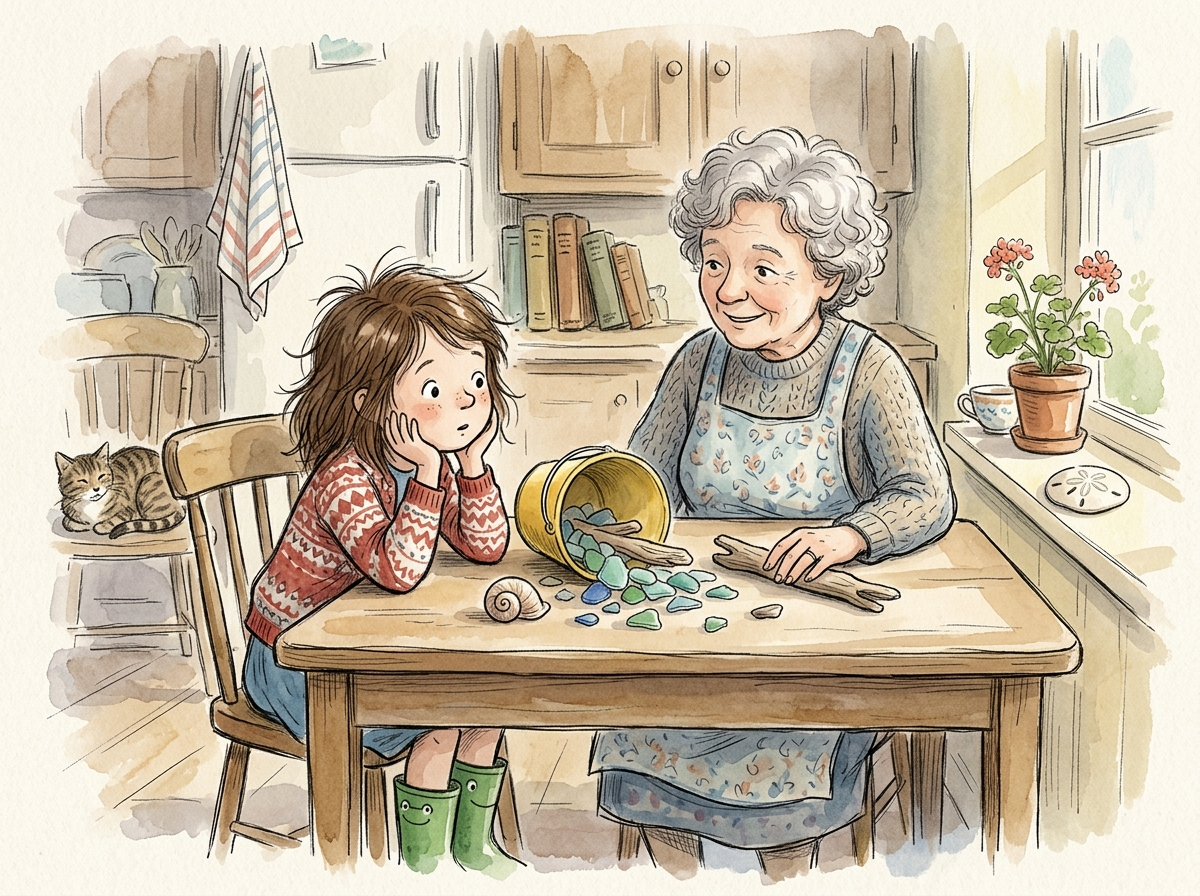
When she pushed through the screen door — bang — Grandma Allie was still at the kitchen table with her tea.
"What did the tide leave you today?" Grandma asked.
Cora set her bucket on the table and took each piece out, one by one. The sea glass that used to be a bottle. The shell that used to be a house. The driftwood that used to be something nobody remembered. The crab claw, the rope, the wishing stone.
And last, the sand dollar, set down soft as a secret.
Grandma Allie picked it up and turned it over in her wrinkled hands. Her eyes went bright and crinkly.
"Oh, Cora," she said. "That's the best one yet."
"Grandma," Cora said, sitting down and resting her chin on her hands, "how come everything the ocean gives back is more beautiful than what it started with?"
Grandma Allie blew on her tea. She looked at the bucket full of tumbled, worn-down, washed-up, beautiful things.
"I think," she said slowly, "the ocean just knows what to do with what it's given."
Cora nodded. That sounded right.
She picked up the sand dollar and carried it to the windowsill, where the morning light caught its tiny star and made it glow. Then she came back and sat with Grandma Allie, and they looked at the bucket of treasures together while the tea sent up its little curl of steam.
Outside, the waves kept coming in, and going out, and coming in again. Working on tomorrow's treasures.