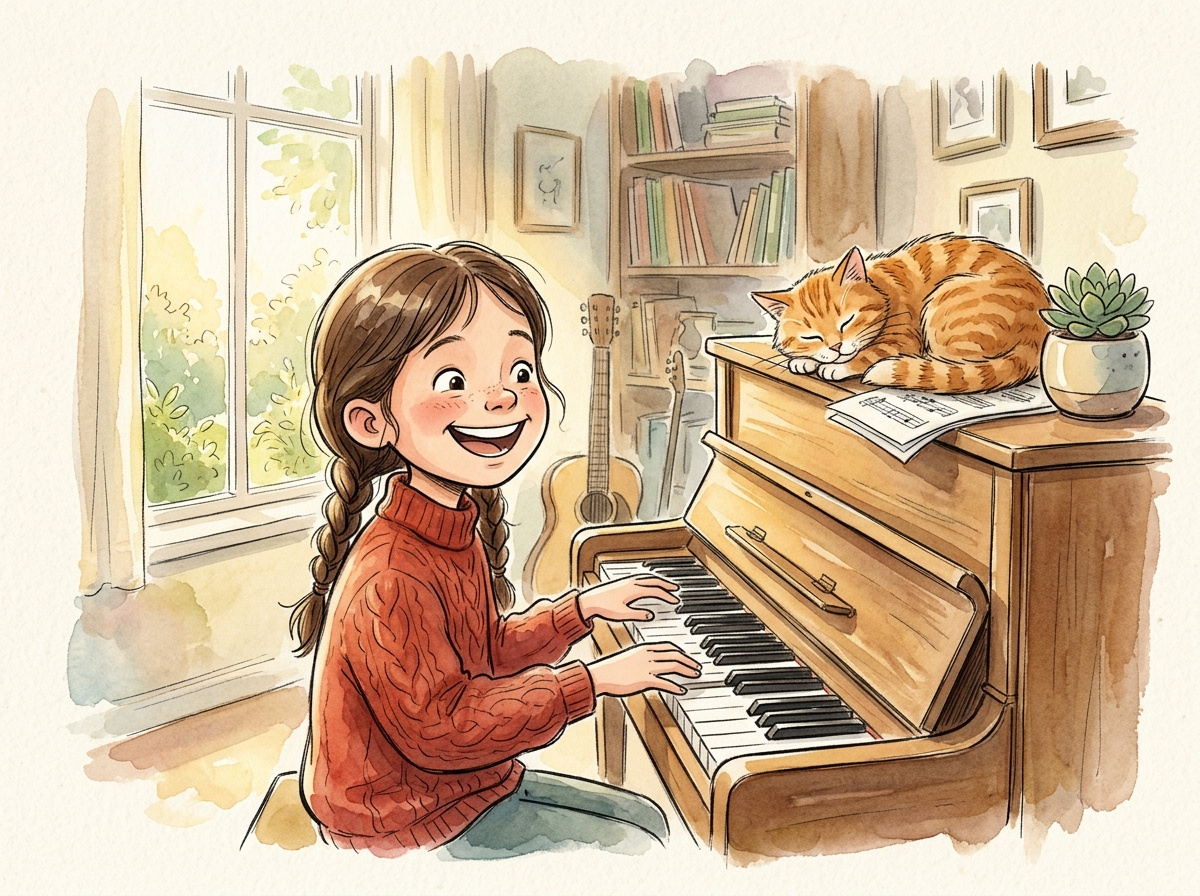
The Wrong Note
Fable
Ages 6–8 · 9 min
At her big piano recital, Sasha’s practiced song is going perfectly until her hand slips and plays one loud, clanging wrong note.
Sasha loved the piano the way some kids love ice cream — completely, with her whole entire self.
She loved the way the white keys felt smooth and cool under her fingers. She loved the way the black keys tucked between them like little hiding places. She loved how if she pressed down softly, the piano whispered, and if she pressed down hard, it sang out loud enough to fill a whole room.
Sasha loved the piano the way some kids love ice cream — completely, with her whole entire self.
She loved the way the white keys felt smooth and cool under her fingers. She loved the way the black keys tucked between them like little hiding places. She loved how if she pressed down softly, the piano whispered, and if she pressed down hard, it sang out loud enough to fill a whole room.
Every Tuesday after school, Sasha went to Ms. Delgado's studio for her lesson. Ms. Delgado had curly silver hair and a cat named Beethoven who liked to sleep on top of the piano while Sasha played. And every day at home, Sasha practiced. She practiced her scales. She practiced her chords. And for the past six weeks, she had practiced her recital piece — a song called "Moonlit Garden" — until she could play it with her eyes closed.
Well, almost with her eyes closed.
The recital was on a Saturday in March. Sasha wore her favorite blue dress with the little stars on it. Her mom braided her hair with a ribbon that matched. Her dad carried flowers — yellow ones — and her little brother, Theo, wore a clip-on bow tie and kept trying to eat it.
The recital hall had rows and rows of folding chairs, and every single one was full. Grandparents. Parents. Brothers and sisters. Friends. Teachers. Even Mr. Kowalski from the hardware store, because his granddaughter played the violin.
Sasha was the seventh performer. She sat in the front row and watched the others play. Some were nervous. Some were calm. One boy forgot to bow and just sort of wandered off the stage, which made everyone laugh in a nice way.
Then it was Sasha's turn.
She walked to the piano. She sat down on the bench. She adjusted it — just a tiny bit forward, the way Ms. Delgado had taught her. She placed her hands on the keys.
And she began.
The first part was beautiful. Her fingers moved like they knew exactly where to go, because they did. She'd practiced this a hundred times, maybe a thousand. The notes floated up into the air like soap bubbles — light and round and shimmery.
She reached the middle section. This was the part with the tricky run, where her right hand had to jump up the keyboard while her left hand held steady. She'd practiced this part the most. She knew it. She knew it.
Her right hand jumped.
And landed on the wrong note.
It wasn't a quiet wrong note. It wasn't a small wrong note. It was a big, loud, honking CLANG of a wrong note — like a goose had somehow gotten inside the piano.
Sasha's stomach dropped. Her face went hot. She kept playing — she finished the rest of the piece — but her hands were shaking, and two more notes wobbled on the way out.
When she stood up to bow, she saw the audience clapping. She saw her dad holding up the yellow flowers. She saw Theo chewing on his bow tie.
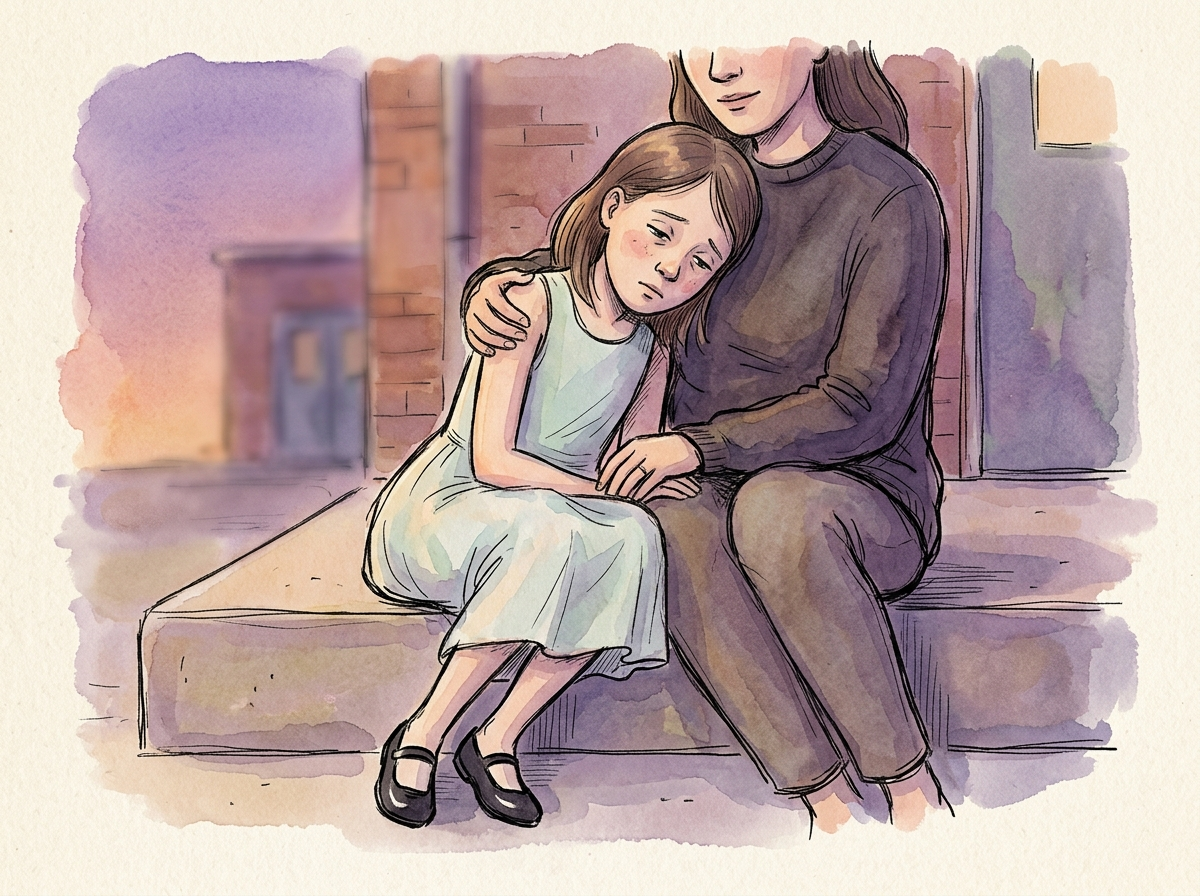
But all she could hear, rattling around inside her head, was that one terrible, horrible, big loud CLANG.
That night, Sasha didn't want to talk about the recital. She said "I'm fine" four times, which is exactly how many times a person says "I'm fine" when they are not fine.
On Sunday, she walked past the piano without playing it.
On Monday, she walked past it again. She didn't even look at it. Well — she looked at it a little. Out of the corner of her eye.
On Tuesday morning, her mom said, "Sasha, you have your lesson with Ms. Delgado today."
Sasha poked at her cereal. "I don't think I want to go."
Her mom sat down next to her. She didn't say anything for a moment. Then she said, "How about you go this one time, and if you still don't want to after, we can talk about it?"
Sasha poked at her cereal some more. The cereal was getting soggy. Soggy cereal is the saddest food in the world.
"Okay," she said. "But just this once."
Ms. Delgado's studio smelled like it always did — like lemon tea and old books. Beethoven the cat was in his usual spot on top of the piano, his orange tail hanging off the edge like a furry pendulum.
"Sasha!" said Ms. Delgado, smiling. "Come in, come in."
Sasha sat on the bench. She looked at the keys. They looked back at her, the way piano keys do — patient and quiet and waiting.
"I messed up," Sasha said. "At the recital. Everyone heard."
Ms. Delgado nodded slowly. "I was there. I did hear it."
Sasha felt her eyes sting. She thought Ms. Delgado might say, "It wasn't that bad," or "Nobody noticed." But Ms. Delgado didn't say either of those things.
Instead, she walked over to a shelf and pulled down a thick, worn book. She opened it to a page in the middle and set it on the music stand.
"Do you know who wrote your recital piece?" Ms. Delgado asked.
"You said it was by a composer named Friedmann."
"Clara Friedmann. She was a pianist in Vienna a long time ago. A wonderful musician. And do you know what happened at her very first big performance?"
Sasha shook her head.
"She played the wrong note. A big one. Right in the middle of the second movement." Ms. Delgado pointed to a spot in the book — an old photograph of a woman sitting at a grand piano, her back very straight. "She was so embarrassed she almost quit."
"Almost?" said Sasha.
"Almost." Ms. Delgado closed the book. "She went home. She didn't play for three days. And then on the fourth day, she sat down at her piano and played that same piece again. She played the wrong part over and over until her fingers understood it so well they could never forget."
"And she never hit a wrong note again?"
Ms. Delgado laughed — a real, big, from-the-belly laugh. "Oh, she hit plenty of wrong notes again. Every pianist does. Every musician who ever lived has played wrong notes. That's not what mattered."
Sasha looked at her. "Then what mattered?"
Ms. Delgado smiled and tapped the piano gently. "She came back to the bench."
The studio was quiet for a moment. Beethoven purred. Outside, a car drove by playing music with the windows down.
Sasha looked at the keys again. She flexed her fingers. They felt stiff, the way fingers do when they haven't played in a few days and they miss it.
"Can we work on the tricky part?" Sasha asked. "The part where my hand has to jump?"
"We absolutely can," said Ms. Delgado.
Sasha placed her hands on the keys. She took a breath. And she began to play.
The first try, she hit it wrong again. She winced.
"Again," said Ms. Delgado calmly.
She played it again. Wrong. But closer.
"Again."
Again. This time, her fingers found the right keys, but it was bumpy.
"Again."
Again. Smoother now.
"Again."
This time — this time — her right hand jumped, and every single note landed exactly where it was supposed to, clean and bright, like stepping stones across a stream.
Sasha grinned. It was the kind of grin that starts small and then takes over your whole face.
"There it is," said Ms. Delgado.
Sasha played it again, just because she wanted to. And then again. And then she played the whole piece from the beginning, all the way through. When she got to the tricky part, her hand jumped — and it landed perfectly.
The last note hung in the air like a firefly.
Beethoven opened one eye, flicked his orange tail, and went back to sleep.
That night, Sasha sat at her piano at home. She played "Moonlit Garden" three more times. Then she played some scales. Then she played a little song she was making up herself, something with no name yet, something new.
Her dad leaned in the doorway, listening.
"Sounds good, Sash," he said.
"Thanks," she said. And she kept playing.