The Wrong Direction
Fable
Ages 6–8 · 9 min
God has a message for the mean city of Nineveh, but Jonah has just bought a ticket for a ship sailing in the opposite direction.
Jonah was having a perfectly wonderful morning.
He had just finished a warm breakfast of bread and honey. The sun was shining. Birds were singing in the fig tree outside his window. Everything was calm and peaceful and exactly the way Jonah liked it.
Jonah was having a perfectly wonderful morning.
He had just finished a warm breakfast of bread and honey. The sun was shining. Birds were singing in the fig tree outside his window. Everything was calm and peaceful and exactly the way Jonah liked it.
Then God spoke to him.
"Jonah," God said. "I need you to go to Nineveh."
Jonah choked on his last bite of bread.
Nineveh?
Nineveh was the biggest, roughest, meanest city Jonah had ever heard of. The people there were loud and rude and didn't listen to anybody — especially not to someone like Jonah, who was not particularly loud and not particularly big and who really, truly, deeply preferred staying home.
"Go to Nineveh," God said, "and tell the people there to stop being so awful to each other."
Jonah set down his bread very slowly. He wiped the honey off his fingers. He looked out the window at the nice, safe fig tree and the nice, safe birds.
Then he said — not out loud, but deep inside his stubborn heart — No thank you.
And Jonah came up with a plan.
If God wanted him to go east to Nineveh, then Jonah would go west. Far, far west. As far west as a person could possibly go. He would go to Tarshish, which was practically the other end of the entire world.
"Can't go to Nineveh if I'm in Tarshish," Jonah muttered to himself, feeling very clever.
He packed a bag. He walked down to the harbor at Joppa, where big wooden ships creaked and swayed in the salty breeze. Sailors shouted to each other. Ropes groaned. Seagulls screamed overhead like they were trying to tell him something.
Jonah ignored the seagulls.
He marched right up to a ship with tall masts and wide sails and asked the captain, "Where is this ship going?"
"Tarshish," said the captain.
"Perfect," said Jonah. "One ticket, please."
He paid his money, climbed aboard, found a quiet spot below deck, and curled up in a corner. The ship rocked gently. The harbor sounds faded. Jonah pulled his cloak over his head and smiled.
There, he thought. That settles it.
The ship sailed out of the harbor and into the wide, blue, sparkling sea. The wind filled the sails. The water whispered against the hull. And Jonah fell fast asleep, dreaming of anywhere — anywhere at all — that wasn't Nineveh.
But the sea did not stay wide and blue and sparkling.
It started with a little breeze that became a bigger breeze that became a wind that became a roar. The sky turned dark — not nighttime dark, but angry dark, like a bruise spreading across the whole heavens. The waves, which had been small and polite, grew into monsters. They rose up taller than the ship's masts and crashed down with a sound like thunder.
The ship tilted left. Then right. Then left again so hard that barrels rolled across the deck and smashed into the walls.
Up above, the sailors screamed.
"We're going to sink!" one shouted.
"Throw the cargo overboard!" yelled the captain. "Lighten the ship!"
The sailors grabbed everything they could — boxes, barrels, ropes, sacks of grain — and hurled them into the churning black water. The wind howled louder. Rain lashed sideways. The ship groaned like it was in pain.
And where was Jonah?
Still asleep. Below deck. Curled up under his cloak. Snoring.
The captain stumbled down the stairs, soaking wet, and found Jonah lying there like it was a peaceful afternoon nap.
"How are you sleeping?!" the captain shouted, shaking Jonah's shoulder. "Get up! Pray to your God! We are all in danger out here!"
Jonah blinked awake. He heard the wind screaming. He felt the ship lurch beneath him. He saw the captain's terrified face dripping with rain.
And deep down, in the pit of his stomach, Jonah knew.
He knew this storm wasn't ordinary. He knew it wasn't bad luck. He knew exactly why the sea was raging.
The sailors gathered around him, shaking and scared. "Why is this happening?" they demanded. "Who are you? Where are you from? What have you done?"
Jonah took a deep breath. His shoulders sagged. The cleverness he had felt back at the harbor seemed very, very far away now.
"My name is Jonah," he said quietly. "And I worship the God who made the sea and the land. He asked me to do something important... and I ran away."
The sailors stared at him. Their eyes went wide.
"You ran away," one of them repeated slowly, "from the God who made... this sea? The one that is tossing us around right now?"
Jonah nodded miserably.
"What should we do?" they cried, because the waves were getting bigger and the ship was creaking in ways a ship should never creak.
Jonah looked at the terrified sailors. These men hadn't done anything wrong. They were in danger because of him — because he had bought a ticket going the wrong direction and thought that settled it.
"Throw me into the sea," Jonah said. "The storm will stop. I know it will."
The sailors didn't want to. They were good men. They tried rowing harder instead, pulling and straining at the oars, but the waves just pushed them back. The storm grew worse and worse.
Finally, with trembling hands, the sailors lifted Jonah up.
"Please don't hold this against us," they whispered to the sky.
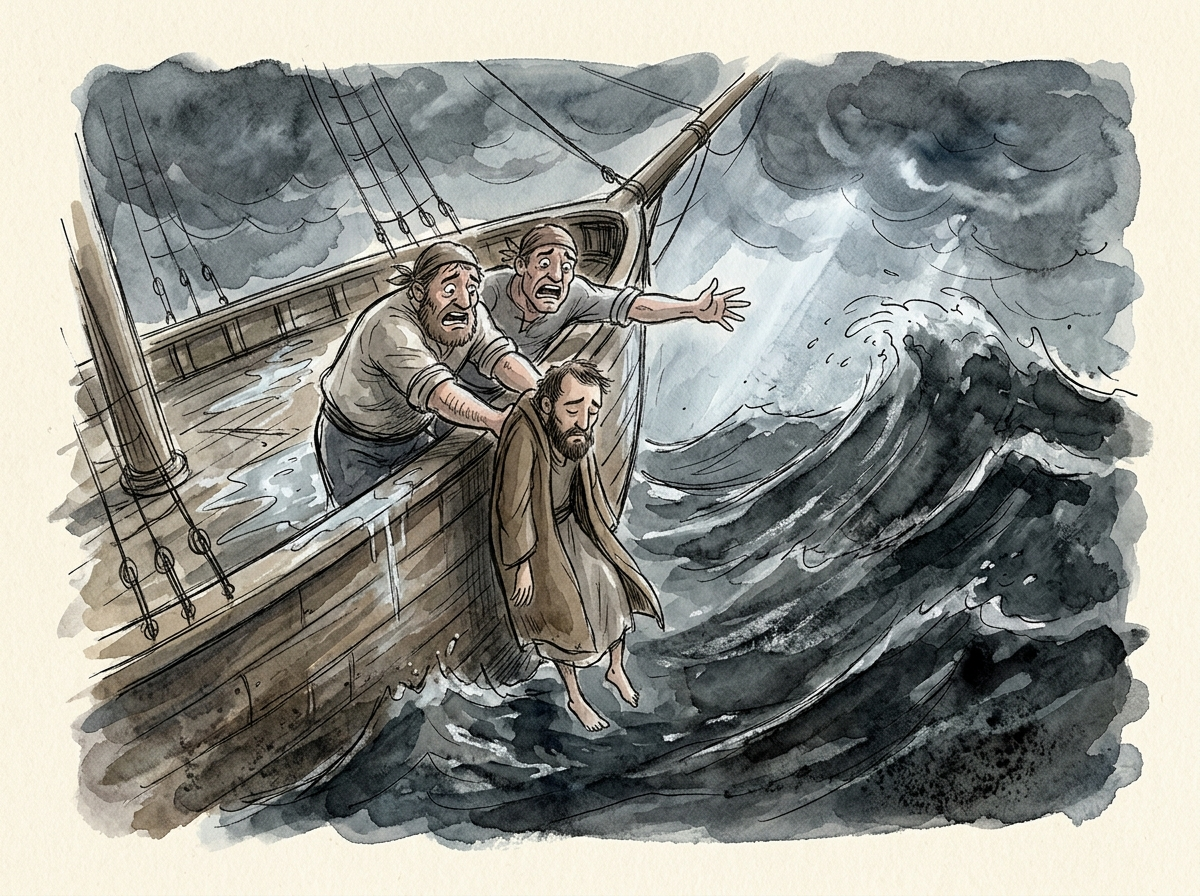
And they dropped Jonah into the raging sea.
The moment — the very moment — Jonah hit the water, the wind stopped. The waves flattened. The clouds broke apart like curtains opening, and the sea became calm and smooth as glass.
The sailors stood on deck with their mouths hanging open, staring at the sudden, impossible quiet.
But Jonah?
Jonah sank.
Down, down, down into the cold, dark water. Seaweed wrapped around him. The light from the surface grew dimmer and dimmer. Jonah was sure this was the end.
Then something moved in the deep.
Something enormous.
A great fish — bigger than anything Jonah could have imagined — opened its tremendous mouth and swallowed Jonah whole.
GULP.
And just like that, Jonah was sitting inside a fish.
It was dark. It was wet. It smelled absolutely terrible — like every rotten fish market in the world combined and then left in the sun for a week. Jonah could feel the fish swimming, feel its great body moving through the water, and he sat there in the slimy, stinky darkness.
For three days. And three nights.
That is a lot of time to sit and think.
And Jonah did think. He thought about his warm breakfast and his fig tree and his safe little life. He thought about the storm and the terrified sailors. He thought about how he had paid good money for a ticket to Tarshish and how well that had turned out.
Mostly, he thought about how you cannot run away from the thing you're supposed to do. You can go east, west, north, or south. You can sail across the whole ocean. You can hide below deck and pull your cloak over your head. But the right thing doesn't stop being right just because you're running from it.
So finally, sitting in the belly of that great, smelly fish, Jonah prayed.
"I'm sorry," he whispered. "I'm listening now."
And God heard him.
The fish swam toward shore, opened its great mouth, and — BLEHHHHH — spat Jonah right out onto the beach. He tumbled across the sand, covered in slime, gasping for air, blinking in the bright sunlight.
He was a mess. He smelled worse than he'd ever smelled in his life. Seaweed hung from his hair.
And then God spoke again, gently, like he'd been waiting all along.
"Jonah. Go to Nineveh."
Jonah stood up. He wiped the slime from his face. He looked east — toward Nineveh, the big, scary city full of people who needed to hear what he had to say.
This time, Jonah started walking.
In the right direction.