The Son Who Came Back
Fable
Ages 9–11 · 11 min
With his inheritance gone and his fine clothes in rags, Levi rehearses a speech begging to be a servant as he walks the long road back to his father's house.
Levi practiced the words again, whispering them to the dust rising from the road beneath his cracked sandals.
"Father, I have done wrong against heaven and against you. I am no longer worthy to be called your son. Please — treat me as one of your hired servants."
Levi practiced the words again, whispering them to the dust rising from the road beneath his cracked sandals.
"Father, I have done wrong against heaven and against you. I am no longer worthy to be called your son. Please — treat me as one of your hired servants."
He said it again. And again. Each time trying to get the tremble out of his voice. Each time failing.
The road stretched long and pale ahead of him, winding between brown hills dotted with olive trees. He had walked this road a hundred times as a boy — racing his older brother Caleb to the well, chasing goats that had wandered too far, running home when his mother rang the bell for supper. Back then, the road had felt short. A skip and a jump and he'd be home.
Now it felt endless.
Levi looked down at himself. His robe — once fine linen dyed the color of pomegranates — was now a rag. Stained, torn at the hem, and reeking of something he tried very hard not to think about.
Pigs.
He thought about the pigs.
It had only been seven months since he'd stood in his father's courtyard, chin high, bag packed, and announced that he wanted his share of the inheritance now. Not when his father died. Now.
He remembered the silence that had followed. His brother Caleb had stopped mid-bite, a piece of bread frozen halfway to his mouth. The servants had looked at the ground. Even the dog had gone still.
His father — a broad man with deep brown eyes and hands roughened by decades of working the land — had studied Levi's face for a long time. Then, without argument, without anger, he had gone inside and come back with a leather pouch heavy with silver coins.
"This is yours," his father had said quietly.
And Levi had taken it.
He hadn't even looked back as he walked out through the gate. He'd been too busy counting the coins, too busy imagining the life waiting for him in the city — the food, the freedom, the adventures. No more rules. No more waking at dawn to tend animals. No more Caleb lecturing him about responsibility. No more father watching him with those patient, hoping eyes.
He was finally going to live.
And for a while — a bright, dazzling, spinning while — he did.
The city of Caesarea was everything he'd dreamed. He rented a room with a balcony overlooking the harbor. He bought new robes, soft leather sandals, a silver ring for his finger. He ate roasted lamb with saffron and honey cakes dripping with syrup. He found friends — so many friends — who laughed at his jokes and slapped him on the back and said, "Levi! You are the most generous man in all of Judea!"
And he was generous. He bought meals for strangers. He tipped musicians double. He lent money to people whose names he barely knew, and when they didn't pay him back, he shrugged and bought another round of drinks.
The pouch got lighter.
He told himself it was fine.
The pouch got lighter still.
He told himself he'd figure it out.
Then one morning he reached into the pouch and felt nothing but the smooth leather bottom.
Gone. All of it. Every last coin.
That same week, a famine crept across the land like a shadow. Grain prices doubled. Then tripled. Markets that had overflowed with figs and bread and olives suddenly had nothing but dust on their tables.
Levi went to his friends for help. But it turned out they weren't really friends at all. They shrugged. They looked away. One of them — a man named Dion, who Levi had once bought an entire new cloak for — pretended not to recognize him in the street.
Levi sold the silver ring. Then the sandals. Then the fine robes. He moved out of the room with the balcony and slept in a doorway behind a tanner's shop, where the smell of chemicals burned his nose.
He was so hungry his ribs showed through his skin.
Finally, desperate and dizzy with hunger, he begged a farmer outside the city for work. The farmer looked him over — skinny, shaking, pathetic — and pointed toward a pen of pigs.
"Feed them," the farmer said. "I'll give you a place to sleep in the barn."
Levi — a Jewish boy who had grown up being taught that pigs were unclean, who had never even touched one — found himself knee-deep in mud, pouring slop into a trough while fat pigs pushed past him, grunting and squealing.
And here was the worst part. The part that burned inside his chest like a coal.
He was hungry enough to eat what the pigs were eating.
He stared at the carob pods in the trough — slimy, brown, chewed-over — and his stomach screamed at him to reach down and grab one.
That was the moment everything broke open inside him.
He sat down right there in the mud, buried his face in his filthy hands, and cried. Not the quick, frustrated tears of someone who's lost a game. Deep, shaking sobs that came from somewhere so far inside him he didn't even know that place existed.
He thought about his father's house. He thought about the hired servants — the men who repaired fences and hauled water. Even they had more than enough bread. They had clean clothes. They had dignity.
And here was Levi, the son who had demanded his fortune and danced away with it, sitting in pig slop with nothing.
He wiped his face with the back of his hand and stood up.
"I'll go back," he whispered. "I'll go back and tell him — I don't deserve to be his son anymore. But maybe — maybe — he'll let me work. Maybe he'll let me haul water or mend fences. Maybe that will be enough."
He started walking that night.
So here he was. Three days of walking behind him. Blistered feet. Empty stomach. And that speech he couldn't stop rehearsing.
"Father, I have done wrong against heaven and against you. I am no longer worthy to be called your son—"
He was close now. He recognized the shape of the hills, the old fig tree split by lightning, the low stone wall where he used to sit and watch the sunset with his father. His heart hammered so hard he could feel it in his throat.
What if his father turned him away?
What if his father looked at him with cold eyes and said, "You are not my son"?
Levi wouldn't blame him. He deserved that and worse.
He came around the last bend, and there — spread across the hillside — was his father's land. The vineyard. The olive grove. The stone house with the clay-tiled roof. Smoke curling from the kitchen. The low murmur of goats.
Home.
Levi stopped. His legs wouldn't move. He opened his mouth to practice the speech one more time, but no sound came out.
And then — something impossible.
A figure appeared on the road ahead. Far away at first. A man. Running.
Running.
No one ran in this village. Certainly not a dignified landowner. It wasn't proper. It wasn't done. A man of his father's age and standing walked slowly, deliberately, with his robe hanging straight and his head held level.
But this man was running. Robe hiked up to his knees, sandals slapping the dirt, arms pumping. Running like the house was on fire. Running like someone's life depended on it.
Levi squinted.
It was his father.
"No," Levi breathed. "No, no—"
His father was running toward him.
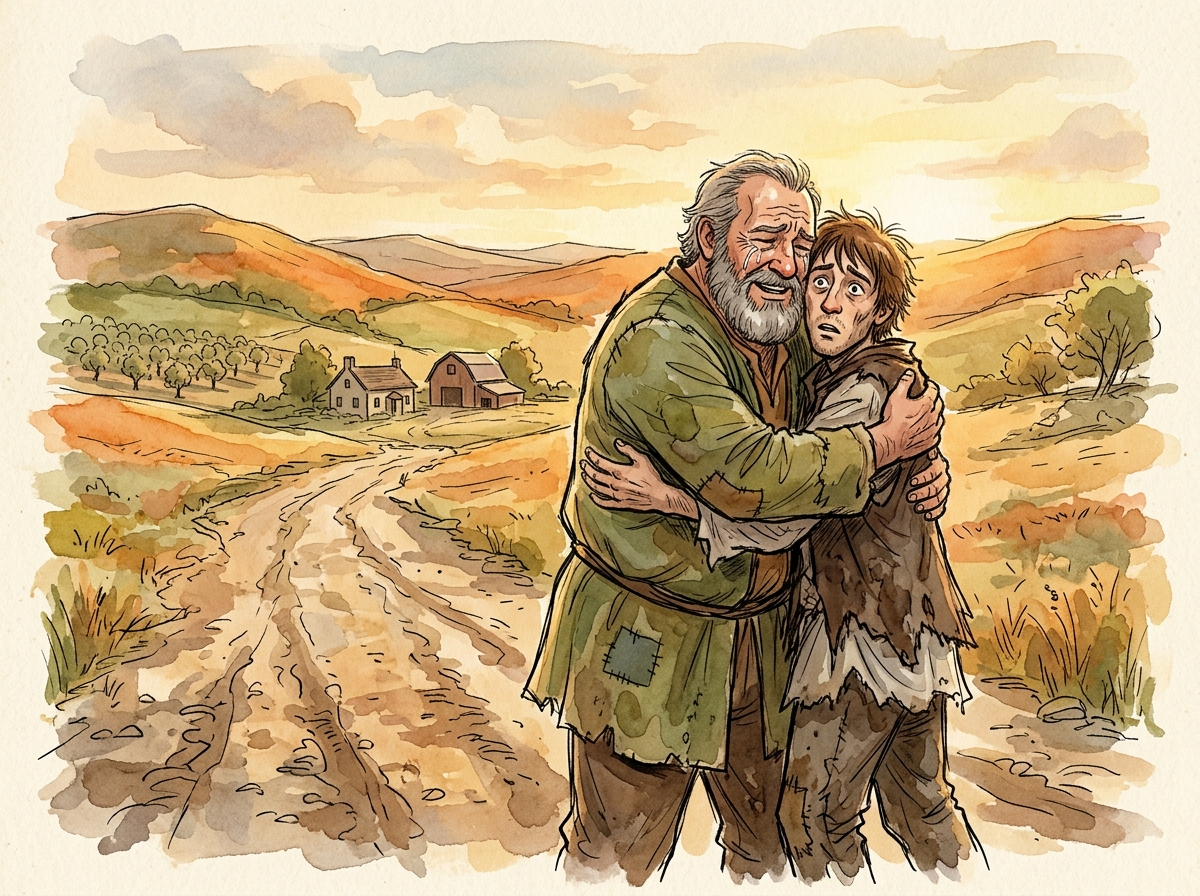
Before Levi could take a single step, before he could open his mouth to begin his carefully practiced speech, his father crashed into him like a wave. Arms wrapped around him — strong, shaking arms — and pulled him so close that Levi could smell the familiar scent of olive oil and wood smoke and earth.
His father was weeping.
Not quietly. Not with dignity. Great, heaving sobs that shook them both. His father held Levi's face in his rough hands and kissed his forehead, his cheeks, his filthy hair — and Levi just stood there, stunned, because this was not how it was supposed to go.
"Father—" he started, his voice cracking. "Father, I have done wrong against heaven and against you. I am no longer worthy to be called your—"
"Micah!" his father shouted over his shoulder, not letting go of Levi for even a second. A servant came running. "Bring the best robe — the one in the cedar chest! Bring a ring for his finger and sandals for his feet!"
"Father, please, I just want to be a servant—"
"And tell the cook to prepare the fattened calf!" His father was laughing now — laughing and crying at the same time, tears streaming into his beard. "We're going to have a feast tonight!"
"Father, listen to me, I don't deserve—"
His father pulled back just enough to look at him. Those deep brown eyes — the patient, hoping eyes that Levi had walked away from seven months ago — were shining.
"My son," his father said, and his voice broke on the word son. "My son was dead, and is alive again. He was lost — and now he is found."
Levi opened his mouth. Closed it. The speech he had practiced a hundred times dissolved like morning fog.
His father draped his own cloak over Levi's ruined shoulders and walked him toward the house, one arm wrapped tight around him, already calling out to the household that his boy was home, his boy was home.
And Levi — filthy, broken, ashamed, amazed — let himself be led.
Behind them, the dust settled on the road.
Ahead of them, someone was already setting the table.