The Sign He Kept Asking For
Fable
Ages 9–11 · 12 min
While hiding from an enemy army in a winepress, Gideon is told he must become a great warrior and save his people, but he believes they have the wrong person.
The night air smelled like dust and fear.
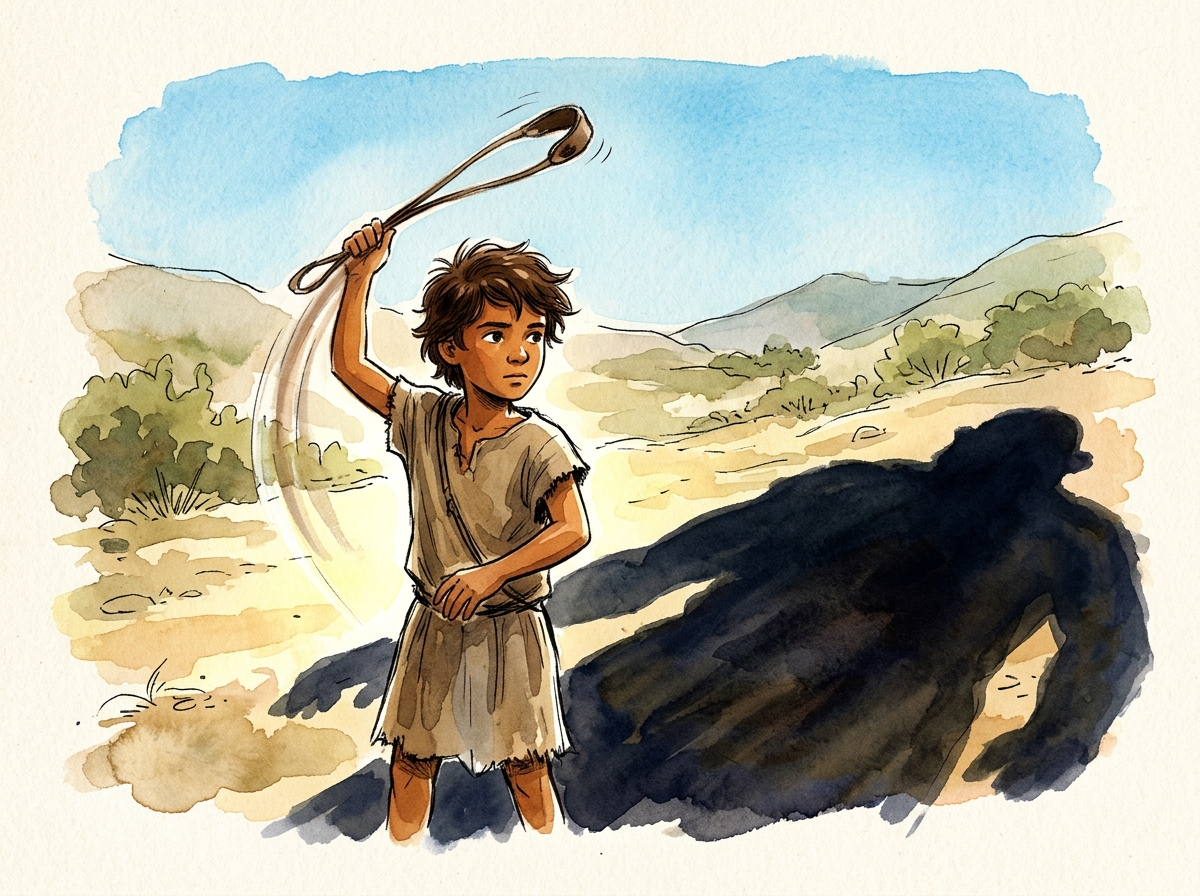
Gideon pressed himself flat against the inside of the winepress — a stone pit carved into the ground where grapes were supposed to be crushed, not where wheat was supposed to be threshed. But that was the whole point. If the Midianites saw him threshing wheat out in the open, they'd take it. They took everything.
The night air smelled like dust and fear.
Gideon pressed himself flat against the inside of the winepress — a stone pit carved into the ground where grapes were supposed to be crushed, not where wheat was supposed to be threshed. But that was the whole point. If the Midianites saw him threshing wheat out in the open, they'd take it. They took everything.
For seven years, the Midianite army had swept across Israel like locusts — thousands upon thousands of warriors on camels, trampling crops, stealing livestock, burning what they didn't want. The people of Israel had been driven into caves and holes in the mountains, hiding like rabbits.
And Gideon? Gideon was hiding in a winepress, beating wheat stalks against the stone walls, trying to save enough grain to keep his family alive for another week.
Thwack. Thwack. Thwack.
"The Lord is with you, mighty warrior."
Gideon spun around so fast he dropped his threshing stick. Sitting on the stone ledge above him was a figure he had never seen before — calm, unhurried, watching him with steady eyes.
Gideon stared. Then he looked down at himself. Covered in chaff. Crouching in a hole. Mighty warrior?
"If the Lord is with us," Gideon said slowly, "then where are all the miracles our ancestors told us about? Where's the God who brought our people out of Egypt? Because from where I'm standing — well, crouching — it looks like He's forgotten us."
The figure didn't flinch. "Go in the strength you have and save Israel from the Midianites. I am sending you."
Gideon blinked. Twice.
"Me?" He almost laughed. "My clan is the weakest in our entire tribe. And I am the least important person in my family. I'm literally the bottom of the bottom. You've got the wrong guy."
"I will be with you," the angel of the Lord said simply. "You will strike down the Midianites as if they were one man."
Gideon's mouth went dry. His heart hammered against his ribs. He wanted to believe it. He wanted to believe it so badly he could taste it like metal on his tongue. But he'd spent seven years watching everything fall apart.
So he did the only thing he could think of.
"Can you give me a sign? That it's really You? Just — stay right here. Don't leave. I'll be right back."
And Gideon scrambled out of the winepress and ran.
He came back carrying a tray loaded with food — a young goat he'd cooked, bread made without yeast, and a pot of broth. It was an enormous amount of food in a time when every bite mattered. He set it all on a rock in front of the visitor.
"Put the meat and bread on the rock," the angel said. "Pour the broth over it."
Gideon did.
The angel reached out the tip of his staff and touched the food. Fire blazed up from the rock — whoosh — consuming the meat, the bread, the broth, everything. And when Gideon looked up, shielding his eyes from the sudden heat, the angel was gone.
Gideon stood there, chest heaving, staring at the scorched rock.
"It was Him," he whispered. "It was really Him."
He built an altar on that spot and called it "The Lord Is Peace."
But here's the thing about Gideon. That moment of blazing, rock-scorching certainty? It didn't last. Not because he was weak. But because what God was asking him to do was enormous. Lead an army? Against the Midianites? Him — the youngest son of the weakest clan?
The doubt crept back in like fog.
Weeks later, Gideon had done something unthinkable. He'd actually sent messengers across the tribes of Israel, calling men to fight. And they came. Thirty-two thousand men gathered on the hillside, sharpening swords and checking shields, looking to him for leadership.
Gideon stood at the edge of camp that evening, staring out at the valley below. The Midianite army spread across the land like a dark sea — a hundred and thirty-five thousand soldiers. Their campfires flickered like terrible stars, stretching all the way to the horizon.
His stomach turned to water.
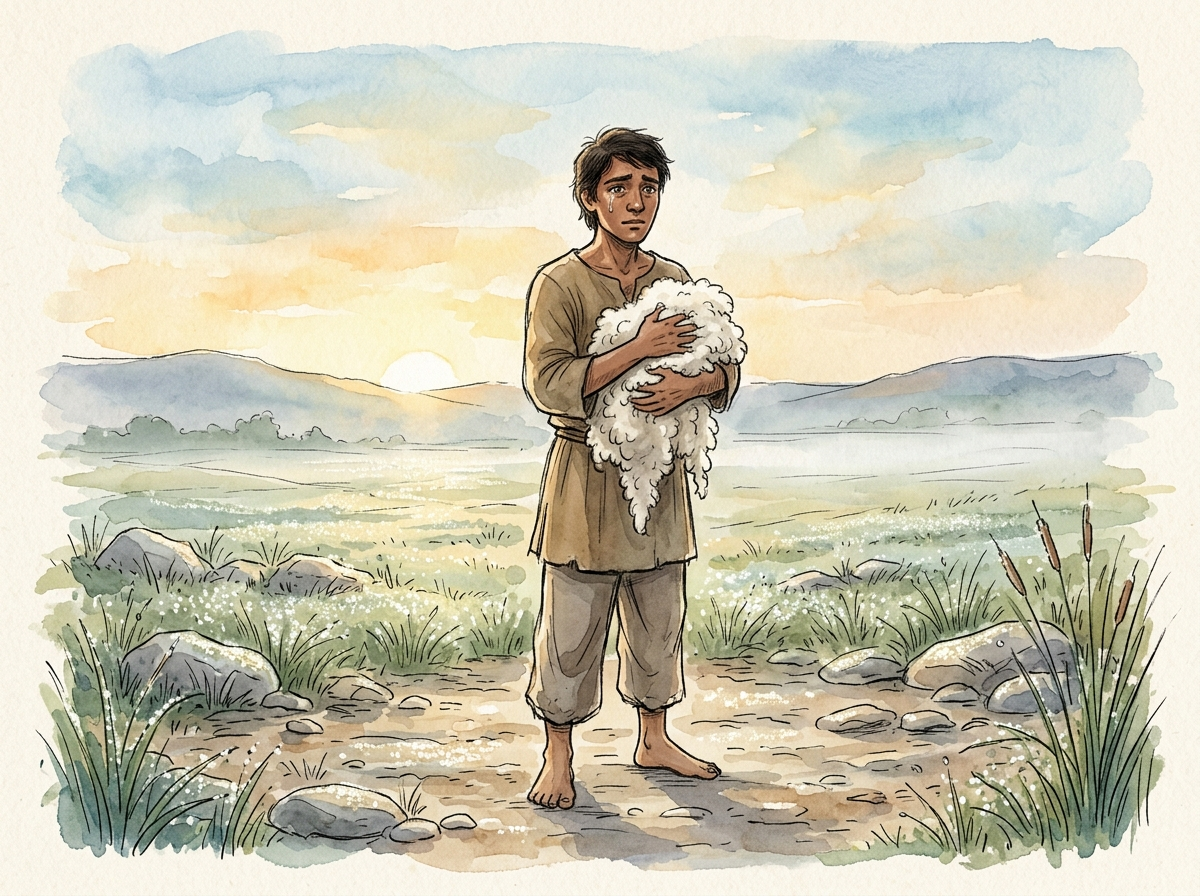
He walked back to his tent, knelt on the ground, and pulled out a fleece — a thick piece of wool, sheared from a sheep.
"God," he said quietly. "I know You already showed me. I know the fire on the rock was real. But I need to ask again. I'm going to put this fleece on the threshing floor tonight. If there's dew on the fleece in the morning but the ground around it is completely dry... then I'll know. I'll know You're really going to use me to save Israel. Like You said."
He set the fleece on the ground and lay down, but he didn't sleep.
Dawn came gray and cool.
Gideon walked to the threshing floor. The ground around the fleece was dry as bone. Not a drop of moisture. But the fleece itself...
He picked it up. It was soaked. So heavy with dew that when he wrung it out, water poured into a bowl — enough to fill it to the brim.
Gideon held the dripping fleece in his hands and felt something warm flood his chest. God had answered. Again.
He should have been ready. He should have marched straight to the front of the army and shouted the battle cry.
But that night, as the enemy campfires flickered in the valley and the wind carried the distant sound of Midianite drums, the doubt came back. It always came back. Not because Gideon didn't believe in God. He did. He just couldn't believe God would choose him.
So Gideon knelt again.
"God," he whispered, and his voice cracked. "Please don't be angry with me. I know I already asked. I know You already answered. But can I ask one more time? Just once more. This time, let the fleece be dry and the ground be covered with dew. If You do that... I won't ask again."
He set the fleece down. He pressed his forehead to the dirt floor of his tent. And he waited.
Morning.
Gideon walked outside. The grass sparkled. The threshing floor glistened with dew. Every rock, every blade of grass, every inch of ground was wet.
He picked up the fleece.
Bone dry.
Not a single drop.
Gideon closed his eyes and held the dry fleece against his chest. He stood there for a long time, breathing, letting it sink in. God had not scolded him. God had not struck him with lightning for asking twice. God had not said, "I already showed you — what's wrong with you?"
God had simply answered. Again. Patiently. Completely. As if to say: I know you're afraid. Ask me again. I'm not going anywhere.
What happened next was almost ridiculous.
God told Gideon his army was too big. Thirty-two thousand men? Too many. God sent home everyone who was afraid — and twenty-two thousand men walked away. Then God cut the remaining ten thousand down to just three hundred, based on how they drank water from a stream.
Three hundred men. Against a hundred and thirty-five thousand.
Gideon must have felt his doubt rising like a tide. But God, who knew Gideon better than Gideon knew himself, said something unexpected: "If you're still afraid, sneak down to the enemy camp tonight and listen."
So Gideon crept down in the dark with his servant, belly to the ground, heart pounding, until they were close enough to hear Midianite soldiers talking in their tents.
One soldier was telling another about a dream. "I dreamed a loaf of barley bread came tumbling into our camp and hit a tent so hard it collapsed."
The other soldier's voice went quiet with dread. "That's Gideon. The God of Israel has given him victory over all of us."
Gideon, lying in the dirt outside their tent, felt something break open inside him. Not confidence, exactly. Something deeper. Trust. Not trust in himself — he still didn't think he was the right man. But trust that God was going to do what God said He was going to do, whether Gideon felt ready or not.
He crept back to camp.
That night, Gideon gave each of his three hundred men a trumpet, an empty clay jar, and a torch hidden inside the jar. No swords. No shields. They surrounded the Midianite camp in the darkness.
And at Gideon's signal, three hundred men blew their trumpets, smashed their jars, held up their blazing torches, and shouted: "A sword for the Lord and for Gideon!"
The sound — the shattering, the blasting, the roaring — exploded from every direction at once. The Midianite army erupted in chaos. In the darkness and confusion, they turned on each other, and then they ran. A hundred and thirty-five thousand soldiers fled from three hundred men with trumpets and broken pottery.
Because it was never about the size of the army. And it was never about the certainty of the leader.
Here's what's remarkable about Gideon.
He asked for a sign. God gave it. He asked again. God gave it again. He asked a third time, changing the conditions, almost embarrassed to be asking. And God gave it again.
Gideon was not fearless. He was not bold. He did not hear God's voice and immediately charge into battle with unshakeable confidence. He was the youngest son of the weakest family, hiding in a hole, threshing wheat in secret, and every time God said, "You're the one," Gideon said, "Are You sure? Can You show me one more time?"
And every time, God showed him.
Gideon won one of the most famous victories in the entire Bible. Not because he never doubted, but because he kept going back to God with his doubt, and God kept meeting him there.
He didn't wait until he was sure. He just made sure he never stopped asking.
And God — patient, steady, unwavering — never stopped answering.