The Seder Question
Fable
Ages 6–8 · 10 min
When everyone at the Passover Seder turns to listen, Jonah stands to sing the Four Questions he practiced for weeks and discovers his mind is completely empty.
Jonah had been practicing for three whole weeks.
Every morning, he stood in front of his bedroom mirror and said the words. Every afternoon, he sang them to his dog, Biscuit, who wagged her tail like it was the greatest song she'd ever heard. Every night, he whispered them into his pillow before falling asleep.
Jonah had been practicing for three whole weeks.
Every morning, he stood in front of his bedroom mirror and said the words. Every afternoon, he sang them to his dog, Biscuit, who wagged her tail like it was the greatest song she'd ever heard. Every night, he whispered them into his pillow before falling asleep.
The Four Questions. The Mah Nishtanah. The most important part of the Passover Seder — at least, the most important part if you were the youngest person at the table. And Jonah was.
"Mah nishtanah halailah hazeh," he sang while brushing his teeth.
"Mikol haleilot," he hummed while tying his shoes.
His older sister, Maya, rolled her eyes every time she heard him. "You know you don't get a trophy for this, right?"
"Maybe I should get a trophy," Jonah said. "I'm going to be perfect."
His mom smiled and kissed the top of his head. "You're going to be wonderful."
"Not wonderful," Jonah corrected. "Perfect. There's a difference."
The night of the Seder arrived like a slow-motion parade.
First came the tablecloth — the fancy white one that Grandma said was older than Dad. Then came the good plates, the ones with tiny gold flowers around the edges. Then came the silver cups and the tall candlesticks and the Seder plate with all its little bowls.
Jonah watched everything being set into place and felt a hum of electricity in his chest. Tonight was his night.
Grandma and Grandpa arrived first. Grandpa smelled like peppermint and gave Jonah a handshake so firm it made his whole arm wobble. Grandma squeezed his cheeks and said, "There's my little scholar!"
Then came Aunt Devorah and Uncle Mo, who brought a box of chocolate-covered matzah that Maya immediately tried to sneak into her room. Then came cousin Talia, who was only three, so she definitely did not count as the youngest — well, actually, she did, but she couldn't even say the questions, so everyone agreed it was still Jonah's job.
The house filled up with voices and laughter and the warm, buttery smell of soup. Jonah practiced one more time in the hallway, whispering the words to Biscuit, who had followed him like a furry shadow.
"I've got this," he told her.
Biscuit sneezed, which Jonah decided meant "yes."
Everyone sat down.
Dad opened the Haggadah and began leading the Seder. They blessed the candles. They blessed the wine — well, the grape juice, for Jonah. They washed their hands. They dipped the parsley into salt water, and Jonah made a face because it tasted like the ocean had sneezed on a leaf.
And then.
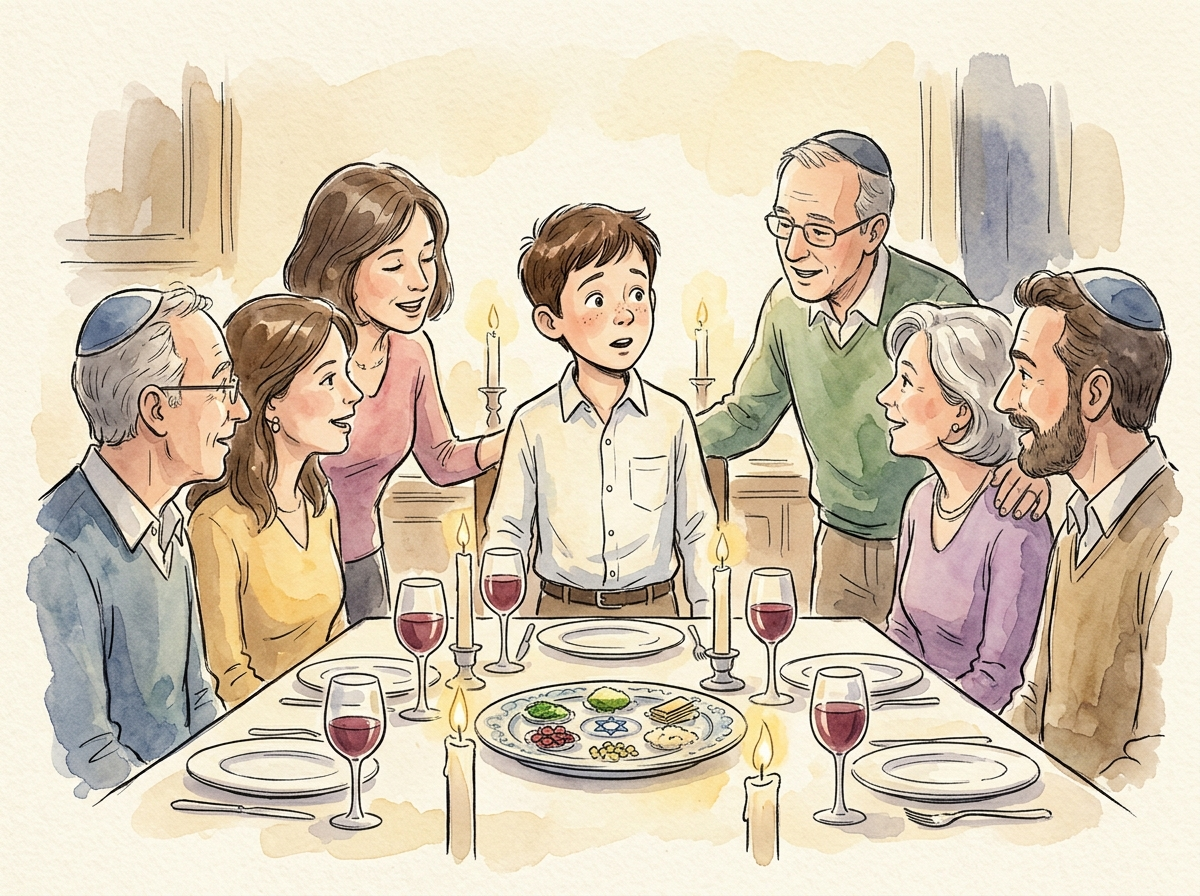
Dad looked across the table. The candles flickered. Every single person turned toward Jonah.
"And now," Dad said, smiling wide, "the youngest at our table will ask the Four Questions."
Jonah stood up.
His chair scraped against the floor. The room went quiet — really quiet, the kind of quiet where you can hear the candle flames whispering to each other.
Fourteen eyes stared at him. Grandma's eyes were already watery, and he hadn't even started yet.
Jonah opened his mouth.
And nothing came out.
Not one word. Not one note. Not even the first "Mah."
His brain, which had held those words so perfectly for twenty-one days, suddenly felt like a jar of spilled marbles. Everything rolled away in every direction, and he couldn't catch a single one.
His face went hot. His ears went hotter. He looked down at his grape juice and wished, more than anything, that he could shrink small enough to hide inside the cup.
"It's okay, honey," Mom whispered. "Take your time."
But taking his time didn't help, because the words weren't late — they were gone.
Jonah's eyes started to sting. He bit his lip hard.
"I forgot," he said. His voice came out small and cracked, like a piece of matzah breaking in half.
For a moment, nobody spoke.
Then Grandpa cleared his throat.
"You know," Grandpa said, leaning back in his chair, "I forgot the Four Questions once too."
Jonah looked up. "You did?"
"Oh, yes. I was eight years old, standing in my grandmother's dining room in a scratchy wool sweater. I opened my mouth and—" Grandpa made a popping sound with his lips. "Nothing. Like a fish."
"What did you do?" Jonah asked.
"Well," said Grandpa, "my uncle hummed the first few notes. And that was enough. The melody brought the words back, like reeling in a fish on a line."
Aunt Devorah laughed. "Same thing happened to me! I was seven, and I was so nervous I accidentally started singing 'Happy Birthday' instead."
"You did NOT," said Maya.
"She absolutely did," said Uncle Mo. "Your aunt sang 'Happy Birthday dear Pharaoh' in front of the whole family."
The table erupted with laughter. Even Jonah felt a tiny smile pulling at the corner of his mouth.
"I forgot the words at my bat mitzvah," Mom said gently. "Right in the middle of my Torah portion. Hundreds of people watching. I just stood there."
"What happened?" Jonah whispered.
"The rabbi whispered the next word. Just one word. And then I remembered the rest."
Jonah looked around the table. Grandpa was nodding. Aunt Devorah was grinning. Even little cousin Talia was banging her spoon cheerfully, though she probably just liked the noise.
"Would it help," Dad said softly, "if we all started it together?"
Jonah thought about this. It wasn't perfect. It wasn't the way he'd imagined it — standing alone, getting every word right, everyone clapping at the end.
But his family was looking at him with eyes that were warm and patient and not disappointed at all.
"Okay," Jonah said.
He stood up again. Dad hummed the first note, low and steady. Then Mom joined in. Then Grandma and Grandpa and Aunt Devorah and Uncle Mo and even Maya, who pretended she didn't know the melody but definitely did.
The tune floated up from the table like something golden and familiar, and just like Grandpa said — the melody was a fishing line, and the words were swimming right there, waiting to be caught.
"Mah nishtanah halailah hazeh," Jonah sang.
His voice was shaky at first, like a baby bird trying out its wings. But the words were there. One by one, they came back, clicking into place like puzzle pieces.
"Mikol haleilot," he continued, and now his voice was stronger.
His family's voices got softer as his got louder. They were pulling back, making room, letting Jonah's voice rise up and fill the space on its own.
By the second question, he didn't need them at all.
By the third question, he was singing clearly and fully, and Grandma was definitely crying now, but the happy kind.
By the fourth question, Jonah felt something warm and bright blooming in his chest — not because it was perfect, but because the whole room was glowing with it, this feeling of all of them together, carrying the words across the table like a bridge.
He finished.
The silence lasted exactly one second.
Then everyone clapped and cheered, and Grandpa reached across and shook his hand with that big wobbly handshake, and Grandma said, "My little scholar!" and Biscuit barked from the living room because she wanted to clap too.
Jonah sat down. His grape juice tasted extra sweet.
Later, during the meal, when everyone was eating Grandma's matzah ball soup and telling stories and laughing too loudly, Maya leaned over and whispered, "You did good, you know."
"It wasn't perfect," Jonah said.
Maya shrugged. "It was better."
Jonah thought about that while he ate his soup. He thought about Grandpa as a boy in a scratchy sweater. He thought about Aunt Devorah singing "Happy Birthday" to Pharaoh. He thought about Mom, thirteen years old, standing in front of hundreds of people with her voice gone missing.
And he thought about how all those voices had risen up around him tonight — not because he failed, but because that's what the people at this table did.
He took another bite of matzah ball and smiled.
Next year, he'd practice for four weeks.
But if he forgot again — well, that would be okay too.