The Ramadan Lantern
Fable
Ages 6–8 · 9 min
Every night of Ramadan, Kareem lights a lantern from his grandpa in Cairo, but now only one date is left in the bowl.
Kareem had exactly one date left.
Not the kind of date on a calendar — a real date, the kind you eat. Wrinkly and brown and sweet as honey. It sat in a little wooden bowl on the kitchen counter, and every time Kareem walked past it, he slowed down just to look.
Kareem had exactly one date left.
Not the kind of date on a calendar — a real date, the kind you eat. Wrinkly and brown and sweet as honey. It sat in a little wooden bowl on the kitchen counter, and every time Kareem walked past it, he slowed down just to look.
One date meant one night. And one night meant tomorrow, Ramadan would be over.
Kareem wasn't sure how he felt about that.
It had started thirty nights ago, when Baba brought down the big cardboard box from the top shelf of the hallway closet. Kareem heard the familiar thunk and came running.
"Is it in there? Is it in there?" he asked, bouncing on his toes.
"Where else would it be?" Baba smiled and opened the flaps.
Inside, wrapped in a soft blue cloth, was Grandpa's lantern.
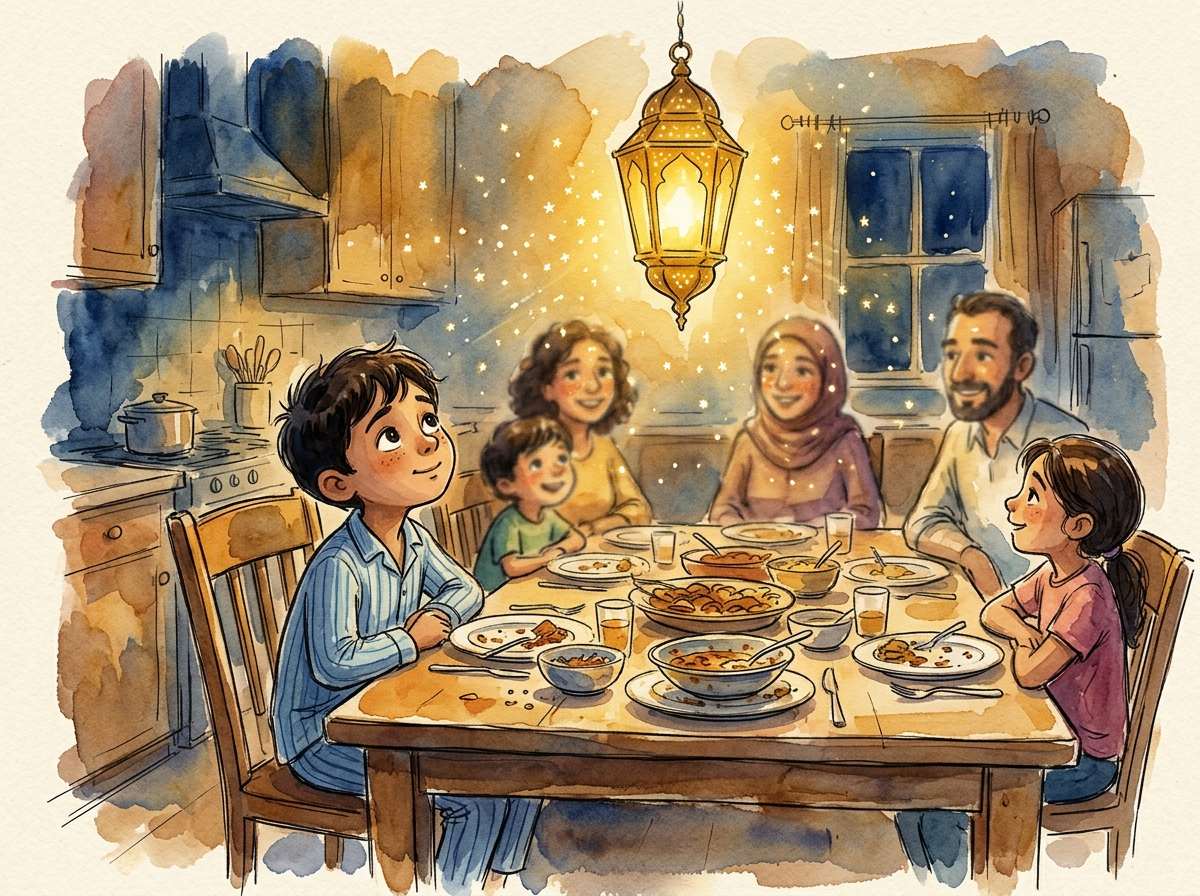
It was called a fanous, and it had come all the way from Egypt — from Cairo, where Grandpa Tarek had grown up. The metal was golden-colored with tiny star shapes cut into every side, and when you put a candle inside and lit it, the stars threw little dots of light all across the walls and ceiling. Like a sky you could hold in your hands.
Grandpa Tarek had given it to Kareem two Ramadans ago, the last time he'd visited. He'd knelt down, placed it in Kareem's palms, and said, "Every night of Ramadan, you light this. And every night, you'll know I'm lighting mine too, all the way in Cairo."
Kareem had nodded very seriously. That was a promise he could keep.
So on the first night of Ramadan, Kareem placed the lantern in the center of the kitchen table. Mama put thirty dates in the wooden bowl. And after the sun went down and the family broke their fast together — with soup and bread and laughter — Kareem ate one date from the bowl and Baba lit the candle inside the fanous.
The little stars appeared on the ceiling.
"Grandpa's lighting his too," Kareem whispered.
"Right now," said Baba. "Right this very moment."
And Kareem felt like Cairo wasn't so far away.
Each night, the same thing happened. The sun would set. The family would eat together. Kareem would take one date from the bowl. Baba would light the fanous. And the stars would come out — not outside, but inside — spinning slowly across the kitchen walls whenever someone walked past and made the candle flicker.
Twenty-nine dates. Then twenty-eight. Then twenty-seven.
Some nights, Uncle Waseem came over and told long, funny stories about growing up with Baba that made milk come out of Kareem's nose. Some nights, Mama read from her favorite book of poems while Kareem lay on the rug and watched the star-lights dance. Some nights, it was quiet, just the three of them, and those nights were good too — warm and close, like being wrapped in a blanket that was exactly the right size.
Fifteen dates. Twelve. Nine.
Kareem started to notice something. Every night the bowl got emptier, his chest got a little heavier. He tried not to think about it.
But now there was one date left. Just one.
Kareem sat at the kitchen table and stared at the fanous. It wasn't lit yet. In the daylight, without the candle, it was just an old metal lantern with a few scratches on the side. You couldn't even see the stars.
"You're being very quiet," said Mama, sliding into the chair beside him.
"I don't want it to be over," Kareem said.
Mama tilted her head. "Ramadan?"
"The lantern nights." He touched one of the little star cutouts with his fingertip. "When Ramadan is done, I have to put the fanous back in the box. And then I won't light it with Grandpa anymore until next year. That's..." He paused. "Mama, that's a whole year."
Mama didn't say anything right away. She just put her hand on his back, and her hand was warm.
"That is a long time," she said.
"What if I forget what it feels like?" Kareem asked. His voice was small.
Mama looked at him for a long moment. Then she said, "Come help me set the table for tonight."
That evening, the house filled with people. Uncle Waseem came, and Auntie Fatima, and their daughter Noor, who was four and thought she was fourteen. Baba's friend from work, Mr. Khoury, came too, carrying a tray of baklava so big he had to turn sideways through the door.
Everyone was talking and laughing, and the kitchen smelled like cinnamon and roasted chicken and the orange blossom water Mama put in everything during Ramadan.
When the sun finally dipped below the rooftops, everyone gathered around the table. Baba said a prayer. And then — food, everywhere, plates being passed, Noor trying to eat rice with her fingers, Uncle Waseem telling another story about the time Baba got his shoe stuck in a sewer grate.
Kareem laughed so hard his stomach hurt.
After dinner, the kitchen got quiet enough for the last date. Kareem held it in his palm. Everyone watched.
"Go on, habibi," said Baba.
Kareem ate it slowly. It was the sweetest one yet — or maybe it just tasted that way because it was the last.
Then Baba brought a match to the candle inside the fanous, and the stars appeared.
They swam across the ceiling, drifting over the faces of everyone Kareem loved. A tiny star sat on Noor's nose. Another one rested on Uncle Waseem's big, laughing belly. The whole kitchen turned into a golden sky.
"Grandpa's lighting his right now," Kareem whispered.
And then the phone rang.
Mama picked it up, looked at the screen, and her whole face changed into a smile. She handed it to Kareem.
"Kareem! Ya Kareem!" The voice was crackly and far away and perfect.
"Grandpa!"
"Did you light it? Tell me you lit it!"
"We lit it, Grandpa! The stars are everywhere!"
Grandpa Tarek laughed, and it was the warmest sound in the world. "Mine too! I'm looking at the stars on my ceiling right now. Same stars, ya habibi. Same light."
Kareem held the phone and looked at the lantern and looked at the little golden stars floating across the room, and something in his chest loosened — like a knot he didn't know was there coming gently undone.
"Grandpa? It's the last night."
"I know."
"I don't want to put the lantern away."
There was a pause. Then Grandpa said, "Kareem, listen. Do you remember all thirty nights?"
Kareem thought. He remembered Uncle Waseem's stories. Mama's poems. The quiet nights on the rug. The soup, the bread, the laughter, the star-light on the ceiling.
"Yes," he said.
"Then the lantern did its job." Grandpa's voice was gentle. "You carry those nights now. They're yours. The lantern just helped you see them."
Kareem looked at the fanous, glowing golden on the table. The little stars turned slowly, slowly.
"And Kareem?"
"Yeah, Grandpa?"
"Next Ramadan, we add thirty more."
That night, after everyone had gone home and Noor had fallen asleep on the couch and been carried out like a sack of flour, Kareem blew out the candle in the fanous. The stars disappeared from the ceiling.
But Kareem stood very still in the dark kitchen, and he could swear he still saw them — little golden dots, hovering just behind his eyes, right where he'd remember them.
He wrapped the lantern carefully in its soft blue cloth and placed it back in the box. Then he closed the flaps and patted the top, gently, the way you'd pat a friend who was going to sleep.
"See you next year," he whispered.
And for the first time, next year didn't feel so far away.