The Quiet Part of Faith
Fable
Ages 9–11 · 11 min
Ever since her beagle Biscuit died, Sera has carried a question for her grandpa about heaven that she is too scared to ask.
Sera had been carrying the question for six months.
It lived in her like a small, smooth stone she'd swallowed by accident — not painful, exactly, but always there. She felt it when she woke up in the morning and the house was too quiet. She felt it at school when Ms. Alvarez talked about the solar system and how the light from some stars took so long to reach Earth that the stars themselves might already be dead. She felt it at dinner when her mom set the table for three, then caught herself and put one plate back.
Sera had been carrying the question for six months.
It lived in her like a small, smooth stone she'd swallowed by accident — not painful, exactly, but always there. She felt it when she woke up in the morning and the house was too quiet. She felt it at school when Ms. Alvarez talked about the solar system and how the light from some stars took so long to reach Earth that the stars themselves might already be dead. She felt it at dinner when her mom set the table for three, then caught herself and put one plate back.
Six months since Biscuit died.
Not a person. A dog. But Sera hated when people said not a person like that meant not important. Biscuit had been a fourteen-year-old beagle with one ear that flopped lower than the other and a habit of sleeping with his nose pressed against Sera's ankle. He'd been alive longer than she had. He'd been there before her first memory. He was, in some way she couldn't fully explain, part of the architecture of her life — like a wall you don't notice until someone removes it and the whole room feels wrong.
She'd cried for three days. Then she'd stopped crying, and that was almost worse, because the sadness didn't stop. It just went underground, like a river you could hear but couldn't see.
And the question had started growing.
Sera's grandpa was the one who knew about God.
Not in a loud way. He didn't stand on corners or hand out pamphlets. He was a retired electrician with big hands and a white mustache and a habit of humming hymns while he made scrambled eggs. But there was something about Grandpa Luis that made Sera feel like he had a direct line to something she couldn't access — like he owned a radio tuned to a frequency she hadn't learned yet.
When she was little, she'd asked him once why the sky was blue, and he'd given her two answers: the science one about light scattering, and then a quieter one about how maybe God just liked blue. She'd loved that. Both answers, stacked on top of each other, like two transparencies laid over the same picture.
She trusted him.
That's why the question was for him. Not for her mom, who got a tight look around her eyes whenever anything heavy came up. Not for Ms. Alvarez, who was brilliant but would probably say something about the "circle of life" that would make Sera feel like she was being managed. Not for her best friend Priya, who would try hard and say the right things but wouldn't know.
Grandpa Luis would know.
The problem was finding the moment. Every time Sera visited him, the question would rise up to the back of her teeth, and she'd swallow it again. Not yet. Not now. What if the answer is bad?
It was a Saturday in March when she finally asked.
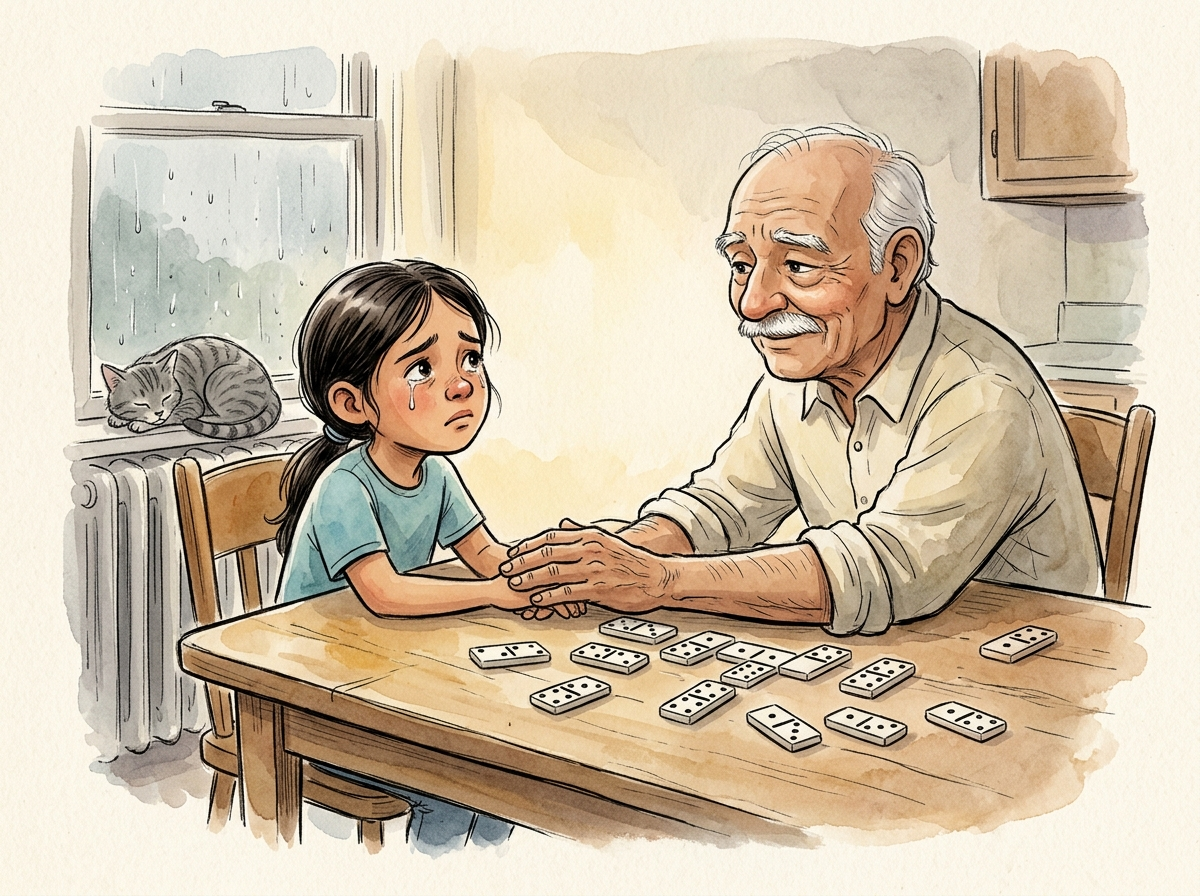
They were at his kitchen table. Grandpa Luis was teaching her to play dominoes — real dominoes, the way he'd learned in Puerto Rico, not the baby version. The tiles clicked against each other like little bones. Rain tapped on the window. His old cat, Perla, was asleep on the radiator, looking like a gray loaf of bread.
Sera placed a double-six and said, without any warm-up at all:
"Grandpa, do animals go to heaven?"
The click of dominoes stopped.
Grandpa Luis looked at her. Not surprised, exactly. More like he'd been expecting this package to arrive, just wasn't sure which day the mail would bring it.
"You're asking about Biscuit," he said.
"Yeah."
He nodded slowly. Then he did something that scared her: he didn't answer right away. Grandpa Luis always had an answer. He was the man with two explanations for the blue sky. The silence lasted five seconds, ten, fifteen — long enough for Sera's stomach to clench.
"I'm going to tell you the truth," he said. "Can you handle the truth?"
"Yes."
"The truth is — I don't know."
Sera felt the stone inside her drop another inch.
"You don't know?"
"No." He placed a domino — a three-five — calmly, like they were still just playing. "Nobody does. Not the priest, not the pope, not the smartest theologian who ever lived. Anyone who tells you they know for certain what happens after death — to people or animals — is telling you something they can't possibly promise."
Sera stared at the dominoes. Her vision went blurry.
"Then what's the point?" she said, and her voice came out louder than she meant, almost angry. "What's the point of believing in God if you don't even know the important stuff?"
Grandpa Luis didn't flinch.
"That's a great question," he said. "That might be the best question anyone's ever asked me."
He leaned back in his chair. Perla shifted on the radiator, resettling her bread-loaf body.
"Let me ask you something," he said. "Do you remember the hurricane? Three years ago?"
"Yeah." Hurricane María's remnants had come through and knocked the power out for four days. Sera had stayed at Grandpa Luis's house. They'd played cards by candlelight.
"Remember how dark it got? No streetlights, no glow from other houses. Real dark, the kind of dark people used to live in all the time."
"I remember."
"Were you scared?"
"A little."
"Me too," he said. "And what did we do?"
Sera thought. "You lit candles."
"I lit candles. Now — did those candles show us everything? Could we see the whole house? The yard? The street?"
"No. Just the table. Our hands. The cards."
"Right. Just enough." He picked up a domino and turned it over in his fingers. "That's what faith is, mija. It's not a floodlight. It doesn't show you the whole picture. It's a candle. It shows you enough to take the next step. Enough to not be alone in the dark."
Sera wiped her eyes with the back of her hand. "But I want to know about Biscuit. I want to know he's okay."
"I know you do."
"It's not fair that nobody can tell me."
"No. It's not."
Grandpa Luis reached across the table and put his big, rough hand over hers. His palm was warm and calloused and smelled faintly of coffee.
"Here's what I can tell you," he said. "I believe — and this is just me, Luis Rivera, talking — I believe that whatever made Biscuit able to love you, that thing doesn't just vanish. I don't think the universe works that way. I think love is too heavy to disappear. It has to go somewhere."
"But you don't know."
"No. I'm holding a candle, same as you."
They sat with that. The rain tapped. Perla purred. The dominoes lay scattered between them like a tiny, abandoned city.
Then Grandpa Luis said, "Can I tell you something about Biscuit?"
"What?"
"The day you were born, your dad called me from the hospital. He was so excited he could barely talk. And in the background, I could hear your mom laughing, and the nurses, and you — crying your head off, this tiny little wail. And your dad said, 'Pop, you should see the dog. He won't leave her side. He's been sitting next to the bassinet for an hour, just staring at her like she's the most important thing in the world.'"
Sera's throat closed.
"That dog loved you before you could even open your eyes," Grandpa Luis said. "Fourteen years. He chose you every single day. Slept against your ankle every single night."
"I know," Sera whispered.
"So here's what I think about when I don't know the answer. I think about the fact that that existed. That kind of love happened. And in my experience — just mine, an old man with dominoes — the things that are most real don't just end. They echo. They get folded into everything that comes after."
He squeezed her hand.
"I can't promise you Biscuit is in heaven. But I can promise you that what you two had was as real as anything I've ever seen. And I'm betting — with my whole heart, mija — that something that real has somewhere to go."
Sera didn't feel fixed. She didn't feel like the stone was gone.
But it felt lighter. Or maybe she felt stronger — strong enough to carry it without it pulling her under.
They played three more rounds of dominoes. Sera won one. Grandpa Luis won two, but she was pretty sure he cheated on the last one because he played a tile she could've sworn wasn't in his hand a minute ago.
When her mom came to pick her up, Sera hugged Grandpa Luis longer than usual. He held on and hummed — some old hymn she didn't know the words to, but the melody wrapped around her like a second pair of arms.
In the car, her mom glanced over.
"Good visit?"
"Yeah."
"You two talk about anything special?"
Sera looked out the window. The rain had stopped, and the sun was doing that thing where it came out right before setting, turning everything golden and sharp, like the world had been dipped in honey.
"Just dominoes," she said.
But that night, before she fell asleep, Sera closed her eyes and pictured Biscuit — his lopsided ears, his warm nose against her ankle, his eyes that always seemed to say I'm here, I'm here, I'm here.
And she held up her candle in the dark.
It didn't show her everything.
But it showed her enough.