The Puja at Sunrise
Fable
Ages 6–8 · 9 min
In the quiet dark before dawn, Asha listens to the bells and humming from her Grandma's puja room and wonders if she is allowed to go inside.
Every morning, before the birds had finished tuning their voices, before the chai kettle whistled, before Papa's alarm clock buzzed its angry little buzz — Grandma was already awake.
Asha knew this because Asha was a light sleeper. The lightest sleeper in the whole house, maybe in the whole apartment building, maybe in all of Bangalore. At least, that's what she told herself.
Every morning, before the birds had finished tuning their voices, before the chai kettle whistled, before Papa's alarm clock buzzed its angry little buzz — Grandma was already awake.
Asha knew this because Asha was a light sleeper. The lightest sleeper in the whole house, maybe in the whole apartment building, maybe in all of Bangalore. At least, that's what she told herself.
Every morning, Asha would hear it: the soft clink of Grandma's glass bangles. The quiet padding of bare feet on cool tile. The tiny scritch of a match being struck.
And every morning, Asha would pull her blanket up to her chin and squeeze her eyes shut and pretend she was still sleeping.
But she wasn't sleeping. Not even a little bit.
One Tuesday — because important things often happen on Tuesdays — Asha decided she would not pretend anymore. She slipped out of bed before the sky had made up its mind about what color to be. She tiptoed down the hallway in her bare feet, and she stood in the doorway of the puja room.
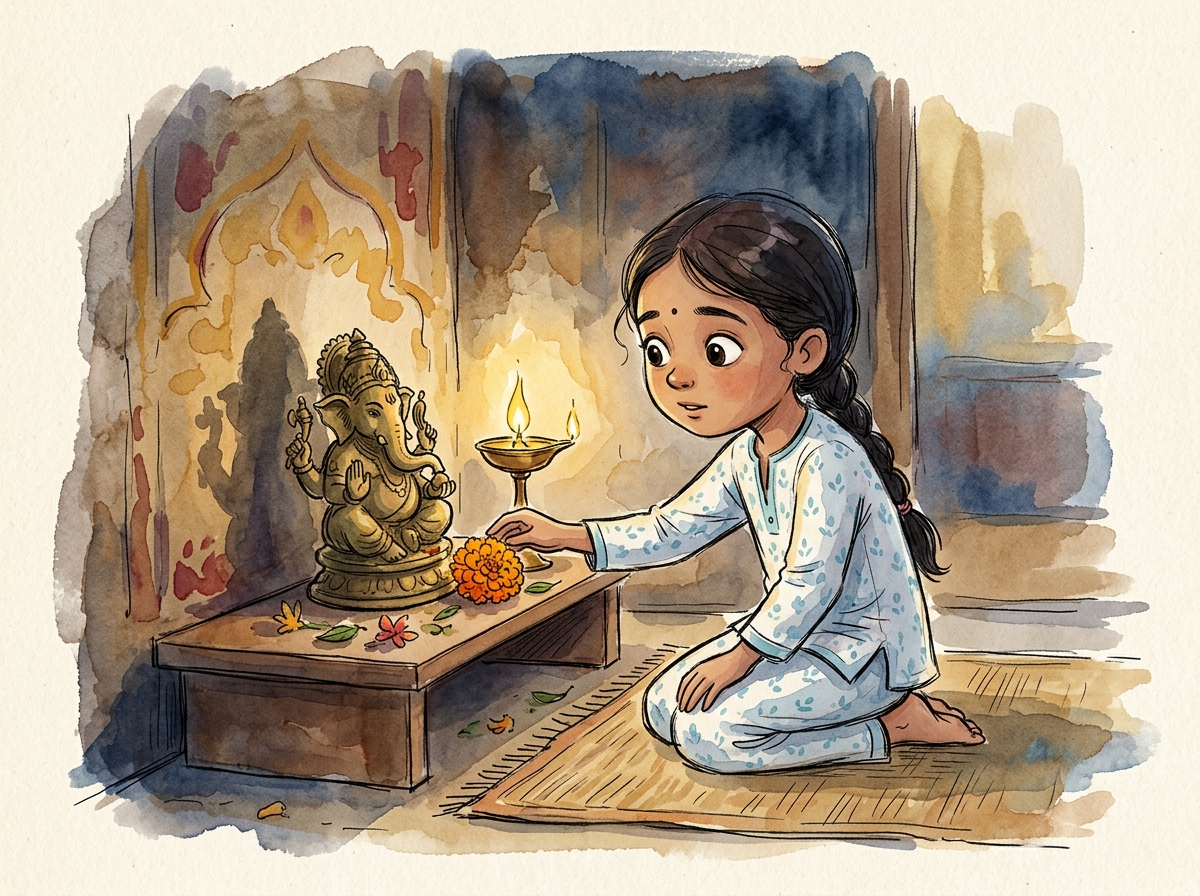
Grandma was sitting cross-legged on the floor. A small brass lamp flickered in front of her, and the flame leaned this way and that, like it was trying to listen too. The little room smelled like sandalwood and marigolds and something else Asha couldn't name — something old and golden and safe.
Grandma's eyes were closed. Her silver hair was braided down her back. Her hands moved slowly, sprinkling flower petals around the small brass figures on the shelf. There was Ganesha with his round belly and gentle eyes. There was Lakshmi standing on her lotus. And there was tiny Krishna playing his flute, no bigger than Asha's thumb.
Grandma rang a small bell — ting, ting, ting — and the sound floated through the dark house like a secret being shared.
Asha held her breath.
Grandma began to hum. Not a song exactly — more like a river that had learned how to sing. The notes rose and fell and wrapped around the room, and Asha felt something warm bloom in the center of her chest, like drinking hot chocolate on a rainy day.
Then Grandma opened one eye.
"Ah," she said, as if she had found a missing sock. "There you are."
Asha's cheeks went hot. "I wasn't spying!"
"Of course not," said Grandma. "Spies don't stand in the doorway where the lamp can see them." She patted the floor beside her. "Come. Sit."
Asha hesitated. The puja room had always felt like Grandma's place. Like Grandma's special thing that nobody else touched. Papa never went in that early. Mama always said, "Let Grandma have her quiet time." Even Asha's older brother, Rohan, who thought he was brave enough for anything, walked past that room in the morning without looking in.
"I don't know what to do," Asha whispered.
"That's alright," said Grandma. "Neither did I, the first time."
So Asha sat down. The floor was cool against her legs. The flame danced, and her shadow danced with it on the wall — a big, wobbly, Asha-shaped shadow that looked much braver than she felt.
"What do I do with my hands?" Asha asked.
"Whatever they'd like," said Grandma.
Asha put them in her lap. Then on her knees. Then back in her lap.
Grandma smiled and picked up a small brass plate. On it were red kumkum powder, a few grains of rice, and a marigold that was so orange it looked like it was showing off.
"Would you like to offer the flower?" Grandma asked.
Asha picked up the marigold. It was soft and a little bit damp, and it smelled like the garden after rain. She held it carefully, the way you hold something that matters.
"Where does it go?"
"Wherever your heart tells you."
Asha looked at the little figures on the shelf. Ganesha seemed to be smiling right at her, his trunk curled up like a happy question mark. She placed the marigold gently at his feet.
"Is that okay?" she asked.
"It's perfect," said Grandma.
They sat together in the quiet. Grandma hummed again, and this time Asha tried to hum along. She didn't know the tune, so she just hummed whatever came out. It didn't match at all. It was bumpy and wobbly and went in completely the wrong direction.
But Grandma didn't stop her. She just kept humming, and somehow, after a little while, their two hums found each other — the way two streams join together and become one.
Outside, the sky was starting to blush pink and orange at the edges. The first real bird — a bold little mynah — began to sing from the neem tree by the window.
"Grandma," Asha whispered, "what are you saying when you hum like that?"
Grandma thought about this for a moment. "I'm saying good morning," she said. "To everything."
"To everything?"
"To the sun for coming back. To the house for holding us. To my knees for still bending." She wiggled her toes. "To my toes, even though they complain."
Asha giggled.
"To you," Grandma added, looking at her. "To Rohan, even though he snores. To your Papa and Mama. To the marigolds that grow even though nobody asks them to."
"That's a lot of good mornings," said Asha.
"It is," said Grandma. "That's why I wake up early."
Asha looked at the flame. It was smaller now, but still steady, still warm. She could hear the house beginning to stir — Papa's alarm clock finally doing its job, Mama's footsteps heading to the kitchen, Rohan rolling over with a thump.
"Grandma?" Asha said. "Can I come back tomorrow?"
Grandma reached over and tucked a strand of hair behind Asha's ear. Her fingers were dry and gentle and smelled like sandalwood.
"The floor will be here," she said. "The lamp will be here. I will be here."
"I'll be here too," said Asha.
And she was.
The next morning, Asha was already sitting on the cool tile when Grandma padded in with her clinking bangles. Grandma raised her eyebrows but said nothing. She just sat down, lit the lamp, and handed Asha the marigold.
This time, Asha placed it in front of little Krishna and his flute.
The morning after that, she was there again. And the morning after that.
Some mornings, Asha hummed. Some mornings, she just listened. Some mornings, she asked questions — "Why do we ring the bell?" and "Does Ganesha really like sweets?" — and Grandma answered every one, even the silly ones, even the ones she'd answered before.
And some mornings, Asha didn't ask anything at all. She just sat with her shadow on the wall and the warm flame and the smell of flowers, and she felt that golden feeling in her chest that she still couldn't name.
One Saturday, Asha came to the puja room and found a second cushion on the floor. It was small and purple — her favorite color. Grandma was already sitting on her own cushion, eyes closed, humming.
She didn't say anything about it.
She didn't need to.
Asha sat down on her purple cushion, and together they said good morning — to the sun, to the house, to the marigolds, to each other, and to everything, everything else.
Outside, the mynah bird sang, the sky turned gold, and a brand-new day began — the way the best days always do.
Quietly, and together.