The Owl Who Overslept
Fable
Ages 6–8 · 10 min
In a quiet church bell tower, Hugo the barn owl wakes up at three in the morning to discover the night is over and he is all alone.
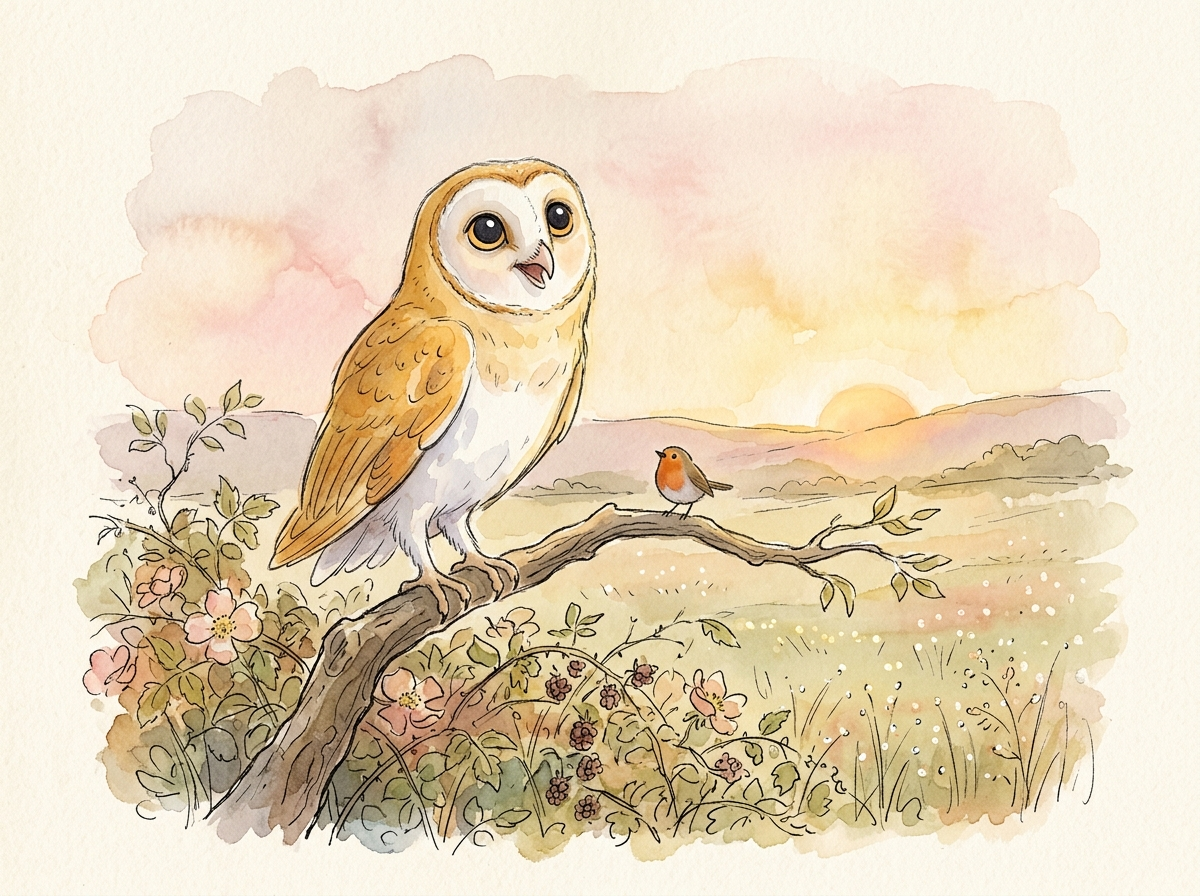
Hugo was a barn owl with feathers the color of golden toast and two enormous dark eyes that looked like they were permanently surprised by something. He lived in the bell tower of an old stone church, right between the big rusty bell and a family of spiders who mostly kept to themselves.
Every evening, when the sun melted behind the hills like a scoop of orange sherbet, all the owls in Fernwood Forest would wake up. They'd stretch their wings, yawn their beaky yawns, and swoop out into the purple sky to begin their night.
Hugo was a barn owl with feathers the color of golden toast and two enormous dark eyes that looked like they were permanently surprised by something. He lived in the bell tower of an old stone church, right between the big rusty bell and a family of spiders who mostly kept to themselves.
Every evening, when the sun melted behind the hills like a scoop of orange sherbet, all the owls in Fernwood Forest would wake up. They'd stretch their wings, yawn their beaky yawns, and swoop out into the purple sky to begin their night.
Every evening, that is, except this one.
Because tonight, Hugo did not wake up at ten o'clock.
He did not wake up at eleven o'clock.
He did not wake up at midnight, or one in the morning, or even two.
Hugo woke up at three o'clock in the morning.
He blinked once. He blinked twice. He looked out of the bell tower at the sky, which was the deep, deep black of a chalkboard wiped almost clean of stars.
"Oh no," Hugo whispered. "Oh no, oh no, oh no."
He fluttered down from his perch and landed on the edge of the tower. The whole forest was silent. Not the exciting kind of silent, like when something is about to happen. The empty kind of silent, like when everything has already happened and you missed it.
"Hello?" Hugo called out.
Nobody answered.
He flew to the Great Oak where his best friend, Meadow the tawny owl, usually spent her nights catching beetles and telling jokes.
Meadow was asleep. Her head was tucked so far under her wing that she looked like a feathery brown basketball.
"Meadow!" Hugo whispered loudly. "Meadow, wake up!"
Meadow opened one eye. Just one. And it did not look happy.
"Hugo," she mumbled. "It's three in the morning. Owls are sleeping now."
"But I just woke up! I missed the whole night! Will you come fly with me? Just for a little while?"
Meadow's one open eye slowly closed. "Goodnight, Hugo."
"But—"
A tiny snore was her only answer.
Hugo's chest felt tight. He flew to the pond where Old Randolph, the great grey owl, liked to sit on a stump and tell stories about the old days.
Randolph was asleep too, leaning against the stump like a lumpy grey pillow with talons.
"Randolph? Sir? Are you awake?"
Randolph let out a snore so loud that three frogs jumped into the pond with tiny plops.
Hugo didn't even bother asking.
He tried the Whispering Pines, where the young owls usually played chase between the branches. Empty. He tried the Mossy Wall, where the screech owl twins practiced their screeching. Silent. He flew all the way to the old barn at the edge of Miller's Farm, where sometimes a group of barn owls gathered to swap stories about the mice they'd almost caught.
Not a soul.
Hugo landed on a fence post and hunched his shoulders. The world felt very big, and he felt very small. It was like showing up to a birthday party on the wrong day and finding all the chairs stacked on the tables.
"I ruined it," he said quietly. "The whole night, gone."
He sat there for a while, feeling sorry for himself, which is a thing that even owls are allowed to do sometimes.
And that's when he heard it.
A sound. Tiny and bright, like someone tapping a little glass bell. Then another sound joined it — a high, sweet whistle, then a trill, then a chirp-chirp-chirp that bounced through the darkness like a rubber ball.
Hugo's head swiveled all the way around — which is a thing owls can do that would be very alarming if you or I tried it.
The sounds were coming from the hedgerow near the farm.
He glided over silently and landed on a branch just above the hedge. And there, in the tangle of hawthorn and blackberry, he saw something he had never seen before.
The dawn chorus was warming up.
A tiny robin with a chest like a red button was perched on a twig, singing a melody so clear it sounded like water running over smooth stones. Next to her, a blackbird was whistling a tune that rose and fell and rose again, like a song that couldn't decide whether to be happy or sad, so it chose both. A wren — so small Hugo could have held it in one talon — was belting out a song so loud and complicated that it seemed impossible it was coming from something the size of a walnut.
Hugo had never heard the dawn chorus. Owls were always asleep by now. This was the music that happened in the crack between night and morning, when the world was turning over in bed and deciding whether to get up.
"Excuse me," Hugo said softly.
The robin stopped singing. The blackbird paused mid-whistle. The wren kept going for another eight bars, because wrens are like that.
"Sorry," Hugo said. "I don't mean to interrupt. I've just… I've never heard anything like this."
The robin tilted her head. "You're an owl."
"Yes."
"Owls are never awake at this hour."
"I know. I overslept. I missed my whole night. Everyone's asleep and I've got nobody to fly with and nothing to do and—"
"Would you like to listen?" the robin asked.
Hugo blinked his big surprised eyes. "Could I?"
"Just sit right there," said the blackbird. "We're about to do the good part."
And then they sang.
One by one, more birds joined in. A song thrush added a pattern that repeated three times — because everything good is worth saying three times, the thrush explained. A chaffinch chimed in with a bright, rattling call. Even a grumpy old crow in a nearby elm added a low, raspy caw every now and then, like a bass drum in an orchestra.
The sky began to change. The black softened to deep blue, then to the color of a bruise, then to the pale grey of a dove's wing. A thin line of gold appeared along the edge of the hills.
Hugo watched the sunrise.
He had never seen one before. Not once in his whole life. Owls went to bed before the sun arrived, like two people sharing a house who leave notes for each other but never actually meet.
The gold line grew into a glowing stripe, and then the sun peeked over the hill — just the very top of it, like a shy child peering over a wall. The fields turned amber. The pond lit up like a mirror. Every single dewdrop on every single blade of grass caught the light and sparkled, and for just a moment, the whole world looked like it was covered in tiny diamonds.
"Oh," said Hugo.
He couldn't say anything else. He just sat there with his beak slightly open and his big dark eyes reflecting the golden light.
The robin landed on the branch next to him. "First sunrise?"
Hugo nodded.
"Pretty good, isn't it?"
"It's the most beautiful thing I've ever seen," Hugo said. And he meant it.
The robin smiled — or did the robin version of smiling, which is mostly done with the eyes. "Come back anytime, owl."
Hugo flew home as the morning light stretched its warm fingers across the fields. The bell tower glowed golden as he swooped inside and settled onto his perch. The spiders were already asleep. The rusty bell gleamed in the early light.
Hugo closed his eyes, feeling warm and full, like he'd just had the most wonderful night after all.
That evening, he woke up right on time at ten o'clock. He flew with Meadow and caught three mice and listened to Randolph's stories and played chase in the Whispering Pines.
But sometimes — just sometimes — Hugo would stay up a little late. He'd find his spot on the branch above the hedgerow, and he'd listen to the dawn chorus, and he'd watch the sun come up and turn the whole world to gold.
And every single time, it felt like the very first time.